
Brazil back on track but still looking for best rhythm
Brazil back on track but still looking for best rhythm
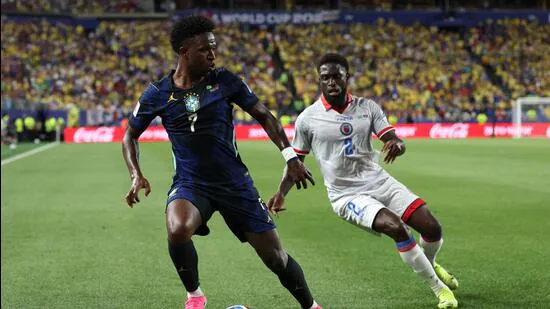
Bharatmorningnews.com – Kolkata: Brazil’s 3-0 victory over Haiti in the opening match of the World Cup provided a much-needed confidence boost, though the team’s performance was far from seamless. The win, secured in the first 25 minutes, validated Brazil’s status as title contenders but left questions about their consistency in the tournament.
Matheus Cunha made history by becoming the fifth player to net a double for Brazil in a World Cup game this century, joining legends like Ronaldo, Neymar, and Richarlison. Meanwhile, Vinicius Junior continued his impressive form with his sixth goal involvement—three goals and three assists—in six appearances. Yet, Brazil’s control of possession was challenged by Haiti’s defensive strategy, which limited space and forced Brazil to adapt mid-game.
Rapinha’s injury in the 40th minute, suspected to be a hamstring issue, added to Brazil’s concerns. Despite this, the match was effectively decided before halftime, with Cunha and Vinicius Junior ensuring a decisive outcome. However, Brazil’s dominance in the second half masked early struggles, as they hesitated to fully assert themselves until the final whistle.
“Our first game was totally different because we had the pressure of being our first one,” said Vinicius Junior after the match. “Everyone was feeling lighter today and the field was also in a better condition, so we were able to do our soccer.”
Brazil fielded their oldest starting XI since the 1962 final against Czechia, which initially hindered their progress. In the opening 20 minutes, they moved slowly, partly due to Haiti’s disciplined 5-4-1 formation. While possession was high, Brazil’s goal-scoring efficiency lacked structure, leading to missed chances.
Rapinha had an early goal disallowed, but Thiago’s quick thinking opened the scoring. This prompted Brazil to press more aggressively on the flanks, exploiting Haiti’s defensive gaps. Cunha’s first goal, assisted by a deflected ball, broke Haiti’s ultra-defensive stance. His second strike, a powerful finish into the top corner, showcased precision—qualities Brazil had previously struggled to display in their 1-1 draw against Morocco.
Despite the win, Brazil’s second-half performance was cautious. Haiti nearly equalized when Ricardo Ade’s header forced Alisson Becker into a swift save. Endrick, making his debut at 19, thought he had extended Brazil’s lead, only for the assistant referee to flag offside. The team’s inability to capitalize on chances raised concerns about their finishing ability.
Carlo Ancelotti admitted Brazil’s approach was still evolving. “Thiago out, Cunha in shouldn’t have been an afterthought,” he noted. “Matheus’ position was a good one for creating problems for the defense. He filtered his passes well and was effective at the front. It can be an option, but we discussed this yesterday. I don’t want a clear identity yet.”
With Neymar’s fitness a priority for the Scotland game, Brazil’s midfield trio—Bruno Guimaraes, Lucas Paquetá, and Casemiro—provided the necessary strength. Vini Junior, the team’s standout performer, completed his hat-trick with a clinical finish from Lucas Paquetá’s pass. While his contributions were vital, there were moments when he seemed isolated.
The result highlights Brazil’s progress but also their need for consistency. History shows they’ve never worried about conceding goals as long as they lead, but the second-half lack of urgency could haunt them if goal difference becomes decisive in Group C. Ancelotti’s emphasis on a holistic approach suggests he’s still refining Brazil’s rhythm for the challenges ahead.