
World Cup Puts Mexico’s Cartel Crisis on the Global Stage
World Cup Puts Mexico’s Cartel Crisis on the Global Stage
Bharatmorningnews.com – The World Cup Puts Mexico’s Cartel Crisis on the Global Stage has drawn international attention to the country’s ongoing struggle with organized crime. In the affluent, green neighborhood of Zapopan, a suburb of Guadalajara, authorities recently uncovered 89 bags of human remains. These bodies, some buried in gullies and others exhumed from anonymous graves, stand in stark contrast to the vibrant energy of the city’s elite shopping districts and manicured parks.
The Intersection of Sport and Crime
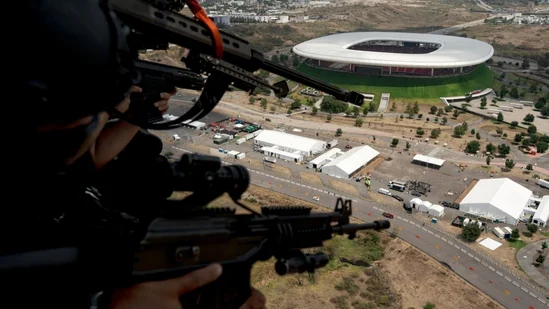
Just outside Guadalajara, the volcano-shaped Akron Stadium will host the first of four World Cup matches starting Thursday. This event brings thousands of fans to a region where cartel activity has recently intensified. Mexican authorities have launched a large-scale security initiative to ensure the tournament proceeds without incident, as the Jalisco New Generation Cartel, based in the area, is one of the country’s most formidable organized crime groups.
Security Measures in Place
To mitigate risks, security teams have fortified a wide perimeter around the stadium, deploying heavy fencing and advanced technology. Aerial patrols by Black Hawk helicopters equipped with snipers will monitor the skies, while a fleet of Tesla Cybertrucks will create an electronic barrier against drones. Over 100,000 personnel are stationed at host venues, including Mexico City and Monterrey, to maintain order during the high-profile event.
Analysts note that the World Cup Puts Mexico’s Cartel Crisis on the Global Stage has become a testing ground for both the government and criminal networks. The Jalisco cartel, which dominates Guadalajara, is likely to uphold a temporary ceasefire during the games. This allows them to exploit the influx of visitors for drug sales and illicit services while avoiding direct clashes with security forces.
Protests and Public Response
Meanwhile, activist groups are highlighting the persistent violence that affects Mexican society. Relatives of over 130,000 missing persons—many victims of cartel kidnappings or killings—have placed posters of their loved ones near World Cup sites. These protests could disrupt access to Estadio Azteca in Mexico City for the opening match, drawing global scrutiny to the crisis.
“We want people to know about what goes on in Mexico,” said Héctor Flores, co-founder of Light of Hope. “People disappear in Mexico every day, and it seems nobody cares except the families.”
Recent demonstrations have escalated, with a militant faction of the national teachers union blocking major roads, toppling player statues, and vandalizing advertisements. Far-left organizations are also rallying for Thursday’s events, further complicating the security landscape. Despite these challenges, Mexican President Claudia Sheinbaum has emphasized stability, vowing her administration will not suppress protests.
Sheinbaum’s government has taken measures to ensure smooth operations, including closing schools and requiring federal workers to work remotely on Thursday. This approach aims to balance the World Cup Puts Mexico’s Cartel Crisis on the Global Stage with the public’s right to express dissent. The president’s comments underscore the broader tension between national pride and the reality of cartel violence.
Anxiety reached a peak in February when security forces killed Jalisco cartel leader Nemesio “El Mencho” Oseguera in a fierce confrontation. The cartel retaliated by seizing and burning buses, blocking roads, and attacking convenience stores, resulting in over two dozen National Guard casualties. This escalation has raised concerns about the impact of the World Cup Puts Mexico’s Cartel Crisis on the Global Stage on the region’s stability.
Gabriela Cuevas, Mexico’s FIFA representative, downplayed fears of renewed violence, citing rapid recovery after the February clashes. She noted the state had returned to normalcy within 72 hours and highlighted the country’s track record in hosting global events, such as a FIFA trophy ceremony in Guadalajara shortly after the riots. However, the World Cup Puts Mexico’s Cartel Crisis on the Global Stage remains a symbol of the country’s complex socio-political challenges.
Despite warnings from the U.S. State Department about pickpocketing and taxi scams, fans remain undeterred. Guadalajara, alongside Vancouver, holds the highest hotel occupancy rate among World Cup host cities, reflecting the event’s economic appeal. Yet, the shadow of cartel activity continues to loom over this global spectacle, reminding the world of Mexico’s persistent crime issue.