
Guru Granth Sahib’s 300-yr-old manuscript open to public in Scotland: How it got there, and its Kohinoor connection
Guru Granth Sahib’s 300-Year-Old Manuscript Unveiled in Scotland: A Kohinoor Connection
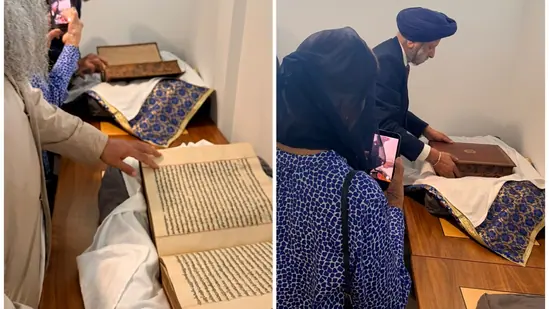
Bharatmorningnews.com – A rare 300-year-old handwritten manuscript of the Sikh holy scripture, Guru Granth Sahib, has been made publicly accessible in Scotland. This historic document, dating back to the 1700s, is believed to be the earliest of its kind in the UK and has drawn widespread interest from the Sikh diaspora and cultural historians alike. The manuscript’s presence in Edinburgh marks a significant milestone in preserving Sikh heritage abroad, especially with its unique link to the Kohinoor diamond’s colonial journey.
Historical Context and Journey to Scotland
The manuscript’s origins trace back to the royal collections of Maharaja Kharak Singh, the eldest son of Maharaja Ranjit Singh, who founded the Sikh Empire. It was acquired by British authorities during the 1848 capture of Fort Dullewalla, a pivotal moment in Sikh history that saw the empire’s dissolution and the transfer of its treasures to the UK. This artifact, now part of the University of Edinburgh’s archives, is one of three Sikh religious texts housed there, each with its own story of displacement and rediscovery.
Collaborative Efforts for Public Access
To ensure the manuscript’s accessibility, the Consulate General of India in Scotland partnered with local gurdwara leaders and the university’s heritage team. This collaboration led to a coordination meeting where representatives from Edinburgh and Glasgow, along with Sikh Sanjog’s Trishna Singh, discussed ways to display the sacred text. The goal was to provide devotees with a meaningful experience, allowing them to connect with their spiritual roots through this rare historical treasure.
“The Consulate team was delighted to join Gurudwara representatives from Edinburgh and Glasgow, Mrs. Trishna Singh of Sikh Sanjog, and University of Edinburgh officials for a coordination meeting to facilitate darshan of the 300-year-old manuscript of Sri Guru Granth Sahib Ji Maharaj at Central Gurdwara, Glasgow,” the statement emphasized.
Restoration and Cultural Significance
After its discovery in the university’s digital archives, the manuscript underwent extensive restoration to preserve its condition for public viewing. Sikh scholars played a crucial role in identifying and verifying its authenticity, bridging the gap between historical research and cultural appreciation. The unveiling of the text in November 2023 at a gurdwara in Leith, Edinburgh, was a momentous occasion, drawing Sikhs from across Scotland to witness the sacred document. The event highlighted the deep-rooted connection between the Sikh community and its heritage, even in a foreign land.
“I was so amazed, but there was part of me that was upset. I thought of my grandparents and my parents who’d lived in Glasgow, Scotland, since the late 1930s and never knew that there was this wonderful, amazing piece of our history sitting here in the university,” Trishna Singh, managing director of Sikh Sanjog, shared.
Legacy and the Kohinoor Diamond Link
The manuscript’s journey to Scotland is intricately tied to the colonial era, specifically the transportation of the Kohinoor diamond by Sir John Spencer Login, a British official who also oversaw the transfer of Sikh artifacts. This historical nexus underscores the broader narrative of cultural exchange and appropriation during British rule. The presence of the Guru Granth Sahib manuscript in Edinburgh now symbolizes a reclamation of Sikh heritage, offering a tangible link to the past while fostering community pride in the present.
Community Impact and Future Plans
The manuscript’s availability has sparked renewed interest in Sikh history among Scots and international visitors. Cultural institutions like the University of Edinburgh are increasingly recognizing the importance of collaborative efforts in preserving and showcasing diverse religious texts. Moving forward, plans include regular public exhibitions, educational programs, and digital archives to make the Guru Granth Sahib manuscript more accessible. This initiative not only honors the text’s legacy but also strengthens the bonds between the Sikh community and Scotland’s cultural landscape.