
‘Swastika connects India and Azerbaijan’: Indian diplomat invokes ancient symbol amid strained ties
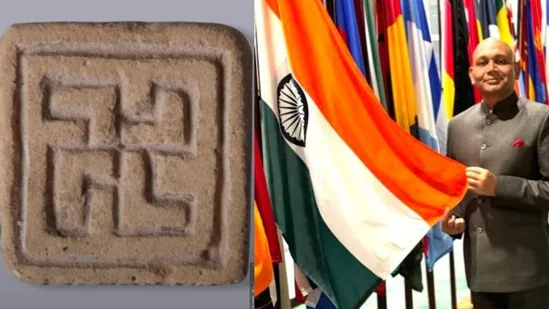
Swastika Connects India and Azerbaijan: Diplomat’s Ancient Symbol Shines Amid Regional Tensions
Bharatmorningnews.com – India and Azerbaijan share a profound historical connection symbolized by the Swastika, a motif that has transcended time and borders. As Indian diplomat Abhay Kumar engages in efforts to ease diplomatic tensions between the two nations, he has turned to this ancient emblem to highlight the enduring cultural and spiritual bonds between them. The Swastika, which has long been a unifying motif in both countries, now serves as a powerful reminder of their shared legacy, even as contemporary disputes test their relationship.
The Swastika: A Universal Sign of Harmony
Long before modern geopolitics defined the relationship between India and Azerbaijan, the Swastika stood as a testament to their intertwined histories. This symbol, revered in Hindu, Buddhist, and Jain traditions, has also been found in ancient Persian and Central Asian cultures, suggesting a deep-rooted exchange of ideas. Kumar’s recent post on X emphasized how the Swastika connects India and Azerbaijan across millennia, pointing to archaeological findings and historical texts that reveal the symbol’s widespread use in both regions. Such shared cultural artifacts underscore the fluidity of borders and the continuity of human civilization.
“The Swastika connects India and Azerbaijan across millennia,” Kumar stated, drawing attention to how ancient civilizations in the region used the symbol to signify prosperity and unity. His message aims to foster mutual understanding and reset the narrative around their current discord.
Azerbaijan’s Strategic Shifts and India’s Response
Recent months have seen India and Azerbaijan navigating a complex web of diplomatic and strategic challenges. The Indian ambassador-designate to Baku, Abhay Kumar, invoked the Swastika connects India and Azerbaijan to redirect focus from current disagreements to a broader historical context. These tensions, however, are not new. Azerbaijan’s backing of Pakistan during the 2021 Pahalgam terror attack prompted India to question its regional alliances. Additionally, disputes over India’s delayed support for Azerbaijan’s Shanghai Cooperation Organisation (SCO) membership have created friction, highlighting the importance of Kumar’s symbolic gesture in rekindling cultural dialogue.
Archaeological Discoveries Reinforce Shared Heritage
Archaeological evidence further reinforces the idea that the Swastika connects India and Azerbaijan through centuries of cultural interaction. Excavations in regions like the Caucasus and the Indus Valley have unearthed artifacts bearing the same motif, suggesting a long-standing exchange of religious and artistic traditions. For example, the Ateshgah Fire Temple near Baku, a 17th- to 19th-century site, served as a convergence point for Indian traders and pilgrims, leaving inscriptions in Devanagari and Gurmukhi scripts. These remnants provide tangible proof of the Swastika connects India and Azerbaijan, demonstrating how the symbol has traversed continents and epochs.
The Swastika as a Bridge in the Modern Era
In the contemporary geopolitical landscape, the Swastika connects India and Azerbaijan has become a poignant metaphor for mutual resilience. While the symbol has been co-opted in modern times, particularly by the Nazi regime, its original spiritual connotations remain intact in both nations. Kumar’s invocation of the Swastika serves to remind audiences of its unifying potential, especially in a time when political tensions threaten to overshadow historical ties. By emphasizing this shared heritage, the diplomat aims to create a narrative of cooperation and cultural synergy, even as the two countries work through their current disagreements.
“The Swastika connects India and Azerbaijan beyond mere aesthetics; it represents a legacy of spiritual and cultural continuity,” Kumar wrote, appealing to a broader audience of history enthusiasts and policymakers alike. His message underscores the importance of remembering the past to navigate the present.
India’s Role in Azerbaijan’s Historical Narrative
The influence of India on Azerbaijani history is evident in the presence of the Swastika connects India and Azerbaijan across various domains. From ancient trade routes to religious practices, the two nations have long shared an interdependent relationship. The Ateshgah Fire Temple, for instance, not only attests to Indian religious traditions in the region but also symbolizes the Swastika connects India and Azerbaijan through shared spiritual values. Similarly, Indian literature and art have found echoes in Azerbaijani culture, illustrating a mutual appreciation that transcends political boundaries. Kumar’s emphasis on these links seeks to revive the significance of the Swastika connects India and Azerbaijan in shaping the region’s collective identity.
By leveraging the Swastika connects India and Azerbaijan, Kumar’s message reflects a strategic approach to diplomacy that blends historical narrative with modern relevance. As both nations strive to redefine their relationship, the symbol offers a timeless reminder of their shared past, urging a more collaborative future. This initiative not only strengthens the Swastika connects India and Azerbaijan but also provides a framework for addressing current challenges through mutual respect and historical awareness.