
Rain in Delhi-NCR due to ‘influence of low-pressure area, monsoon trough’: What does that mean?
Rain in Delhi NCR Due to Low-Pressure Area and Monsoon Trough
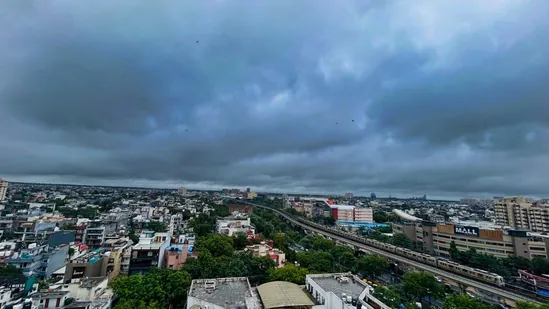
Bharatmorningnews.com – Delhi-NCR’s recent heavy rain, triggered by the influence of a low-pressure area and the monsoon trough, has caused widespread flooding and traffic disruption across the region. On Thursday afternoon, Ghaziabad’s Vasundhara streets turned into waterways, while Noida’s high-rises were shrouded by thick clouds. The downpours have created chaotic conditions in Gurugram and New Delhi, with roads and expressways experiencing severe congestion.
Why Delhi NCR is Experiencing Heavy Rain: Meteorological Factors
The monsoon season has brought intensified rainfall to Delhi-NCR, with the heaviest downpours recorded in East Delhi, Noida, and Ghaziabad. In contrast, western and central Delhi, along with Gurugram, saw lighter precipitation. Meteorologists attribute this to the active low-pressure area and the positioning of the monsoon trough, which has significantly influenced the weather patterns in the region.
“The monsoon has finally gained strength in Delhi-NCR… due to the influence of an active low-pressure area and the monsoon trough, there is a possibility of intermittent rain continuing until July 10,”
explained by Skymet Weather in a recent social media post. This alignment of atmospheric conditions has led to prolonged rainfall, impacting daily life and infrastructure in the National Capital Region.
Decoding Meteorological Terms: What Causes Delhi-NCR Rain
Understanding the causes of Delhi-NCR rain requires breaking down key meteorological concepts. The monsoon trough, a persistent low-pressure belt, plays a central role in guiding the flow of moisture-laden air. Simultaneously, low-pressure areas generate upward air movement, creating favorable conditions for condensation and precipitation. These systems are critical in determining the intensity and distribution of rainfall during the monsoon season.
What is a Low-Pressure Area and How Does It Affect Weather?
A low-pressure area forms when atmospheric pressure dips below surrounding regions, drawing air inward and causing convergence at the surface. In the Northern Hemisphere, this air spirals counterclockwise, rising vertically and leading to cloud formation. The presence of such systems, particularly over northeast Madhya Pradesh and southeast Uttar Pradesh, has contributed to the rain in Delhi NCR due to their interaction with the monsoon trough.
This dynamic process is central to the weather dynamics in the region. As air rises, it cools, reducing its capacity to hold moisture and triggering the condensation of water vapor. Such conditions are essential for the formation of clouds and the subsequent rainfall that Delhi-NCR experiences during the monsoon months.
Understanding the Monsoon Trough and Its Role in Rainfall
The monsoon trough, a vast low-pressure system stretching from southwest Rajasthan to Bangladesh, acts as the backbone of the monsoon. Its position over Delhi-NCR has created an optimal environment for rainfall, aligning with the seasonal movement of moisture-laden winds. This trough’s extension over the Gangetic plains ensures a steady supply of rain in Delhi NCR due to its continuous influence on atmospheric circulation.
As the monsoon trough shifts, it affects the distribution of rain across India. For instance, a northward movement of the trough leads to break monsoon conditions over major parts of the country, while the plains face intermittent rainfall. This explains the recent weather patterns in Delhi NCR due to the trough’s alignment and the presence of low-pressure systems.
Current Weather Dynamics and Future Outlook
According to the India Meteorological Department (IMD), the low-pressure system over northeast Madhya Pradesh has been a key driver of the rain in Delhi NCR due to its interaction with the monsoon trough. The trough’s favorable positioning has sustained rainfall, creating a challenging environment for residents and commuters alike.
Skymet Weather highlights that the monsoon trough’s alignment with Delhi has intensified the rainfall, emphasizing its role in the region’s weather patterns. As the monsoon season progresses, the interplay between these systems will continue to shape the climate in Delhi NCR due to their cyclical influence on the subcontinent’s weather.