
Navy key protector of India’s economic interests: Rajnath Singh
Navy as Guardian of India’s Economic Security: Rajnath Singh Highlights Strategic Role
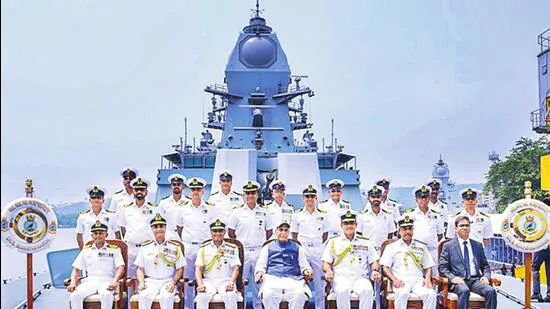
Bharatmorningnews.com – India’s naval force has emerged as a pivotal protector of the nation’s economic interests, a role emphasized by Defence Minister Rajnath Singh in his recent address. Speaking in Visakhapatnam, Singh highlighted the Indian Navy’s critical contribution to securing trade routes and ensuring maritime dominance, particularly in the face of growing competition from regional powers like China. The event coincided with the commissioning of the Indian Navy’s newest stealth frigate, INS Mahendragiri, which underscores the service’s commitment to safeguarding the country’s economic security through robust naval capabilities.
The Strategic Importance of Maritime Security
“Recent events have once again proven how essential a capable and responsive navy is for any nation… From maritime security to economic security, the Indian Navy is the trusted power of the entire Indo-Pacific region,” Singh stated.
As a cornerstone of India’s strategic defense framework, the Navy plays a dual role in both military operations and economic protection. With the Indo-Pacific region becoming a hotspot for global trade and geopolitical tensions, India’s maritime interests are under constant threat. The Indian Navy’s ability to patrol critical waterways, defend territorial waters, and project power across the Indian Ocean ensures the uninterrupted flow of goods, energy resources, and global commerce through the region’s vital chokepoints.
Project 17A: A Leap in Indigenous Shipbuilding
The commissioning of INS Mahendragiri marks a significant enhancement to India’s naval presence in the Indian Ocean Region and the Indo-Pacific, where China’s maritime expansion remains a focal concern. Singh highlighted that the vessel will strengthen the eastern seaboard’s defenses and extend the country’s blue-water capabilities, enabling it to protect vital economic corridors such as the Strait of Malacca and the Suez Canal.
“INS Mahendragiri will further strengthen our combat readiness and contribute significantly to safeguarding India’s maritime interests,” said Navy Chief Admiral Krishna Swaminathan.
As the sixth of seven stealth frigates under the ₹45,000-crore Project 17A, INS Mahendragiri is named after the Mahendragiri mountain range in the Eastern Ghats. These ships represent a major step toward India’s self-reliance in defense manufacturing, with 75% indigenous content. The frigates are equipped with advanced weaponry, including the BrahMos supersonic cruise missile, and systems designed to counter emerging threats to the nation’s economic interests.
Project 17A has not only transformed India’s naval design capabilities but also its strategic footprint in the Indo-Pacific. By reducing the time between launch and delivery from 63 to 31 months, the program has accelerated the deployment of these critical vessels. The total construction duration has also been cut by 20%, from 95 to 75 months, while technical assessments are now completed in just one sea trial, compared to the traditional five to seven required. Such efficiency ensures that the Indian Navy can swiftly respond to any disruptions to its economic interests.
India’s Maritime Economic Interests in the Global Context
India’s economy is deeply intertwined with maritime trade, which accounts for over 90% of its international commerce. With approximately 12.5 million ships operating in the world’s oceans, the Indian Navy’s role in securing these routes is indispensable. The service’s presence in the Indian Ocean Region helps deter piracy, ensure the safety of oil tankers, and protect the transportation of goods to and from the Arabian Sea, the Bay of Bengal, and the South China Sea.
Additionally, the Navy’s strategic positioning allows India to monitor and control the Andaman and Nicobar Islands, a key area for trade and defense. The recent advancements in the P-17A frigates, including their stealth technology and multi-role capabilities, are designed to address both conventional and asymmetric threats to the country’s economic interests. These ships can operate in contested waters, safeguarding India’s access to strategic resources and energy imports.
By strengthening its naval infrastructure, India is not only enhancing its military capabilities but also reinforcing its economic resilience. The Indian Navy’s expansion aligns with the nation’s broader vision of becoming a global maritime power, capable of protecting its interests in an increasingly competitive region. This strategic focus is vital for sustaining India’s economic growth and ensuring its place in the global trade network.
India’s naval strategy is also tailored to address the growing influence of China in the Indo-Pacific. As China expands its naval presence and infrastructure projects in the Indian Ocean, the Indian Navy’s role as a protector of economic interests becomes even more pronounced. The service’s ability to maintain a presence in the Bay of Bengal and the Andaman Sea ensures that India can counter any encroachment on its maritime zones, which are crucial for economic stability.