
Farhad Samji reveals how Akshay Kumar’s 4th-wall-breaking interval scene in Welcome to the Jungle came about | Interview
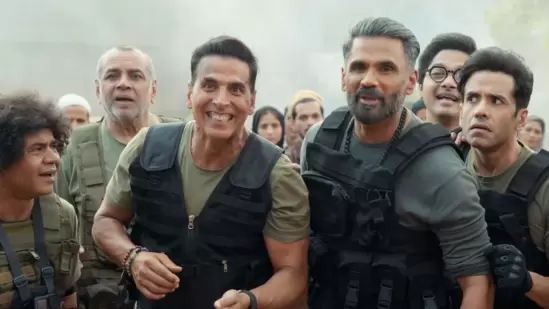
Farhad Samji Reveals the Origin of Akshay Kumar’s Fourth-Wall Interval Scene in ‘Welcome to the Jungle’
Bharatmorningnews.com – As ‘Welcome to the Jungle’ celebrates its ₹100 crore milestone at the Indian box office, writer Farhad Samji reflects on the film’s lengthy creation process, the challenges of casting over 34 actors, and the evolving priorities of moviegoers in the post-pandemic era. The film’s most iconic moment—Akshay Kumar breaking the fourth wall during the interval—has sparked conversations, but Samji insists it was a narrative necessity rather than a calculated gimmick.
The Genesis of a Memorable Moment
Samji recalls the scene where Kumar directly addresses the audience, saying, “You must be getting up from your seats for the interval now.” This moment, which became a talking point, arose from a creative hurdle. The team had a hit song but struggled to integrate it naturally into the jungle storyline without disrupting the flow. “A song, no matter how popular, can fracture the story’s rhythm,” he explains. “Breaking the fourth wall was the only way to keep the momentum while allowing the audience to laugh at the same time.”
“The crowd’s enthusiasm for the film has surpassed initial projections, with audiences transforming theaters into lively arenas.”
Building a Star-Studded Ensemble
Developing the film took nearly three-and-a-half years, with multiple script revisions before it reached Kumar. Samji emphasized the importance of a diverse cast, stating that recognizable faces were essential for the third installment of the Hera Pheri franchise. “We knew from day one that the story needed an ensemble to captivate a broad audience,” he says. “It wasn’t just about talent—it was about creating a shared experience that felt expansive.”
Transparency and Character Depth
Managing such a large cast required a hands-on approach. Samji credits honesty as the cornerstone of the process, ensuring actors understood their roles without false promises. “Transparency has been our key approach,” he notes. “We didn’t guarantee massive parts and then sideline them. The actors appreciated the clarity, and it made collaboration smoother.”
“Even with limited screen time, characters like those played by Farida Jalal and Kirron Kher are praised because of their nuanced development. For instance, Johnny Lever’s character delivers a punchline while silently talking, or Jacqueline’s character is so ‘dumb’ she questions a horse instead of a weapon.”
Revisiting Comedy and Audience Expectations
Samji acknowledges that some social media users felt the comedy involving Disha Patani and Jacqueline Fernandez didn’t resonate as strongly as the veteran actors’ performances. “Each character has a unique arc and voice,” he explains. “If I had assigned Johnny Lever’s traits to Jacqueline or Disha, it wouldn’t fit their roles. It’s about variety—just because one dish isn’t the most popular doesn’t mean it’s not valuable.”
“Every character has an arc and a specific language. Giving Jacqueline or Disha the traits of Johnny Lever would have clashed with their personas. It’s like preparing a buffet—some items may not be everyone’s favorite, but the variety ensures something appeals to all.”
Samji also highlights the writing of female characters, noting that they play pivotal roles with distinct comedic punchlines. “I’m proud of how the women in the film contribute, with lines that often go unnoticed but are crucial to the narrative,” he adds.
Post-Pandemic Audience Priorities
In the wake of the pandemic, Samji observes a shift in how audiences evaluate films. “There’s no formula anymore,” he says. “People want to know if their investment is worth it. A family of four spends 2000-3000 rupees, and they expect a return on that time and money.”
“A family’s decision to watch a film is a big commitment. My driver once asked me, ‘Sir, is the film worth watching?’ knowing that taking his family to the theater cost him 3,000 rupees. The material has to speak for itself—quality is the ultimate judge.”
Samji’s insights underscore the balance between innovation and audience satisfaction, proving that even a seemingly simple moment can redefine a film’s impact.