
‘Eat faster’: Office notice says 1 extra lunch minute means 1 hour unpaid work, sparks outrage
‘Eat Faster’ Office Rule Sparks Outrage Over Unpaid Time
Bharatmorningnews.com – A recent workplace directive, eat faster, has ignited heated discussions online, with employees and critics questioning the extent of corporate control over personal time. The notice, which circulated on social media, states that any extra minute spent on lunch translates to an hour of unpaid work, prompting accusations of micromanagement and unfair labor practices. The policy, though unattributed to a specific company, has become a focal point for debates about work-life balance and the evolving expectations of modern employment.
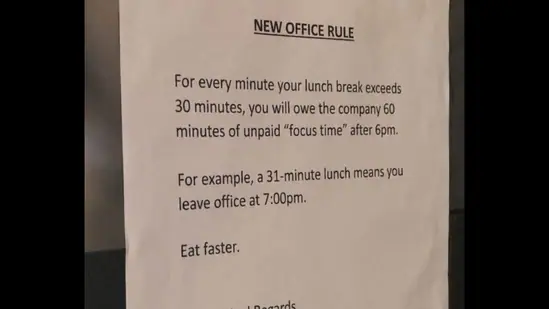
The directive introduces a novel accountability system, where employees are required to compensate for time spent beyond a 30-minute lunch break. For example, taking an additional minute could mean staying an hour past the standard 6 pm departure time. While some argue this promotes punctuality and efficiency, others view it as an aggressive tactic to squeeze more productivity from workers without additional compensation. The eat faster rule has been interpreted as a symbolic gesture to enforce strict time discipline, often at the expense of employee well-being.
“For every minute your lunch break exceeds 30 minutes, you will owe the company 60 minutes of unpaid ‘focus time’ after 6 pm. For example, a 31-minute lunch means you leave office at 7:00 pm,”
the notice declared. This direct command has been shared widely, with many employees questioning its practicality and fairness. The eat faster rule, while seemingly simple, has sparked a broader conversation about how companies are redefining time management in the workplace.
Social Media Outcry Over Excessive Control
Reactions to the post have been swift, with users condemning the policy as an example of overbearing workplace control. One commenter argued, “Employees should write—for every minute worked extra, company owes salary of 1 hr. Eg- worked till 18:01, means company pays extra salary of 1 hr. Let us leave early.” Another user recalled, “I worked for a company where being just 1 minute late would result in a 30-minute salary deduction,” highlighting a pattern of punitive measures in corporate environments.
Others framed the issue as a symptom of modern work culture, where the pressure to maximize productivity often overshadows employee autonomy. “People glorify this as hustle culture,” noted a critic. “1 minute late means an extra 60 minutes of work? Bro is running a corporate prison, not a business,” said a final commenter. These voices underscore the growing frustration with policies that prioritize clock time over actual work output.
Some critics linked the eat faster rule to broader cultural attitudes. “Typical backward Indian business owner mindsets, that’s why they don’t grow to international. Labour exploitation is very normal in India,” one user stated, suggesting the policy reflects a traditional view of labor as a commodity. This perspective has fueled debates about how workplace norms vary across regions and industries, with some advocating for more flexible approaches to time management.
Implications for Work Culture
The eat faster policy raises critical questions about the balance between efficiency and employee welfare. While it aims to curb idle time, critics argue that such measures can lead to burnout and dissatisfaction. “What should matter is the work getting done efficiently, not just filling office hours and warming up the chairs,” another commenter emphasized. This sentiment highlights a growing demand for work cultures that value quality over quantity, even in the context of time-sensitive tasks.
Employees have also raised concerns about the fairness of the rule. “Why should one extra minute of lunch equate to an hour of unpaid work?” a user questioned. The debate has extended to whether companies should account for time spent on necessary activities, such as eating, or if such tasks are considered non-essential. Some suggest that the policy may serve as a blunt instrument to monitor employee behavior, potentially creating a stressful environment where even minor delays are penalized.
Despite the criticism, the eat faster notice has found support among certain segments of the workforce. A few argue that it encourages a disciplined mindset, ensuring that every minute is utilized effectively. “This is just a reminder that time is money,” one user wrote, framing the rule as a practical approach to optimizing productivity. However, the controversy shows that such policies often strike a chord with employees who feel their personal time is being undervalued.
(Disclaimer: This report is based on user-generated content from social media. HT.com has not independently verified the claims and does not endorse them.)