
11 dead in Kolkata warehouse collapse; CM says ex-mayor signed flawed plan for money
11 Dead in Kolkata Warehouse Collapse: CM Blames Ex-Mayor for Flawed Plan
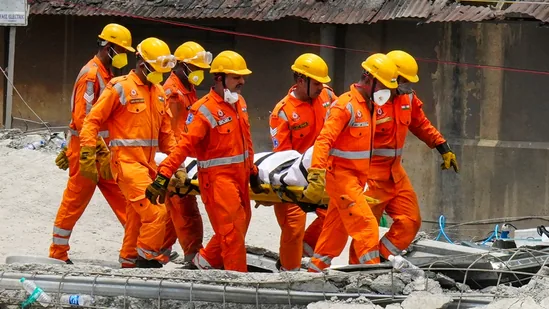
Bharatmorningnews.com – Kolkata witnessed a devastating incident when a four-story under-construction warehouse in Taratala collapsed on Wednesday, resulting in the tragic loss of 11 lives. The collapse, which occurred at 12:07 pm, sent shockwaves through the community and prompted an urgent rescue operation by local authorities. The tragedy has sparked intense scrutiny into the construction plan, with West Bengal Chief Minister Suvendu Adhikari accusing the previous Trinamool Congress (TMC) government of corruption. He claimed that the ex-mayor’s involvement in signing the flawed design was a critical factor in the disaster, linking it to the money-driven decision-making process.
The Incident and Immediate Response
The warehouse, located in the bustling Taratala area of Kolkata, was under construction and had not yet received final approval for occupancy. According to officials, the structure collapsed suddenly, trapping several workers inside. Rescue teams worked tirelessly to extract survivors and recover bodies, but the scale of the disaster left many families in despair. The CM’s remarks, delivered during a press conference, emphasized the role of negligence and financial incentives in the planning stage, calling it a “tragic fallout” of systemic corruption.
Initial investigations revealed that the building’s design had critical structural flaws, including insufficient load-bearing capacity and inadequate safety measures. The disaster has raised questions about the oversight in construction projects, particularly those involving public infrastructure. Local residents expressed anger over the lack of transparency, with some accusing officials of prioritizing profits over people’s safety. “This was a shortcut to profit, not a safe structure,” said one witness, highlighting the community’s frustration with the process.
Arrests and Legal Accountability
Following the collapse, the Kolkata Police detained five individuals, including the warehouse owner Shambhu Nath Behera, for their alleged role in the incident. Among those arrested were Gulzar Hussain, the project supervisor; Kamal Samanta, a fabricator; Dibakar Samanta, a labour supplier; and Abdul Hamid, the broker who facilitated the project’s approval. The police also launched a suo motu FIR under sections 105, 110, and 3(5) of the Bharatiya Nyaya Sanhita (BNS), charging the accused with culpable homicide and joint criminal liability.
“We have found all the records. What happened is a fallout of your sins. This building plan was sanctioned by you on January 17 this year. By taking money, you have turned the City of Joy and greater Kolkata into a city of death,” Adhikari stated during a confrontation with rebel TMC legislators.
The CM’s accusations centered on the ex-mayor’s signature on the flawed plan, which he argued was a clear indication of negligence. The KMC, or Kolkata Municipal Corporation, has since been led by commissioner Smita Pandey, an IAS officer, who has taken steps to investigate the matter further. However, the ex-mayor, Firhad Hakim, has maintained that he was unaware of the plan’s defects, pointing to his role as a political leader rather than an engineer.
Compensation and Government Actions
As part of the response, the government announced compensation packages to support the victims’ families. Adhikari pledged ₹10 lakh per deceased individual and ₹1 lakh for each injured person, while the Prime Minister’s Office offered additional support, providing ₹2 lakh to the families and ₹50,000 to those injured. These measures aim to alleviate the financial burden on affected households, though critics argue they are insufficient given the scale of the tragedy.
“There is no chance of letting anyone go without punishment. We will not let any building rise without an audit,” the CM said, revealing the creation of an audit committee to scrutinize construction plans and ensure compliance with safety standards.
The audit committee is expected to review the entire process of the warehouse’s approval, including the role of engineers and municipal officials. Adhikari’s remarks suggest a broader effort to hold the previous administration accountable for its decisions. The incident has also prompted discussions about the need for stricter regulations in construction projects, particularly in densely populated urban areas like Kolkata.
Investigation and Structural Faults
Authorities have confirmed that the building plan, signed by the former mayor, contained significant structural defects. These included the use of substandard materials and a lack of proper reinforcement, which may have contributed to the collapse. The KMC engineers—Aminur Sheikh, Nirmalendu Sardar, and Ranjan Das—were specifically named in the CM’s accusations for failing to detect these flaws during their inspections.
“See how you approved a faulty plan, despite its structural defects. The plan bears the signature of the former mayor,” Adhikari remarked, though he did not directly name Firhad Hakim.
The investigation into the disaster is ongoing, with officials examining the construction timeline and the responsibilities of each party involved. The police’s Special Investigation Team (SIT) has also detained Firhad Hakim’s former personal assistant, Kalicharan Banerjee, for questioning. Hakim claimed that he had established systems for plan approvals and emphasized that the collapse was due to poor supervision rather than his oversight. “I established systems for plan approvals. As far as I know, it is not illegal,” he stated, defending his role in the incident.
Aftermath and Broader Implications
The tragedy has left a profound impact on Kolkata, with families of the victims demanding justice and stricter enforcement of safety regulations. The CM’s focus on the ex-mayor’s role has intensified political tensions within the TMC, as leaders are now being scrutinized for their decisions. The incident also highlights the challenges of ensuring quality in public infrastructure projects, where financial interests often override safety standards.
As the investigation progresses, the case is likely to become a symbol of accountability in urban development. The audit committee’s findings could lead to reforms in how construction plans are reviewed and approved. Meanwhile, the families of the 11 dead in Kolkata warehouse continue to seek clarity on the circumstances that led to the collapse, hoping for a resolution that addresses both the immediate loss and the systemic issues at play.