
‘India no dharamshala’: Yogi warns against love, land jihad
‘India No Dharamshala’: Yogi Adityanath Warns Against Love, Land Jihad
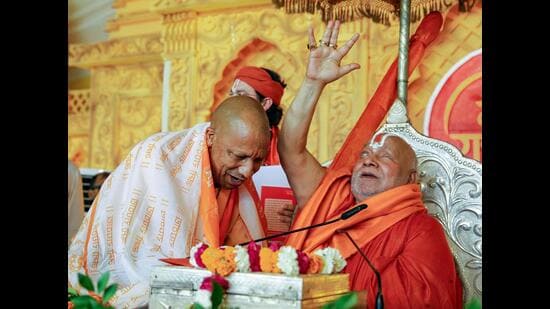
Bharatmorningnews.com – India no dharamshala — a phrase that has gained renewed attention in recent discussions — was once again emphasized by Uttar Pradesh’s Chief Minister Yogi Adityanath during a landmark event in Lucknow. The statement, which underscores the nation’s cultural resilience, warns against the growing threat of “love, land jihad” and “religious conversion conspiracies,” framing these as strategies aimed at altering India’s demographic and social fabric. Adityanath’s remarks, delivered at the closing ceremony of the Shri Ram Katha Mahotsav, reflect his commitment to safeguarding traditional values in the face of modern challenges.
Understanding the Term ‘Dharamshala’
The term “dharamshala” traditionally refers to a place of refuge or a sanctuary for those who follow a particular faith, often symbolizing a safe haven for religious practices. However, Adityanath’s use of the phrase has taken on a more assertive tone, suggesting that India is not merely a passive dharamshala but an active guardian of its cultural and spiritual heritage. This interpretation aligns with his broader vision of fostering national unity while resisting external influences that could fragment the nation’s identity.
Adityanath’s address highlighted the importance of Lord Ram’s teachings in uniting diverse regions of India, particularly in an era marked by rising sectarian tensions. He cited the Shri Ram Katha Mahotsav, a nine-day cultural event organized by Jagadguru Ramanandacharya Swami Rambhadracharya, as a platform to explore how ancient wisdom can guide contemporary societal challenges. The event, held in Lucknow, attracted thousands of participants and featured discussions on Ram’s principles of justice, righteousness, and community harmony.
The Ram Janmabhoomi Case and Its Significance
The CM also referenced the 2019 Supreme Court ruling in the Ram Janmabhoomi case, a pivotal moment in India’s legal and religious discourse. The constitutional bench’s decision to recognize the site as Lord Ram’s birthplace marked a significant victory for those advocating for the preservation of Hindu heritage. Adityanath underscored the importance of this ruling, emphasizing how it reaffirmed the country’s historical and cultural roots. He noted that the evidence presented during the case, including historical records and scholarly contributions, had helped cement the site’s significance in the collective consciousness of India.
“Those aiming to sow discord often exploit caste, language, and regional differences,” Adityanath stated. “Yet, India’s saintly traditions strive to bind communities together and propel the nation forward.”
This quote encapsulates his warning that “love, land jihad” — a term he used to describe the deliberate spread of religious conversion through romantic and economic means — is a calculated effort to erode the nation’s unity. He argued that such tactics are often employed by individuals who lack faith in India’s foundational values, seeking to impose their own interpretations of religious and cultural identity.
Adityanath further stressed the necessity of applying Lord Ram’s teachings in daily life, not just as a philosophical exercise. He pointed to the role of spiritual leaders in this endeavor, highlighting how figures like Swami Rambhadracharya have consistently promoted the message of Ram to strengthen communal bonds. “Swami Rambhadracharya could have chosen rest, but he persists in promoting Ram’s message for the country’s benefit,” the CM said, underscoring the sage’s dedication to the cause.
While the Shri Ram Katha Mahotsav served as a celebration of India’s cultural heritage, Adityanath used the occasion to highlight the urgency of addressing the threat posed by “love, land jihad.” He drew parallels to the Kerala High Court’s earlier warnings in 2009 and 2011, which had highlighted the risks of religious conversion through personal relationships and economic incentives. Adityanath argued that these warnings had gone unnoticed, prompting the UP government to introduce a 2020 legislation aimed at curbing such practices.
“We must stay watchful,” Adityanath concluded. “Negative forces arise in every age, but unity among people is key to facing them.” His call for vigilance resonates with the broader narrative of “India no dharamshala,” which seeks to position the nation as a bastion of traditional values rather than a passive dharamshala. By weaving together historical references, legal milestones, and cultural events, Adityanath’s message reinforces the idea that India’s cultural DNA is a powerful force against external threats to its identity.