
Trump Tries Old Move to Woo a More Powerful Kim Jong Un
Trump Repeats 2018 Gamble as North Korea Grows Stronger
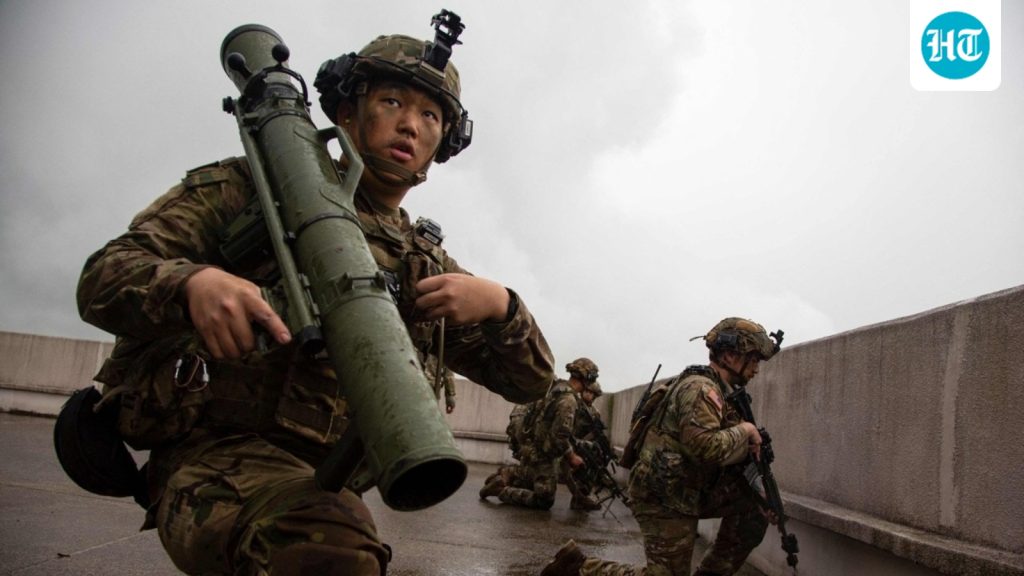
Bharatmorningnews.com – President Trump reached back into a familiar diplomatic playbook this weekend, ordering reductions to the annual joint military exercises with South Korea that commenced Monday. The decision, issued Sunday, mirrors a move he made during his first term to coax Kim Jong Un toward nuclear negotiations.
A More Formidable Adversary
The calculus behind the gesture has shifted dramatically since 2018. North Korea’s armed forces now represent a far more serious threat to Washington and its regional partners than they did when Trump first suspended the drills. Over the intervening years, Pyongyang expanded its nuclear stockpile, ramped up missile output, and gained battlefield experience and technology by dispatching troops to support Russia’s war in Ukraine. Backed by Moscow and Beijing, the North Korean economy has grown even under the weight of global sanctions.
Armed with those gains, Kim has thus far dismissed every diplomatic overture extended by Trump since the president took office again.
Strain from the Iran Conflict
Compounding the dilemma, the ongoing U.S. war with Iran has fueled unease across Asia that American security forces are stretched too thin to credibly deter both China and North Korea. Shortly after hostilities began, the United States relocated dozens of missile interceptors and other assets from South Korea to the Middle East, according to The Wall Street Journal. Most recently, the Pacific-based aircraft carrier USS George Washington is en route to the Middle East to relieve the USS Abraham Lincoln. Whether Washington holds sufficient munitions to escalate the Iran conflict remains contested in policy circles, though the White House insists the country has enough for any operation.
Asian allies already face mounting pressure from the Trump administration to absorb a larger slice of the regional security burden.
Military Officials Sound the Alarm
The exercises launched without visible signs of immediate scaling back, but Trump’s last-minute order on the eve of the 11-day event has unsettled military planners and advisers worried about eroding readiness.
Mark Montgomery, a retired U.S. Navy rear admiral now serving as a senior fellow at the Foundation for Defense of Democracies, argued that trimming joint drills would blunt Washington’s deterrence posture toward both China and North Korea while failing to reassure allies of America’s reliability as a partner.
“This was a mistake in 2018 and it’s a bigger mistake in 2026,” Montgomery said. “Kim Jong Un is more powerful now because of the technology and equipment he’s gotten from Russia.”
In 2018, Trump had suspended the joint drills during a summit with Kim as a concession to advance denuclearization talks, then scaled down additional exercises the following year.
Diplomatic Reactions and Retoric
On Saturday, Trump shared a photograph of himself and Kim from a 2019 meeting at the inter-Korean border, captioning it with a boast about their personal rapport.
“Despite the unfriendly look on this particular picture, there are many where we’re smiling, Kim Jong Un and I get along GREAT!”
In a separate Sunday post, he labeled the joint drills costly and provocative—language straight from his first-term playbook—and characterized North Korea as “unthreatening and respectful.” He also accused South Korea of failing to aid the United States in its fight with Iran. Seoul responded Monday by saying it was in discussions with Washington about contributing to the Iran effort.
Pyongyang, for its part, has long branded the U.S.-South Korea drills as hostile. On Thursday, a spokesperson for North Korea’s foreign ministry described the exercises as a “rehearsal for an aggressive war” posing a grave threat to the country’s security.
Seoul’s Position and the Road Ahead
Since last year, South Korean President Lee Jae Myung has floated scaling back the joint exercises to improve the odds of engagement with the North. Kim, meanwhile, insists the United States must accept North Korea as a nuclear state before any dialogue can begin.
This year’s drills already incorporated fewer battalion-level field-training exercises than last year’s edition. It was not immediately clear where the Pentagon would apply further reductions now that the exercises are underway. Despite the turbulence, military cooperation between the United States and its Asian partners has remained robust, as evidenced by the recent biennial “Rim of the Pacific” exercise.
Related Reading
Frequently Asked Questions
What is Trump Tries Old Move to Woo?
Trump Tries Old Move to Woo is the main topic of this guide. The article explains the context, practical details, and next steps readers should understand.
Why does Trump Tries Old Move to Woo matter?
Trump Tries Old Move to Woo matters because readers are looking for a useful answer, not just a short summary. Good content should match search intent and help them decide what to do next.