
Terms of Trade: Is PK’s parabolic victory hyperbolic in Bihar’s larger politics?
Terms of Trade: Is PK’s Bihar Victory Sustainable?
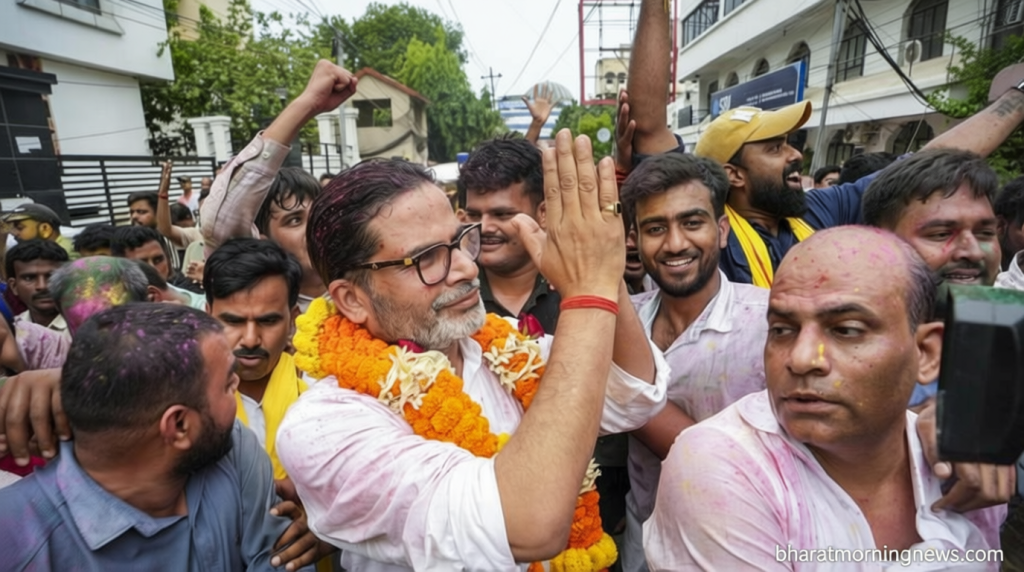
Bharatmorningnews.com – Conducting meaningful empirical studies on broader electoral dynamics rarely relies on by-election outcomes. Yet circumstances warrant deeper examination when an unfamiliar contender captures a constituency from a governing party that has maintained control for thirty years, particularly when that seat previously belonged to the party’s national leadership. The recent Bankipur assembly constituency by-poll in Bihar offers several noteworthy observations regarding Prashant Kishor’s decisive win. Understanding the Terms of Trade in this contest reveals much about Bihar’s evolving political landscape.
Vote Share Analysis Reveals Clear Patterns
The statistical picture presents itself without ambiguity. Kishor secured nearly half of all votes cast in this contest. Meanwhile, the Bharatiya Janata Party achieved only thirty-five percent of the total vote, marking its poorest showing in Bankipur since the constituency was established in 2009. The Rashtriya Janata Dal, serving as Bihar’s primary opposition force, managed merely ten percent of the electorate’s support.
Examining results from the 2025 state assembly elections provides additional clarity. Kishor successfully attracted supporters from both major parties, considering the BJP and RJD previously captured sixty-two point six percent and twenty-nine point five percent respectively in that contest.
Bankipur: A Special Case
Representing the broader Bihar electorate, Bankipur proves exceptionally uncharacteristic. The constituency stands as perhaps the most metropolitan and affluent area within the entire state, featuring a substantial proportion of upper-caste residents. Consequently, projecting Kishor’s singular triumph to his newly formed Jan Suraaj party would be hasty. The organization secured only three point four percent during the 2025 assembly polls.
Nevertheless, these considerations do not diminish the significance of Kishor’s Bankipur achievement for Bihar’s political landscape. Several factors explain why.
A Political Crossroads for Bihar
Bihar’s political trajectory shifted considerably after Nitish Kumar’s elevation to the Rajya Sabha earlier this year. Kumar embodied a broader alliance uniting upper-caste groups and non-Yadav Other Backward Classes against the RJD’s Muslim-Yadav coalition model. His appeal rested equally on perceived administrative competence and the fear of RJD resurgence.
However, the RJD’s consecutive electoral defeats have eroded its influence. Today, the party appears more besieged than besieging, a transformation even its traditional Muslim supporters recognize. The BJP’s choice of Samrat Choudhary as chief minister signals a strategic shift toward embracing OBC politics rather than confronting it through upper-caste alliances alone.
This approach, while sensible, may not satisfy the party’s upper-caste supporters as effectively as their backing of Kumar, who represented the effort to remove Lalu Yadav from power. Recent tensions surrounding the extrajudicial killing of a Brahmin man highlight this concern. Complicating matters further, many upper-caste BJP leaders who helped establish the party’s presence in Bihar have died. The organization has grown geographically but weakened its foundational support base—a crucial lesson from recent results.
Looking Beyond the By-Poll
Kishor never intended to settle for merely becoming an MLA or MP. His career as a political consultant afforded him considerable visibility and influence. His decision to skip the assembly elections and focus solely on this by-poll demonstrates strategic thinking. The essential question remains: how will he leverage this victory within Bihar’s political framework?
His likely approach involves recognizing that Jan Suraaj cannot achieve breakthrough success independently. Finding a coalition partner becomes necessary. Both the BJP and RJD automatically qualify as unsuitable options since neither would relinquish leadership or opposition status to a third party. The JD(U), currently experiencing decline following Nitish’s departure, offers limited prospects.
The Congress party emerges as Kishor’s most viable alliance candidate. Despite possessing considerable historical recognition and legacy value, the organization lacks substantial grassroots strength, making it receptive to a dominant partnership arrangement.
Understanding the Terms of Trade in Bihar’s politics requires looking beyond individual victories to examine structural shifts in voter alignment and party coalitions.
Frequently Asked Questions
What are the Terms of Trade in Bihar’s current political scenario? The Terms of Trade refer to the evolving dynamics between major parties—BJP, RJD, JD(U), and emerging players like Jan Suraaj—as they navigate shifting voter preferences and coalition possibilities in Bihar.
Why is Bankipur considered an uncharacteristic constituency? Bankipur is Bihar’s most metropolitan and affluent area with a high concentration of upper-caste residents, making it different from typical rural Bihar constituencies.
What does Kishor’s Bankipur victory suggest for Jan Suraaj? While impressive, the victory may be situational given Jan Suraaj’s modest 3.4% showing in the 2025 assembly elections. The party will need strategic alliances to expand beyond Bankipur.
Which party is most likely to partner with Jan Suraaj? The Congress party appears most viable due to its historical legacy combined with limited grassroots strength, making it receptive to a dominant partnership arrangement.
How has Nitish Kumar’s Rajya Sabha elevation affected Bihar politics? Kumar’s elevation created a political vacuum and prompted realignment, with the BJP shifting toward OBC politics while upper-caste supporters seek new avenues for influence.