
Row over ₹99 lakh subsidy to union minister Bhagirath Choudhary from agriculture ministry, he says ‘nothing hidden’
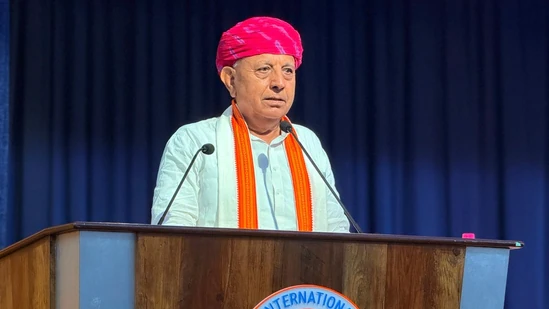
Row Over 99 Lakh Subsidy to Union Minister Bhagirath Choudhary from Agriculture Ministry
Bharatmorningnews.com – A recent controversy has sparked a heated debate over the allocation of ₹99.6 lakh in subsidies to Union Minister Bhagirath Choudhary from the Agriculture Ministry. The issue has intensified as Choudhary, who holds the position of Minister of State in the Union Ministry of Agriculture and Farmers’ Welfare, has defended the process, claiming that the subsidy was given transparently and without any hidden motives. The dispute has raised questions about the fairness of benefit distribution and whether the minister’s personal interests were prioritized over public welfare.
Details of the Subsidy Approval Process
The controversy gained traction after The Indian Express revealed that the subsidy was approved by a committee where Choudhary served as ex-officio Vice-President. This role, which comes with authority in decision-making, has led to accusations of potential conflicts of interest. The subsidy scheme, intended to support commercial agriculture, reportedly included the minister’s family’s landholdings as eligible beneficiaries. Such a setup has drawn comparisons to other cases where subsidies are directed to political allies, prompting calls for greater scrutiny of the process.
Minister’s Defense and Context
Choudhary, representing Ajmer in the Lok Sabha, emphasized his deep connection to agriculture, stating that he has been involved in farming since his youth. “I applied for the subsidy in 2018, just like thousands of other farmers,” he explained. “I even maintained a detailed record of all loans and subsidies received, proving there is no secrecy.” He added that local officials had visited the site to verify the claims, further reinforcing his argument that the process was legitimate and open to public inspection. However, critics argue that his dual role as both applicant and approver undermines the transparency of the scheme.
“Thousands of farmers install polyhouses and claim subsidies. I did the same. What’s the issue?”
Political Reactions and Criticisms
The opposition Congress party has been vocal in its criticism, branding the subsidy as a case of “conflict of interest” and accusing the BJP-led government of hypocrisy. Pawan Khera, a prominent Congress leader, pointed out that Choudhary’s position as both the applicant and approver creates a clear pathway for preferential treatment. Meanwhile, former Rajasthan Chief Minister Ashok Gehlot condemned the NDA administration, calling it a “new model of corruption.” He argued that the allocation of public funds to ministers and their families exemplifies a broader pattern of misuse, where subsidies are treated as privileges rather than equal opportunities for all farmers.
Family Benefits and Broader Implications
The controversy extends beyond Choudhary’s personal involvement, as his family’s agricultural ventures are also implicated in the subsidy scheme. In addition, the report highlights that the family of Naresh Pal Gangwar, a senior IAS officer in the Ministry of Fisheries, Animal Husbandry, and Dairying, received over ₹1.16 crore in subsidies over five years. This has fueled claims of systemic favoritism within the ministry, with critics suggesting that the scheme may be designed to benefit a select group rather than the general farming population. The case has sparked a larger discussion about how subsidies are managed and whether they are truly reaching those in need.
Choudhary’s Broader Criticism of Government Policies
Choudhary’s defense of the subsidy has also included a critique of the government’s approach to welfare. He pointed out that public funds are often seen as a tool for political gain rather than genuine support for the underprivileged. “It’s troubling that the poor are expected to express gratitude for just 5 kg of free ration and a simple midday meal for their children,” he said. “These are rights, not favours, yet ministers treat public money as if it belongs to their own families.” His remarks highlight a growing frustration with how subsidies and other welfare schemes are being perceived as tools of privilege rather than equality.
“Ministers and their kin have cornered subsidies, drawing benefits and treating public money as their father’s estate.”
The debate over the 99 lakh subsidy underscores a wider tension between transparency and accountability in government programs. While Choudhary insists that the process was open and fair, the controversy has reignited discussions about the need for stricter oversight of subsidy approvals. As the case unfolds, it remains a focal point in the ongoing discourse about how public resources are allocated and whether they are being used to serve the broader interests of the people they are intended to help.