
Rare sighting at SCO Summit: PM Modi, Xi, Putin, Sharif captured in one frame
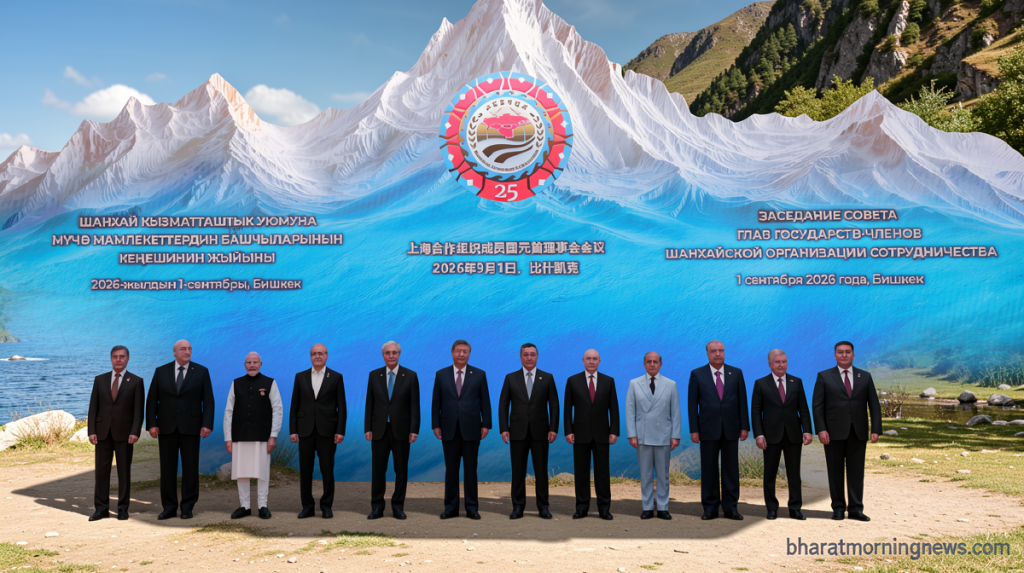
Four Leaders, One Frame: SCO Summit in Bishkek Puts Global Power Dynamics on Display
Bharatmorningnews.com – The 26th Shanghai Cooperation Organisation summit in Bishkek, Kyrgyzstan, produced one of the most closely watched diplomatic images of the year when Prime Minister Narendra Modi, Chinese President Xi Jinping, Russian President Vladimir Putin, and Pakistan Prime Minister Shehbaz Sharif stood shoulder to shoulder for the official group photograph on Tuesday. The image, taken inside the Yrys Ordo Congress Hall, encapsulated the shifting architecture of Eurasian geopolitics in a single composition — four leaders representing nations that together command vast populations, nuclear arsenals, and critical energy corridors.
The photograph was not merely ceremonial. It capped a week of intensive bilateral and multilateral engagements that placed India at the centre of a complex web of relationships spanning South Asia, Central Asia, the Middle East, and Europe. For observers tracking the SCO’s evolution from a security-focused bloc into a broader economic and diplomatic platform, the gathering in Bishkek underscored how the organisation now functions as a stage where competing and converging interests are negotiated in real time.
The Roundtable and the Broader Delegation
Beyond the symbolic weight of the group photo, a substantive roundtable discussion convened at the same venue brought together the full roster of participating heads of state. Kyrgyzstan President Sadyr Japarov, serving as the summit’s host and rotating chairman, chaired the session. In addition to Modi, Xi, Putin, and Sharif, the table included Iranian President Masoud Pezeshkian, Belarusian President Alexander Lukashenko, Kazakhstan President Kassym-Jomart Tokayev, Uzbek President Shavkat Mirziyoyev, and Tajik President Emomali Rahmon.
The summit drew representatives from 10 member states, 15 partner countries, and two observer nations — a footprint that gives the SCO considerable reach across the Eurasian landmass. Collectively, the ten full members account for roughly 25 per cent of global GDP, a figure that has grown steadily as Central Asian economies expand and trade corridors linking China, India, and Europe gain momentum. The organisation’s stated guiding principles emphasise long-term ties built on good-neighbourliness, mutual interest, and universally recognised norms of international law, though in practice its agenda now stretches well beyond security into energy, connectivity, and multilateral coordination.
Modi-Putin Bilateral: Friendship Language Meets Ukraine Pressure
On Monday, ahead of the multilateral sessions, Modi held a dedicated bilateral with Putin centred on trade, investment, energy cooperation, and defence collaboration. The timing carried added significance: Putin is scheduled to travel to India within a week to attend the annual BRICS summit, making the Bishkek talks a prelude to a larger engagement in New Delhi.
Modi opened the meeting with a warm public address, addressing Putin as “my friend” in televised remarks before the two sat down. He then pressed a point that has become a recurring theme in Indian diplomatic discourse on the European conflict:
“There’s a need to move from endless war to end of war.”
Delivering that line, Modi switched from Hindi into English, a rhetorical choice that signalled the message was intended for a global audience as much as for his counterpart. The call for an end to Russia’s war in Ukraine reflects India’s longstanding position of supporting all efforts toward peace while maintaining its strategic partnership with Moscow.
Putin’s reply was brief and non-committal:
“We’re moving in this direction.”
He offered no further elaboration, a response consistent with the Kremlin’s cautious public posture on the conflict. Putin did, however, take the opportunity to credit Modi personally, describing their relationship as “very kind, personal, friendly relations, for which I thank you,” and framed the bilateral as a continuing strengthening of strategic partnership. The two leaders had earlier shared a lighthearted moment at the Tianjin SCO-related event, a “carpool diplomacy” episode that drew widespread attention and underscored the personal dimension of their ties.
Modi-Pezeshkian: A Two-Year Gap Closed
Earlier on Monday, Modi met Iranian President Masoud Pezeshkian on the summit’s sidelines, marking the first face-to-face encounter between the two leaders in two years. The meeting came amid heightened regional tensions and India’s interest in deepening energy and transit links with Iran, including the Chabahar corridor and broader connectivity initiatives linking the Persian Gulf to Central Asia.
What the Bishkek Gathering Signals
The concentration of so many major leaders in one Kyrgyz capital over a single week is itself a data point. It illustrates how the SCO, once perceived primarily as a China-Russia-led security compact, has matured into a multilateral forum where India, Pakistan, Iran, and Central Asian states all find a seat at the table. For India, the summit offered simultaneous opportunities to advance bilateral agendas with Moscow and Tehran while projecting a consistent multilateral voice on peace and cooperation. The group photograph — Modi, Xi, Putin, and Sharif in a single frame — remains the most compressed visual summary of that complex, layered diplomacy.
The leaders also participated in the Nomad Games following the summit sessions, a cultural tradition of Kyrgyz hospitality that offered a less formal setting for continued exchanges. As the summit concluded, attention turned to the upcoming BRICS gathering in India, where Putin’s visit will extend the bilateral trajectory set in motion in Bishkek.
Related Reading
Frequently Asked Questions
What is Rare sighting at SCO Summit?
Rare sighting at SCO Summit is the main topic of this guide. The article explains the context, practical details, and next steps readers should understand.
Why does Rare sighting at SCO Summit matter?
Rare sighting at SCO Summit matters because readers are looking for a useful answer, not just a short summary. Good content should match search intent and help them decide what to do next.