
Dhami takes swipe at Rahul Gandhi over caste remarks during tea in Khatima
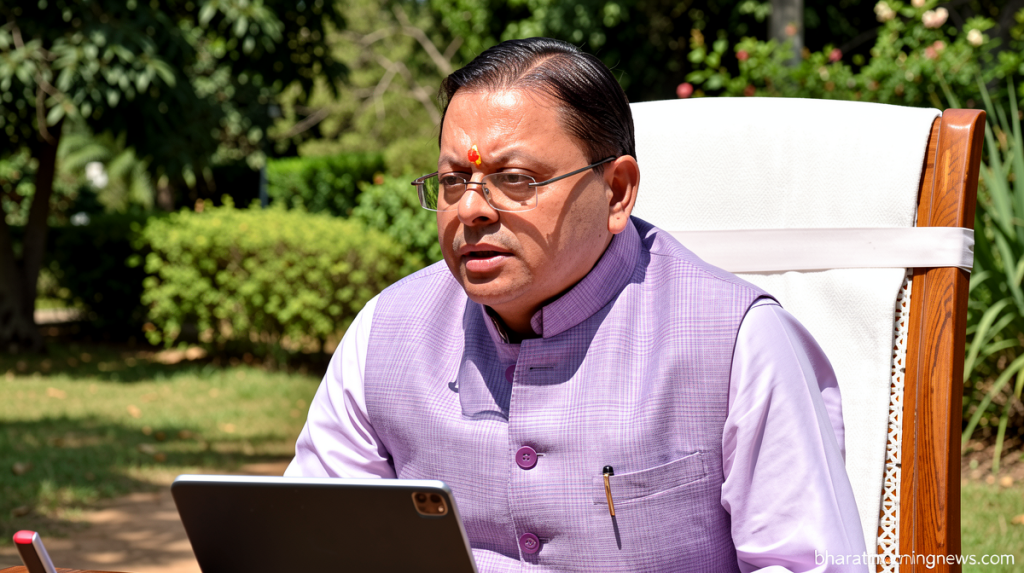
Uttarakhand CM Pushkar Singh Dhami Challenges Caste-Centric Political Framing After Tea Interaction in Khatima
Bharatmorningnews.com – The national conversation around caste-based representation and social justice has long occupied the centre of Indian political discourse. Yet in a small hillside town in Uttarakhand, Chief Minister Pushkar Singh Dhami offered a pointed counter-narrative: that the reflexive search for caste markers in every social encounter betrays a reductive and divisive approach to governance. Speaking after sharing tea with residents of Khatima, Dhami directed his criticism squarely at Congress leader Rahul Gandhi, whose recent public comments on caste had drawn wide attention across the country.
A Cup of Tea, Not a Political Arena
The setting was unremarkable by design. Dhami sat among locals in Khatima, accepting tea served in single-use plastic cups, engaging in casual conversation with men and women from varied walks of life. It was precisely this ordinariness that became the crux of his argument. He described being able to savour the flavour of the brew and feel the genuine warmth of the people around him, while noting that no one in the circle identified themselves by caste or demanded political categorisation.
From that observation, Dhami drew a sharp political conclusion. He characterised the impulse to locate caste and discrimination in such an unstructured gathering as the ultimate expression of narrow-minded politics. In his framing, a leader who insists on reading every social interaction through the prism of caste hierarchy is not advancing social justice but entrenching division.
“The cup may be disposable, but our thinking should not be so disposable that we start looking for caste and politics even in a cup of tea,” Dhami said.
Uttarakhand’s Social Fabric as a Political Principle
Dhami anchored his argument in what he described as the state’s deep-rooted tradition of communal living. Uttarakhand, a mountain state of roughly four million people spread across dense forests and narrow valleys, has historically organised its social life around shared labour, mutual aid, and collective responsibility. Neighbourhoods in the region have long functioned as units of mutual support rather than as collections of caste-defined groups. Dhami argued that this heritage of brotherhood and reciprocal affection ought to shape how public life and political debate are conducted, especially when individuals from different occupational and social backgrounds meet in informal settings.
He stressed that political leadership in the state should work to reinforce social cohesion, not to deepen fault lines. Repeatedly labelling ordinary interactions as sites of caste conflict, he warned, risks manufacturing polarisation where none organically exists and diverts attention from the material concerns—infrastructure, employment, healthcare, education—that affect residents regardless of their social origin.
The Wider National Debate
Dhami’s remarks land in the middle of an ongoing and often heated national argument. Since the early 2000s, questions of caste-based reservation, representation in legislatures, and the lived experience of discrimination have moved from the margins of party manifestos to the centre of electoral campaigning. The Indian National Congress, under Rahul Gandhi’s leadership, has in recent years foregrounded caste identity as a organising principle of its political messaging, arguing that state structures continue to reproduce historical hierarchies. Opponents, including several regional and right-leaning formations, contend that an overemphasis on caste categorisation fragments the electorate and distracts from class-based economic grievances.
Dhami did not deny that caste discrimination exists or that social-justice questions merit serious policy attention. What he challenged was the methodological move of treating caste as the primary lens through which every social encounter must be interpreted. In his view, politics should aim to unite people around shared civic interests rather than to sort them into competing identity categories before any substantive issue is even discussed.
Direct Engagement Beyond Administrative Channels
Beyond the caste debate, Dhami used the Khatima episode to underline a broader point about governance in Uttarakhand. He described such informal interactions as essential channels through which a chief minister can understand the texture of daily life—concerns about road connectivity in remote hamlets, access to winter healthcare, the economic pressures on smallholder farmers and forest-dependent communities. These conversations, he said, offer a window into experiences that formal administrative reporting rarely captures.
The state’s geography compounds the challenge. Uttarakhand’s terrain means that many villages are accessible only by narrow mountain roads, often impassable for months during monsoon and winter. For residents of such areas, a brief, unscripted encounter with the chief minister can carry more practical significance than any number of policy documents. Dhami framed these encounters not as photo-ops but as opportunities to listen, to register grievances, and to calibrate policy to conditions on the ground.
Democratic Discourse and Its Limits
In closing his remarks, Dhami acknowledged that political disagreement is an inherent feature of democratic life and that parties will continue to contest questions of representation, reservation, and social equity. What he drew a line against was the instrumentalisation of caste identity as a permanent dividing mechanism in everyday social relations. He reiterated that Uttarakhand’s tradition of communal solidarity should remain the organising value of public life, and that efforts to fracture society along caste lines do not advance the broader interests of the nation.
The exchange in Khatima, for all its informality, thus became a microcosm of a much larger contest over how Indian politics should be conducted: whether the primary unit of political analysis is the individual citizen with shared civic interests, or the caste group with historically specific grievances. Dhami’s intervention, delivered over a disposable cup of tea, stakes out the former position with unusual directness.
Related Reading
Frequently Asked Questions
What is Dhami takes swipe at Rahul Gandhi?
Dhami takes swipe at Rahul Gandhi is the main topic of this guide. The article explains the context, practical details, and next steps readers should understand.
Why does Dhami takes swipe at Rahul Gandhi matter?
Dhami takes swipe at Rahul Gandhi matters because readers are looking for a useful answer, not just a short summary. Good content should match search intent and help them decide what to do next.