
‘We will not associate with any political party: Abhijeet Dipke
We will not associate with any political party: Abhijeet Dipke
Bharatmorningnews.com – Abhijeet Dipke, the founder of the Cockroach Janata Party (CJP), has made it clear that his movement will not align itself with any political party. Speaking after a significant protest in New Delhi, Dipke reiterated his stance that the youth of India are growing increasingly disconnected from the traditional political framework. He described the CJP as an independent initiative, one that aims to challenge the status quo without seeking direct support from established parties. This declaration comes amid rising concerns about the government’s responsiveness to the needs of the younger generation, and it underscores Dipke’s commitment to maintaining the party’s autonomy.
Homecoming Amid Threats
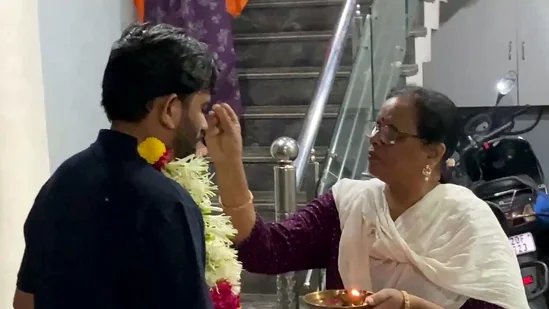
After returning to his home in Waluj Mahanagar, Chhatrapati Sambhajinagar, Dipke was greeted by his family with a traditional aarti, a gesture of reverence and celebration. However, the return was not without tension, as police security was deployed around the area following warnings of potential threats. Despite the precautions, Dipke remained resolute, emphasizing that the movement’s strength lies in its grassroots support and the collective voice of the youth. “We will not associate with any political entity,” he stated, adding that the group’s focus is on creating a platform for young activists to express their aspirations freely.
Education and Employment Challenges
Dipke’s frustration with the current political landscape is closely tied to his critique of the education system and rising unemployment. He highlighted the stark reality that five million students graduate every year, yet only two million secure employment, leaving millions in uncertainty. “We will not associate with any political party that prioritizes divisive rhetoric over job creation,” he said, pointing out that the BJP government’s emphasis on religious politics has overshadowed critical issues like examination irregularities. The CJP, he argued, is not just a protest movement but a call to action for systemic reform in both education and employment.
“The education system has failed to prepare our youth for the future, and we will not associate with any party that neglects this crisis,” Dipke remarked. “Every student deserves transparency and opportunity, but the current regime has turned exams into a tool for political games. Until we see real change, the movement will remain independent and unwavering.”
Political Rebuttal and Public Perception
In response to Maharashtra Chief Minister Devendra Fadnavis’ claim that the Delhi protest was not representative of the youth’s true sentiments, Dipke challenged the narrative. “We will not associate with any political party that labels dissent as lawlessness,” he said, drawing a parallel between the protest and the broader political climate. He questioned how a 17-year-old student exposing CBSE exam flaws could be branded as an anarchist, while the state government’s policies remain untouched. This critique highlights the CJP’s belief that the political establishment is more concerned with maintaining control than addressing the concerns of the youth.
“Students, journalists, and even opposition voices are being labeled as anti-national,” Dipke added. “We will not associate with any party that uses such tactics to silence critics. The true test of a government is how it handles the aspirations of its citizens, not how it labels them.”
Expanding the Movement’s Reach
Dipke emphasized that the CJP’s agenda is not limited to local issues but has a national scope. He stated that the movement will continue to grow, with plans to expand its reach across states. “We will not associate with any political party that hesitates to support the youth’s demands,” he said, calling for collaboration with like-minded groups. However, he clarified that the CJP remains committed to its core principles of independence and grassroots mobilization. This approach has already garnered widespread attention, with thousands participating in the Jantar Mantar protest, showcasing the movement’s momentum.
“Our movement is not about aligning with a single party but about uniting all who share the vision of a more equitable society,” Dipke explained. “We will not associate with any group that compromises our mission. The next phase of the protest will focus on amplifying our message and pushing for accountability at the highest levels of government.”
Call for Systemic Change
Dipke’s remarks underscore a broader demand for systemic change, particularly in governance and education. He criticized the government for its lack of action on examination scandals, stating that the prime minister must take responsibility for these failures. “We will not associate with any political party that avoids addressing corruption and injustice,” he said, urging leaders to prioritize the interests of the youth over political gains. The CJP, he argued, is a movement that challenges the existing power structures and seeks to create a more inclusive political environment for Gen Z.
As the movement gains traction, Dipke remains focused on its core mission: to empower the youth and ensure their voices are heard. He has no immediate plans to return to the United States, instead choosing to channel his efforts into the growth of the CJP. “We will not associate with any political party that undermines our cause,” he concluded, reiterating his commitment to independence. With the next phase of protests set to unfold nationwide, the CJP is poised to become a significant force in India’s political discourse, driven by the principles of transparency, accountability, and youth empowerment.