
Hamilton rewrites the script, this time in red
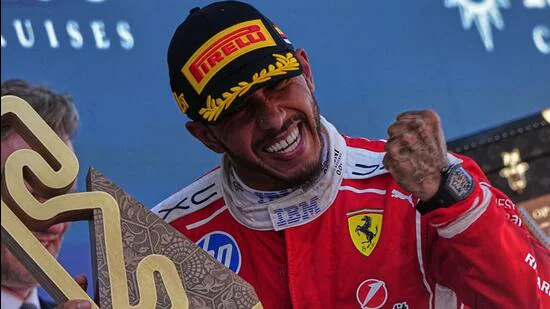
Hamilton rewrites the script, this time in red
Bharatmorningnews.com – When Lewis Hamilton stepped onto the starting grid at the Circuit de Barcelona-Catalunya, he carried with him a story that transcended the sport itself. This time, he was no longer representing Mercedes, but Ferrari—yet the legend of the seven-time world champion was as vivid as ever. After nearly 18 months of uncertainty, the 41-year-old Brit had managed to rewrite the narrative, not just for himself, but for the entire Formula 1 landscape. His win in the iconic red livery of Ferrari marked a pivotal moment, one that would be remembered as a testament to his enduring brilliance and the dynamic evolution of the championship in 2026.
A legacy that defies the odds
Hamilton rewrites the script this time—his journey to victory was anything but straightforward. The move to Ferrari, once seen as a bold yet risky endeavor, had sparked debates across the motorsport world. Could a driver of his stature, with a career spanning over two decades, still deliver the kind of magic that had defined his early years? As the race unfolded, the answer became clear. Hamilton’s performance was a masterclass in resilience, strategy, and sheer determination. His ability to adapt to a new team’s demands and outperform the reigning champions showcased his versatility and his knack for turning challenges into triumphs.
Hamilton rewrites the script this time, beginning with a strategic masterstroke. Ferrari’s decision to equip him with soft tires from the start seemed to expose potential weaknesses, but it was a calculated risk. The team’s aggressive three-stop plan allowed Hamilton to capitalize on moments of chaos, such as the unexpected retirement of Fernando Alonso, which triggered a Virtual Safety Car. This pause became the catalyst for a race that would be remembered for its dramatic twists and Hamilton’s unshakable composure.
Conquering the red of Ferrari
From the outset, Hamilton rewrites the script this time with a performance that defied the odds. While his teammate Charles Leclerc started from pole, Hamilton’s second-place grid position was not a disadvantage but a platform for strategic brilliance. The race’s early laps revealed the tension between the two teams, as Hamilton pushed relentlessly to assert his dominance. His tire strategy, though initially fragile, became a cornerstone of his victory, allowing him to outpace Leclerc and secure a position that would define the race’s outcome.
Hamilton rewrites the script this time, especially when the race’s momentum shifted dramatically. Kimi Antonelli, Mercedes’ young star and championship leader, had initially seemed poised to challenge for the win. However, a misstep on Lap 62—perhaps a miscalculation or a moment of pressure—allowed Hamilton to stretch his lead. The 19.5-second margin he secured over Russell was not just a technical feat but a symbolic victory, reaffirming his status as one of the greatest drivers in F1 history. Norris’s podium finish completed a rare all-British top three, a moment that felt like a throwback to the golden era of motorsport.
“Grazie a tutti, thank you so much,” Hamilton said over the team radio, his voice thick with emotion. “You’ve helped me achieve this dream. To the fans, thank you for continuing to remind me of who I am.”
Hamilton rewrites the script this time in a way that resonated with fans and analysts alike. The emotional weight of his win was amplified by the symbolism of Ferrari’s red livery, a color historically associated with competition and triumph. For the first time in 56 years, the oldest race winner of the era was draped in the iconic red of a rival team, redefining the notion of legacy and reinvention. His victory not only bolstered Ferrari’s credibility in the 2026 championship but also served as a reminder that the sport’s history is continually shaped by those who dare to challenge the status quo.
The significance of Hamilton rewrites the script this time extends beyond the race itself. It marked a generational shift in F1, with the veteran champion and the prodigious rookie Antonelli locked in a battle that captured the imagination of the sport. Hamilton’s win disrupted the championship’s momentum, proving that even in an era of technological advancement, the human element remains irreplaceable. His ability to execute punishing stints, adapt to changing conditions, and outmaneuver the competition solidified his place as a pioneer who continues to redefine boundaries.
As the final laps were completed and the red flags waved, the motorsport world was left in awe. Hamilton rewrites the script this time, not just with a victory but with a statement that would echo through the seasons. Ferrari’s tifosi, once uncertain about their team’s capabilities, now looked to the future with renewed optimism. Meanwhile, Mercedes faced a moment of reflection, questioning whether their strategy had been too rigid in the face of such an unexpected surge. Hamilton’s win was a masterstroke, a blend of old-world grit and modern-day precision, and a reminder that the story of Formula 1 is as much about the drivers as it is about the teams they represent.