
India, France to double trade in five years, eye greater cooperation in nuclear energy
India, France to Double Trade in Five Years, Eye Greater Cooperation in Nuclear Energy
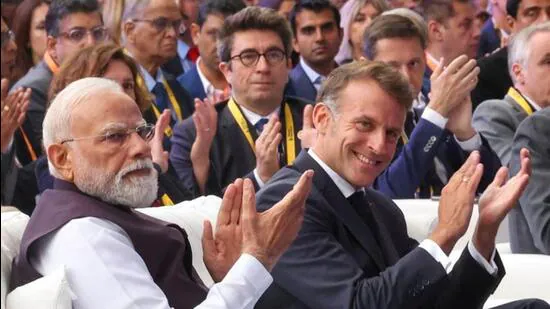
Bharatmorningnews.com – Prime Minister Narendra Modi and President Emmanuel Macron convened in Nice, France, to outline a shared objective of expanding bilateral trade to twice its current value of approximately $16 billion within the next five years. The summit also focused on deepening collaboration in nuclear energy, as part of broader efforts to strengthen ties amid global challenges like the Ukraine and West Asia conflicts.
The leaders met at Villa Kerylos, a historic venue in the coastal city of Nice, following the joint inauguration of Bharat Innovates 2026. This event aimed to connect Indian deep tech startups with international investors. The meeting marked the first stop of Modi’s European tour, which will include Slovakia before he joins the G7 Summit in France later this week.
Key Areas of Discussion
Modi highlighted on social media that the talks with Macron centered on enhancing cooperation in defense, technology, space, security, counter-terrorism, innovation, healthcare, and education. He emphasized that the India-EU Free Trade Agreement (FTA) is a significant catalyst for economic growth, while the proposed Economic Security Dialogue will address supply chain resilience in critical minerals and technology.
“India and France will keep working together to boost economic ties. The India-EU FTA provides unparalleled momentum in this regard,” Modi stated. “We are also launching an Economic Security Dialogue to ensure stronger supply chains in critical minerals and technology.”
Foreign Secretary Vikram Misri detailed the outcomes of the meeting, including the establishment of a high-level mechanism to accelerate trade growth, a dialogue on economic security, and an Innovation Roadmap 2030. France is India’s third-largest EU trade partner, with two-way trade reaching $15.81 billion in the past decade. India’s exports to France amounted to $7.1 billion during the same period.
Defense and Nuclear Energy Collaboration
Defense cooperation, particularly India’s plan to acquire 114 Rafale combat jets, was a major topic. Misri noted that Macron’s visit in February elevated bilateral relations to a special global strategic partnership. The ongoing Rafale deal, including a push for indigenous content, was discussed, with Modi advocating for Make in India principles in defense manufacturing.
Under the multi-role fighter aircraft (MRFA) project, India will purchase 18 Rafale jets from Dassault Aviation in fly-away condition. The remaining 96 jets will be produced domestically, incorporating about 50% indigenous components.
Strengthening Nuclear Partnerships
Modi and Macron acknowledged the potential of India’s SHANTI Act to foster new opportunities in nuclear energy, particularly in small and advanced modular reactors (SMRs and AMRs). Misri highlighted past negotiations between EDF Group and the Nuclear Power Corporation of India Limited regarding the Jaitapur project in Maharashtra, as well as the SHANTI Act’s role in enabling private sector involvement and foreign investments.
“A key focus of the discussions was on strengthening and diversifying bilateral ties in the fields of economic growth, technology and innovation,” Misri noted. “This is especially relevant in view of the conclusion of negotiations earlier this year on the India-EU FTA.”
While the Jaitapur project remains under review, the meeting opened doors for French nuclear firms to engage with Indian partners in both conventional reactors and advanced SMRs. Misri described the dialogue as “rich vein of discussions,” signaling a shift toward joint ventures in the nuclear sector.
Other key outcomes of the meeting included the initiation of a General Security Dialogue, underscoring the strategic depth of their relationship. The talks reinforced commitments to shared goals in global stability and technological advancement.