
SC reserves order on referring CEC appointment issue to 5-judge bench
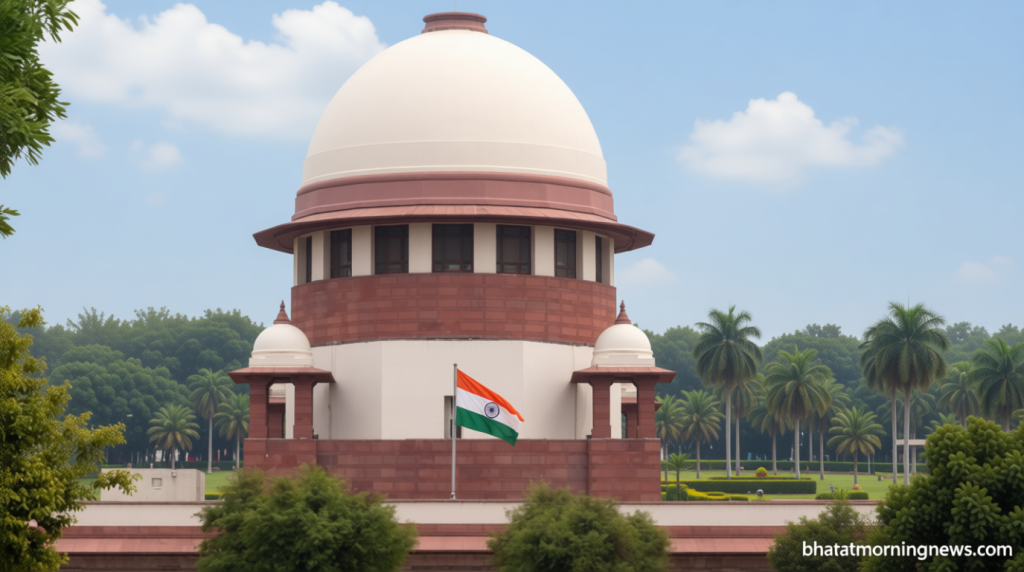
Supreme Court Holds Decision on Five-Judge Bench Referral for CEC Appointment Dispute
Bharatmorningnews.com – New Delhi: On Thursday, the apex court held back its verdict regarding whether the legislation governing the selection of the Chief Election Commissioner and other Election Commissioners warrants consideration by a five-judge bench. This development followed the government’s opposition to a two-judge bench handling the matter.
The ruling came during proceedings on multiple petitions contesting the constitutional validity of the CEC and EC (Appointment, Conditions of Service and Term of Office) Act, 2023. A primary contention involved removing the Chief Justice of India from the Selection Committee, which had been established following a landmark five-judge Constitution bench ruling in the Anoop Baranwal case. That precedent remained operative until Parliament enacted new legislation.
Arguments for Larger Bench
Justices Dipankar Datta and Satish Chandra Sharma constituted the hearing bench. They announced:
“The judgment on the question as to whether the writ petitions need to be referred to a bench of five judges is reserved.”
During oral arguments, Attorney General R Venkataramani and Solicitor General Tushar Mehta contended that Article 145(3) of the Constitution mandates a minimum five-judge composition. They emphasized that substantial constitutional questions regarding interpretation required such a larger bench.
Challengers’ Position
Among the petitioners were Congress leader Jaya Thakur and the Association for Democratic Rights, an NGO. Their legal team, comprising several senior advocates, challenged the 2023 legislation on multiple fronts. They argued the law violated Article 14 due to its arbitrary character and undermined the guarantee of free and fair elections under Article 324 of the Constitution.
The petitioners maintained that the Anoop Baranwal judgment had already resolved the significant legal questions. The remaining issue, they submitted, was whether the newer legislation breached those established principles.
Constitutional Questions Raised
Examining the contested legislation, the bench highlighted Section 7 of the 2023 Act. This provision establishes a selection committee with the Prime Minister as Chairperson, alongside the Leader of Opposition in Lok Sabha and a Union Minister nominated by the PM. The bench posed a critical question:
“The question arising before us is whether Section 7 is ultra vires the Constitution. Where is the concluded authority that this is a decided question.”
The court further noted that the Baranwal judgment was intended to remain effective until Parliament passed appropriate legislation.
Parliamentary Wisdom Under Scrutiny
Before reserving orders, the court examined why Parliament excluded the CJI from the selection panel despite his continued involvement in choosing the CBI Director. The bench questioned:
“Can we question the Parliamentary wisdom for including CJI as part of the selection committee for choosing Lokpal and CBI Director and not for such a high office such as CEC.”
The court received information that the CJI no longer participates in the Lokpal selection panel.
Legislative Independence vs Judicial Precedent
Solicitor General Mehta submitted that the Baranwal decision preceded the parliamentary law and therefore could not constrain legislative discretion. He noted the judgment emerged in March 2023, while the legislation became operative in December of the same year. According to Mehta, legislative independence, much like judicial independence, forms part of the Constitution’s basic structure and cannot be modified by a Constitution bench ruling.
Attorney General Venkataramani expressed concern that the Baranwal judgment operated on the premise that previous CEC and EC appointments had weakened the rule of law. He warned:
“If ultimately, the judgment is so designed that for all practical purposes, the Parliament will have to be gagged, that will be a very serious thing.”
Trust and Fairness in Appointments
Mehta addressed the petitioners’ concerns about the selection panel’s independence. The bench clarified:
“It is not lack of faith but a tilt they are talking about. Should there be no show of fairness when you are appointing CEC and ECs is what they are asking.”
Senior advocates Vijay Hansaria, Gopal Sankaranarayanan, Shadan Farasat, Sanjay Parikh, and advocate Prashant Bhushan led the petitioners. They cited historical instances where substantial constitutional questions regarding legislative interpretation were resolved by two or three-judge benches.
The bench reminded the petitioners:
“We are dealing with a specific statute. Whether Parliament conferring authority to the Prime Minister to select a Minister as the third person of the selection committee — that question has not been answered.”