
What happens when the West runs out of interceptor missiles
When the Sky Shield Runs Dry: The West’s Interceptor Dilemma
A City Under Siege, Out of Bullets
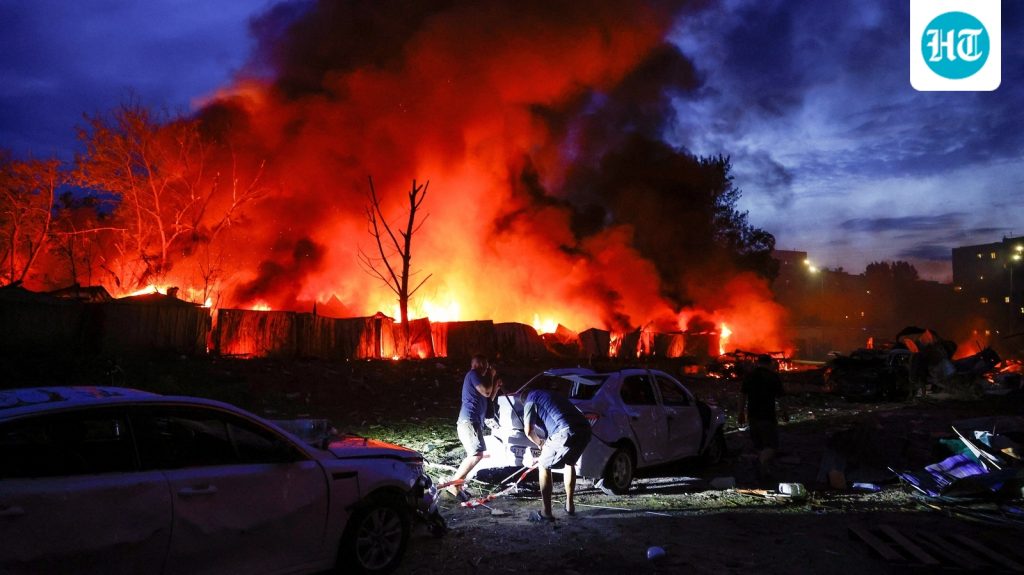
Bharatmorningnews.com – Once again, Kyiv’s civilians are spending the night crammed into packed metro tunnels or parked inside underground garages. Overhead, the aerial bombardment has degraded into something approaching a slaughter. Russian forces are raining ballistic and hypersonic missiles on the capital at escalating rates. Ukraine, which had previously deflected the vast majority of such strikes using Patriot air-defence batteries, is now what the military calls “going Winchester”—a term of art meaning the ammunition is spent.
The Ukrainian predicament stands as the starkest symptom of a broader Western interceptor shortfall. America’s own depleted stockpile also helps account for why President Donald Trump has repeatedly walked back threats to resume hostilities with Iran. Across the Atlantic, allied governments are growing anxious.
Allies Left Waiting
Switzerland anticipates its Patriot procurement could slip by as much as seven years. Taiwan fears that 102 batteries ordered years ago will fail to arrive within the current calendar year as originally scheduled. Lockheed Martin, the manufacturer of the most sophisticated variant—the PAC-3 MSE—states it cannot assure any foreign customer of a delivery date, owing to the Pentagon’s authority to redirect units domestically.
Munitions scarcity is nothing new in wartime, particularly in large-scale attritional conflicts. What makes the present situation alarming is that America is drawing down after a comparatively brief campaign against a mid-sized regional power. A Heritage Foundation study published recently in Washington projects that a full-scale confrontation with China would burn through the interceptor inventory within days, rendering U.S. bases in Japan and Guam effectively unusable.
Decades of Complacency, Accelerated by One War
The immediate trigger was the extraordinary volume of interceptors expended by America and its Middle Eastern partners during Mr Trump’s campaign against Iran this year. The Centre for Strategic and International Studies (CSIS), another Washington think-tank, estimates the Pentagon has launched close to two-thirds of its pre-war Patriot inventory, alongside substantial portions of other interceptor types.
Yet that war merely pulled forward a reckoning decades in the making. On both sides of the Atlantic, defence industries had been operating to a peacetime tempo even as the drums of conflict quickened. That structural error was amplified by the worldwide proliferation of missiles, by generals’ preference for glamorous platforms over the munitions those platforms consume, by America’s dysfunctional budgeting machinery, and by a deep-seated complacency regarding U.S. air supremacy.
CSIS projects that restoring Patriot stocks to pre-war levels will require time until 2029—and that assumes Congress approves Mr Trump’s enormous $1.5 trillion defence-budget request, a 50 percent jump over current outlays, which appears unlikely. Patriots have nonetheless become the principal point-defence system—designed to shield a specific asset such as an air base—for 19 nations.
“Patriot is a dinner-jacket solution: you don’t need it very often, but when you do, very little else will do,” explains Justin Bronk of the Royal United Services Institute (RUSI), a British think-tank.
The Economics of Shooting Down Cheap Arrows
The fundamental problem is one of cost asymmetry. Ballistic missiles are typically cheaper than the interceptors tasked with destroying them; a single PAC-3 MSE round runs $4 million to $5 million. Iran’s Shahed drones—or comparable unmanned aerial vehicles—are two orders of magnitude cheaper still. Defenders, moreover, conventionally launch at least two interceptors per incoming threat to raise the probability of a kill.
“If your adversary can field a one-way attack UAV for the price of a used car, and your answer is a surface-to-air missile that costs the same as a small apartment here in London, you’re losing the exchange even though you’re winning every single engagement,” Colonel Sabah Al Sabah, a Kuwaiti officer, argued at a recent RUSI event.
Ukraine’s Fading Interception Record
Kyiv has improvised a layered air-defence architecture. It maintains a world-class network capable of countering swarms of Russian drones and, aided partly by European air-defence systems, can neutralise most larger cruise missiles. Only the scarce Patriots, however, are matched to Russia’s Iskander-M and Kinzhal ballistic missiles. In March, Ukraine claimed roughly a 70 percent interception rate against ballistic threats. By July that figure had collapsed to 20 percent. In August the numbers grew still grimmer. On a single night—August 5th—no interceptions were recorded at all. The air force has ceased issuing its regular public updates. Russia, observing the trend, is ramping up missile production.
Seeking Relief: Transfers and Accelerated Production
With winter closing in, Ukraine has requested at least 300 Patriot interceptors. Several nations still hold them in meaningful quantities—Germany, Greece, Poland, and Spain among them—but they are growing increasingly reluctant to release them.
A parallel track is to manufacture them faster. This year the manufacturers committed to scaling PAC-3 output from roughly 600 units annually to approximately 2,000 by the early 2030s. The Pentagon has begun
Related Reading
Frequently Asked Questions
What is What happens when the West runs?
What happens when the West runs is the main topic of this guide. The article explains the context, practical details, and next steps readers should understand.
Why does What happens when the West runs matter?
What happens when the West runs matters because readers are looking for a useful answer, not just a short summary. Good content should match search intent and help them decide what to do next.