
Scientists discover mysterious orange-lipped monkey species deep in Congo rainforest – all about the Likweli
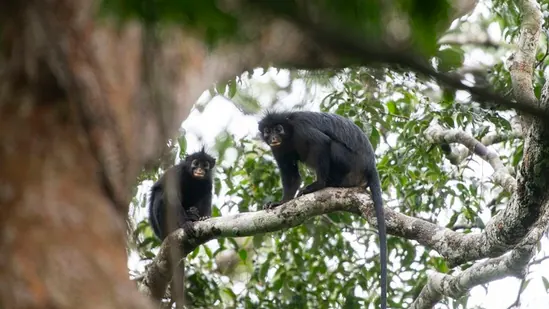
Scientists Discover Orange-Lipped Monkey Species in Congo Rainforest
Bharatmorningnews.com – Scientists have made a groundbreaking discovery deep within the Congo rainforest, uncovering a previously unknown primate species with an unmistakable orange-lipped feature. This unique primate, now named the Likweli, was identified after years of exploration and study in one of Africa’s most remote regions, highlighting the vast biodiversity still hidden from human view. The find not only adds to the growing list of primate species in the Democratic Republic of Congo (DRC) but also underscores the importance of continued research in preserving these ecosystems.
A Hidden Primate in the Canopy
The Likweli, scientifically classified as *Colobus congoensis*, was first observed in 2008 during an expedition along the Lomami River. Its distinctive appearance, characterized by jet-black fur and a striking pink-and-orange mouth, set it apart from other primates. Researchers initially struggled to confirm its existence due to its elusive behavior and limited habitat. However, repeated sightings and the collection of physical evidence in 2018 led to its formal documentation in a study published in *PLOS One*, marking a significant milestone in primate science.
One of the most intriguing aspects of the Likweli is its vocalization—a deep, resonant call that differs from neighboring primate species. This unique sound, combined with its habitat preferences, suggests it may have evolved in isolation, adapting to the dense and complex environment of the Congo rainforest. The species’ physical traits, including its size and coloration, offer clues about its ecological niche and survival strategies, which are still under investigation.
Geographic Isolation and Evolutionary Insights
Unlike many primate species that thrive in vast habitats, the Likweli occupies a remarkably small area—just 650 square miles, comparable in size to Luxembourg. This geographic confinement has likely contributed to its long-standing obscurity, as it remains hidden from human detection. Genetic analysis of the species’ DNA reveals that it split from its closest relatives approximately five million years ago, placing it in an ancient lineage that predates many known primate groups.
The discovery of the Likweli could reshape our understanding of primate evolution. Its isolated habitat may have allowed it to develop unique traits over millennia, making it a living fossil in the modern era. Scientists emphasize that the species’ survival is tied to the protection of its forest home, which faces threats from deforestation and habitat fragmentation. The Likweli’s identification highlights the urgent need for conservation efforts in the Congo, a region critical to global biodiversity.
Local communities in the area have also contributed to the species’ discovery. They refer to it as “kasaba nkoni,” meaning “branch shaker,” a name inspired by its graceful movement through the treetops. This cultural connection adds depth to the scientific narrative, bridging traditional knowledge with modern research. The Likweli’s existence challenges the assumption that all primate species have been cataloged, reminding researchers of the rainforest’s untapped potential.
Confirming the Existence of a New Species
After years of fieldwork, scientists meticulously gathered evidence to confirm the Likweli as a distinct species. This process involved over 3,000 miles of patrols and 114 direct observations, which provided critical data for its classification. Researchers analyzed skin, skeletal, and tissue samples from three captured individuals, comparing them to known primate species to establish their uniqueness.
Lead researcher John Hart explained the significance of the find: “The orange-lipped feature is not just a visual trait but a key identifier that helps distinguish the Likweli from its relatives. Its genomic analysis has opened new avenues for studying primate evolution and the adaptability of species in isolated environments.” The confirmation of the Likweli’s existence also raises questions about how many other species remain undiscovered, especially in the Congo’s dense and uncharted regions.
Implications for Conservation and Future Research
The discovery of the Likweli underscores the need for targeted conservation strategies in the Congo rainforest. As deforestation accelerates, the survival of species like the Likweli depends on preserving their limited habitats. Conservationists argue that the species’ geographic isolation makes it particularly vulnerable to environmental changes, emphasizing the urgency of protecting this fragile ecosystem.
Further research is essential to understand the Likweli’s role in the rainforest’s ecological balance. Scientists are now studying its diet, social behavior, and reproductive habits to determine how it interacts with its environment. The orange-lipped feature, though visually remarkable, may also serve a functional purpose, such as aiding in communication or camouflage. These findings could provide new insights into the adaptations of primates in extreme conditions, expanding the scope of evolutionary biology studies.
With its striking appearance and ancient lineage, the Likweli represents a rare example of a species that has remained hidden for centuries. Its discovery not only enriches our knowledge of African primates but also serves as a reminder of the rainforest’s role as a cradle of biodiversity. As researchers continue to explore the Congo, they hope to uncover more secrets that will deepen our understanding of life on Earth.