
When two wars meet at lake: Ukraine’s strike in Caspian Sea and the Iran-Russia angle
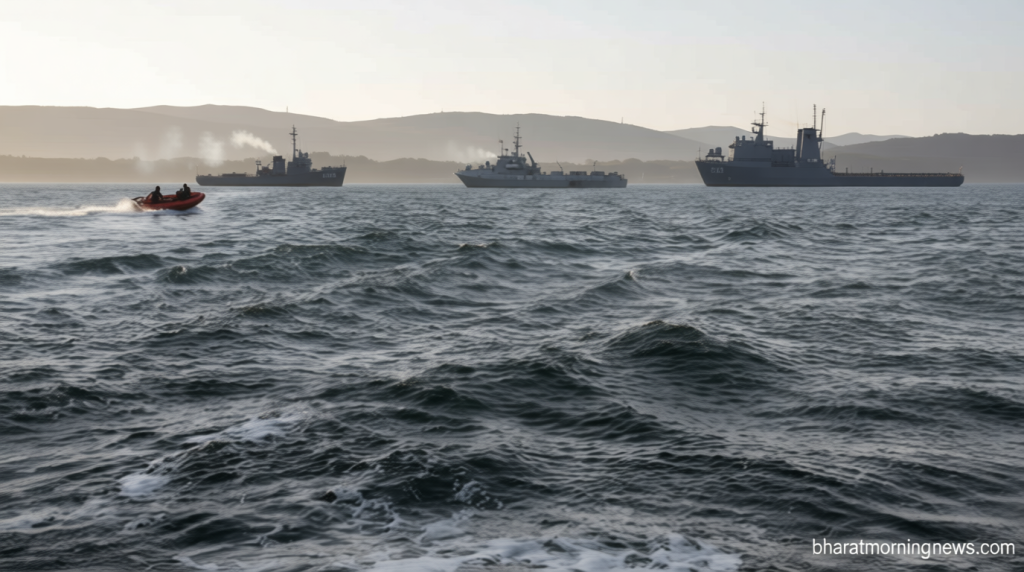
Ukraine’s Caspian Sea Operation: A Collision of Two Conflicts
Bharatmorningnews.com – For the first time, two ongoing conflicts converged directly last Saturday when a Ukrainian drone attack on the Caspian Sea escalated tensions between Tehran and Kyiv while highlighting the region’s growing strategic importance for Moscow and Tehran.
Diplomatic Fallout from the Strike
Tehran reported that the assault on an Iranian ship resulted in one sailor’s death and additional injuries. Meanwhile, Kyiv explained that its extended-range operations targeted vessels transporting military supplies between Iran and Russia, alongside a Russian naval vessel.
Tehran characterized the incident as “hostile and criminal”, requesting an audience with Ukraine’s chargé d’affaires and cautioning about “unforeseen” repercussions.
Ukraine responded by rejecting the warnings as “unjustified and groundless”.
Russian spokesperson Dmitry Peskov supported Tehran’s position, asserting that the operation constituted an attack on Iran directly.
The Caspian’s Strategic Positioning
The incident shifted attention to the Caspian Sea—a landlocked expanse exceeding 1,500 kilometers from Kyiv, shared by Russia and Iran among other nations. Questions emerged regarding Ukraine’s decision to conduct operations in this distant location.
Ukraine’s Security Service (SBU) reported that drones struck an oil platform in the northern Caspian, a Russian missile boat, and cargo ships subject to international sanctions. Iran’s ambassador to Russia, Kazem Jalali, informed state media that the vessel, identified as the Anna, sat approximately 5 kilometers from the Volga river’s mouth during the attack.
According to Iranian sources, the ship transported iron cargo from Astrakhan, Russia, to Anzali, Iran’s primary Caspian port. However, Ukraine’s ambassador to Israel, Yevgen Korniychuk, disputed this narrative, asserting the vessel carried drone and missile components destined for Russia.
Iranian foreign minister Abbas Araghchi communicated to Russian and European counterparts that the attack “cannot go unanswered”.
Indirect Connections Between the Wars
While the Caspian strike created a direct link, the conflicts had previously intersected indirectly. Russia has extensively utilized Iran-manufactured and modified Shahed drones throughout its campaign against Ukraine. Conversely, Kyiv recently dispatched specialists to Gulf states—targets of Iranian retaliation for hosting American military facilities—to exchange knowledge on drone interception techniques.
Geopolitical Significance of the Caspian
As the globe’s largest inland water body, the Caspian borders five nations: Russia, Iran, Azerbaijan, Kazakhstan, and Turkmenistan. The 2018 Convention on the Legal Status of the Caspian Sea prohibits third-country armed forces from deploying on its waters, creating what has become an uncommon shared refuge for Moscow and Tehran.
Basil Germond, professor of international security at Lancaster University, described the region as a “rear maritime space” for Russia.
Germond observed in The Conversation that as Ukrainian drones and missiles render the Black Sea increasingly dangerous, portions of Russia’s naval capabilities have relocated to the Caspian through inland waterways.
For Iran, whose southern ports face a US naval blockade, the Caspian has evolved into a vital corridor. Bijan Khajehpour, managing partner at Vienna-based Eurasian Nexus Partners, explained to CNN that the sea provides Tehran “a strategic complement rather than a substitute for Iran’s existing maritime access”, enabling commerce with Russia, the Caucasus, central Asia, and—through rail connections—China and eastern Europe.
“The recent blockade by the US has underlined the strategic value of the Caspian Sea route,” he stated.
Military Logistics Through the Caspian
The region also serves as a critical conduit for Iran-Russia military cooperation. American intelligence has determined that Iranian ballistic missiles traveled through the lake, while Shahed drone deliveries to Russia followed Caspian routes beginning in 2022.
Ukraine’s Strategic Objectives
Analysts identify two primary motivations behind the operation. Olha Polishchuk, a researcher for the Armed Conflict Location and Event Data Project (Acled), told the BBC that Saturday’s attack represented “less about opening a new front against Tehran” than an expansion of Ukraine’s efforts against the logistical networks supporting Russia’s military campaign.
“Targeting that route allows Kyiv to put further pressure on Russia’s supply networks beyond the traditional battlefield,” she explained.
The second objective involves signaling capability. Conducting an operation more than 1,500 kilometers from Kyiv demonstrates Ukraine’s extended-range capabilities during a period when President Volodymyr Zelenskyy emphasizes his forces’ expanding reach.