
The Nashik Kumbh: A ₹34,700-crore vision of faith, power and development
Nashik Prepares for a Vast Simhastha Kumbh Transformation
Bharatmorningnews.com – President Droupadi Murmu’s ceremonial raising of sacred flags at Ramkund in Nashik and Kushavarta Tirtha in Trimbakeshwar signals the opening of preparations for a religious gathering with consequences far beyond ritual. The Nashik-Trimbakeshwar Simhastha Kumbh Mela, held once every 12 years, is becoming the focus of a major public infrastructure and administrative programme ahead of its first principal bathing day in August 2027.
Maharashtra has outlined projects worth an estimated ₹34,732 crore for the event, which is expected to draw about 12 crore pilgrim visits. The planning effort aims to improve movement, sanitation, public safety and accommodation across two major pilgrimage locations while also leaving behind facilities intended for long-term use.
Permanent infrastructure at the centre of the plan
Much of the proposed investment is directed towards assets expected to remain useful after the mela concludes. Roads are being widened, while a 65-kilometre circular route is under development. Upgrades are planned for railway stations and the airport, alongside sewage-treatment initiatives and river-cleaning work.
The scale of the preparations reflects an effort to manage not only a large religious congregation but also the practical pressures it will place on Nashik and Trimbakeshwar. Both towns must accommodate pilgrim flows while continuing to serve residents, businesses and regular urban activity.
Temporary arrangements will still be extensive. Authorities are mapping large settlement areas for pilgrims and ascetics, while crowd-management plans include cameras, drones and artificial intelligence-based monitoring systems. These measures are intended to help officials respond to congestion and coordinate movement during the busiest ritual periods.
Nearly 85% of the ₹34,732-crore allocation has been identified for permanent works, with the balance reserved for temporary facilities and mela-specific arrangements. The emphasis on lasting assets is central to the argument for the size of the investment.
The infrastructure being developed for Simhastha Kumbh Mela will benefit Nashik and the district in the long term. These world-class facilities will boost tourism and help establish Nashik as a global tourism destination even after the Kumbh Mela.
That approach places roads, bridges, sanitation systems and transport upgrades at the heart of the project rather than treating them as short-lived additions for a single festival. Once the gathering ends, those facilities are expected to remain part of the region’s public infrastructure.
A Kumbh shaped by two sacred centres
Nashik’s Simhastha has a religious layout unlike the Kumbh events at Prayagraj, Haridwar and Ujjain. At those sites, Vaishnav and Shaiva akhadas participate in ritual bathing at one location. In Nashik and Trimbakeshwar, the two traditions observe the practice separately.
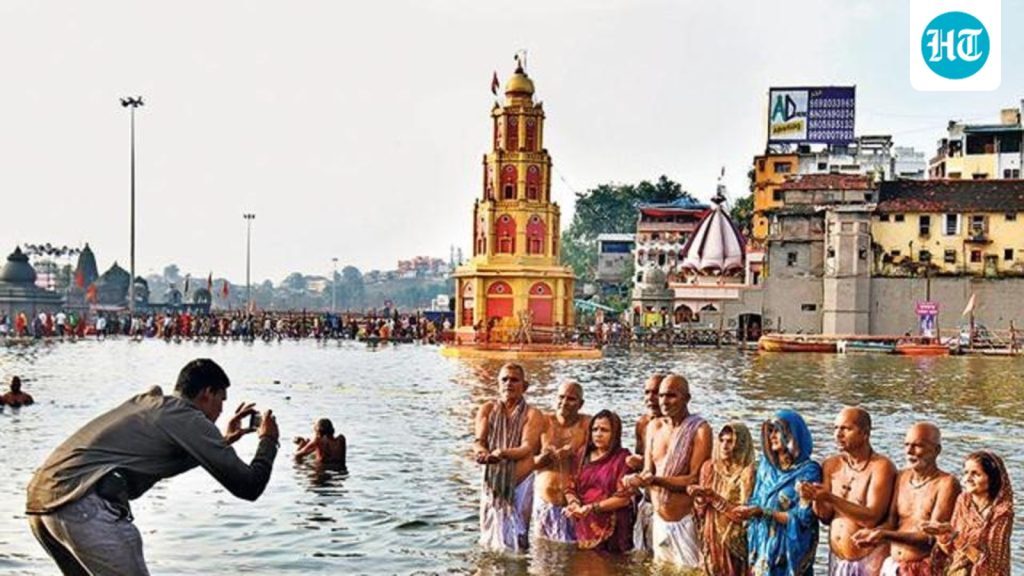
The Vaishnav akhadas bathe at Ramkund, situated on the Godavari in Nashik. The Shaiva akhadas undertake their ritual bath at Kushavarta Tirtha in Trimbakeshwar, which is regarded as the symbolic origin of the river. This dual-centre arrangement makes transport, security and crowd planning especially complex because activity is spread across distinct places rather than concentrated in one pilgrimage zone.
The practice emerged after a violent dispute in 1790 between ascetics from the two traditions over the right to bathe first. The Peshwas stepped in and assigned Ramkund to the Vaishnav akhadas and Kushavarta to the Shaiva akhadas. Mahant Bhakti Charan Das, national spokesperson for the three Vaishnav akhadas, has said that the division has continued ever since.
Preparations for the 2027 gathering have also created an unusual moment of joint engagement. Representatives from all 13 akhadas — three Vaishnav and 10 Shaiva — held a combined meeting with Chief Minister Devendra Fadnavis. The interaction brought together traditions whose principal bathing observances remain geographically separate.
Administrative capacity and political stakes
The event has become an important test of Maharashtra’s ability to coordinate a large-scale religious gathering. It follows the 2025 Maha Kumbh at Prayagraj, where attendance was estimated at 66 crore. Nashik is not seeking to duplicate that model or its footfall, but the comparison has raised expectations around logistics, public facilities and administrative management.
For Fadnavis, the Simhastha also carries political importance. The successful staging of the Maha Kumbh in Prayagraj strengthened Uttar Pradesh Chief Minister Yogi Adityanath’s standing by linking religious leadership with visible administrative execution. Nashik offers Fadnavis a similar opportunity to demonstrate organisational capability and establish a longer political legacy, even as Maharashtra faces concerns linked to drought.
The Nashik-Trimbakeshwar Kumbh Mela Authority, or NTKMA, is the central coordinating body for the mela. It is led by the Nashik divisional commissioner, with Kumbh Mela Commissioner Shekhar Singh serving as member-secretary. Singh previously served as Pimpri-Chinchwad Municipal Commissioner.
The authority’s challenge is not simply to deliver construction projects before 2027. It must align ritual requirements, transport planning, environmental work, accommodation, security systems and the needs of two densely inhabited pilgrimage centres. Success will depend on whether the permanent projects and temporary arrangements function together when the largest crowds begin arriving.
As the sacred flags are raised, the religious calendar and the development calendar now move forward together. The coming months will determine whether Nashik and Trimbakeshwar can turn an ambitious ₹34,732-crore plan into a Simhastha that serves pilgrims while creating durable benefits for the region.
Related Reading
Frequently Asked Questions
What is The Nashik Kumbh?
The Nashik Kumbh is the main topic of this guide. The article explains the context, practical details, and next steps readers should understand.
Why does The Nashik Kumbh matter?
The Nashik Kumbh matters because readers are looking for a useful answer, not just a short summary. Good content should match search intent and help them decide what to do next.