
Supreme Court orders all states to release protesting students under 18, those with no criminal records
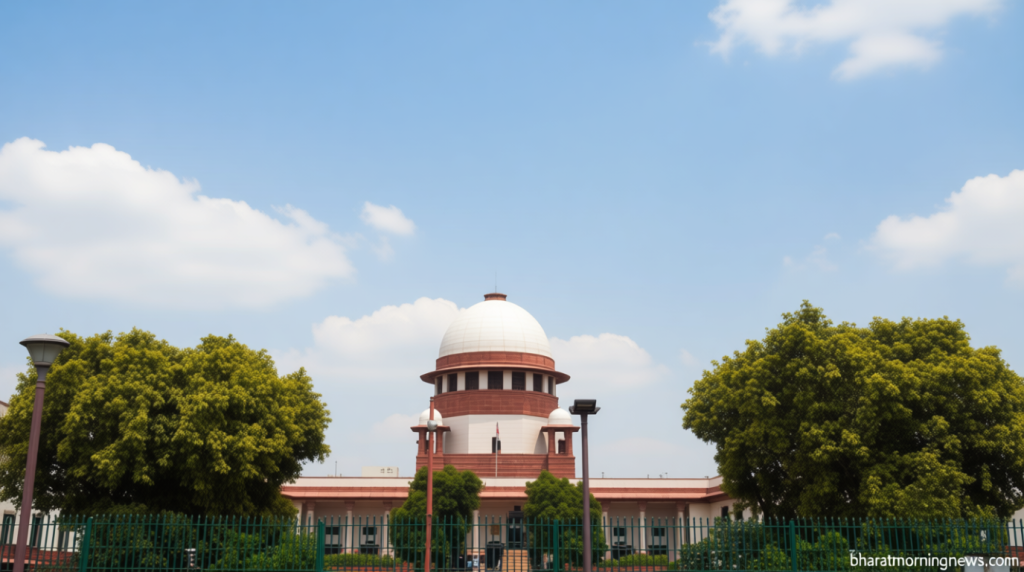
Supreme Court Orders All States to Release NEET Protest Students
Bharatmorningnews.com – The Supreme Court orders all states to immediately release students under 18 years of age who were detained during NEET-related demonstrations. The apex court issued comprehensive directives on Tuesday, mandating that minors involved in the rallies must be freed without delay. Additionally, the bench placed restrictions on law enforcement agencies regarding coercive measures against demonstrators and the disclosure of their personal details.
Chief Justice Surya Kant headed the three-member bench alongside Justices Joymalya Bagchi and V Mohana. While granting interim relief, the court made it clear that this protection would not apply to individuals with prior criminal records or those classified as anti-social elements.
Call for Thorough Inquiry
Notices were issued to the Union government along with chief secretaries from eight states: Delhi, Maharashtra, Bihar, Assam, Kerala, West Bengal, Madhya Pradesh, and Uttar Pradesh. The court emphasized that both allegations of police brutality and violence directed at law enforcement officers necessitate an independent examination.
“The allegations by petitioners make out a prima facie case for an independent probe,” said the bench, adding that the proposed inquiry must also examine complaints by families of injured police personnel.
The judicial order addressed multiple petitions challenging the heavy-handed response during demonstrations related to the NEET examination controversy. These included the July 20 “Sansad Chalo” march in the capital and subsequent rallies in various regions.
Constitutional Protection for Peaceful Protests
During proceedings, the bench noted that student demonstrations enjoy constitutional safeguarding provided they remain non-violent. The Chief Justice highlighted that peaceful student demands fall within permissible limits under the Constitution.
“It was completely a peaceful protest by students raising demands. Such a protest is permissible and protected under the Constitution,” observed the CJI, while cautioning that peaceful demonstrations were often infiltrated by “uninvited guests with agendas”.
The court further remarked that when uninvited participants with separate agendas join peaceful gatherings, they effectively become co-hosts, warranting comprehensive investigation.
Specific Allegations Under Scrutiny
The judiciary reviewed numerous claims including the deployment of pellet guns, electric batons, and lathi charges. Additional allegations involved assaults on female demonstrators and media representatives, alongside accusations that plainclothes police officers participated in violent incidents.
“Use of pellet guns, electric batons and lathi resulting in life-threatening injuries are some of the issues… Excessive use of pellet guns is something that needs to be looked into,” it said.
Concurrently, the court acknowledged reports indicating that over two hundred police personnel sustained injuries throughout the protest period.
Government Response and Future Steps
Solicitor General Tushar Mehta, representing both the central government and Delhi Police, expressed no opposition to an independent investigation. He emphasized that perpetrators causing harm to students must face accountability while attacks on police officials require separate examination.
“If students have suffered in any manner, perpetrators have to be brought to book,” submitted Mehta, while also urging that attacks on police officials be investigated. He suggested that anti-social elements may have infiltrated the demonstrations and said he did not believe students themselves would have engaged in violence.
The bench cautioned against discrediting legitimate peaceful movements and stressed the need for scientific, evidence-based investigations rather than hasty conclusions.
The court indicated plans to establish a high-powered committee capable of examining violent incidents occurring beyond Delhi’s boundaries. Furthermore, the judiciary signaled potential modifications to existing jurisprudence concerning police conduct during public demonstrations.
“The previous judgments with the passage of time may require some modifications… A time has come to collate all these principles and update them,” emphasised the bench, while inviting stakeholders to suggest changes regarding the permissible use of tear gas and other force-control measures.
As interim arrangements, the court ordered the preservation of CCTV footage, drone recordings, body-worn camera videos, wireless communication logs, and PCR call records associated with the protests.