
Smart City Mission funds likely to run out by September, hubs under strain
Smart City Mission Funds Likely to Deplete by September, Hubs Face Uncertain Future
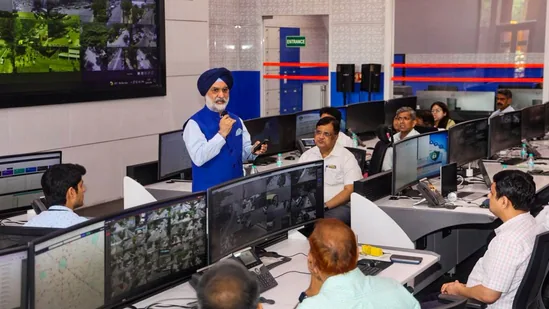
Bharatmorningnews.com – As the Smart City Mission enters its final stretch, concerns are mounting about the exhaustion of its financial resources by September 2024. The initiative, launched in 2015 to modernize urban infrastructure across India, has seen its funding allocation strain under the weight of operational costs. With core systems such as integrated command and control centers (ICCCs) struggling to maintain functionality, the long-term sustainability of these hubs is now in question. The mission’s reliance on state and central grants has left many cities vulnerable to disruptions once the initial funding phase concludes.
Operational Strain and Technical Challenges
Jabalpur, a key city in the mission, has become a case study in financial strain. Its ICCC, initially designed to streamline urban management through advanced digital tools, now operates with limited resources. While the center played a pivotal role during the pandemic by monitoring health data and coordinating emergency responses, its current state reflects a broader issue: the Smart City Mission funds likely to deplete by September, leaving critical systems underfunded. The Intelligent Traffic Management System (ITMS), once a cornerstone of the city’s infrastructure, has been inactive for over a year due to a lack of maintenance support. Technicians report that servers, firewalls, and network components are no longer being serviced, threatening the continuity of essential services.
The situation is compounded by the expiration of a five-year contract with the primary system integrator in August 2024. This has resulted in the dismissal of 46,000 smart streetlights’ maintenance staff, leaving the city without the means to update software or replace aging hardware. Officials warn that without immediate intervention, the ICCC may become a functional relic, unable to support its core operations or adapt to evolving urban demands.
Financial Mismanagement and Revenue Shortfalls
Shivamogga in Karnataka exemplifies the financial challenges faced by many Smart City hubs. Its ICCC, equipped with integrated systems for traffic management, waste monitoring, and GPS tracking, now operates on dwindling resources. Despite generating significant revenue through automated enforcement and penalties, the city’s financial model has failed to allocate these funds back to the infrastructure. This has created a dependency on state grants, which may not be sufficient to sustain the system long-term.
Dehradun’s ICCC has also encountered similar hurdles. While its surveillance network collected ₹40 crore in traffic fines, only ₹11 crore has been disbursed to maintain operations. The city now requires an additional ₹16-17 crore annually to keep its systems running, a demand that many local authorities struggle to meet. Officials highlight that the lack of dedicated funding for software upgrades and hardware replacements has pushed the network to the brink of collapse, jeopardizing data accessibility for emergency services and other critical departments.
“The Smart City Mission funds likely to deplete by September, and we are already seeing the effects of this financial crunch,” remarked a municipal official overseeing Jabalpur’s infrastructure. “Without consistent support, the ICCC may become a white elephant, unable to fulfill its intended role in urban governance.”
Technical staff in several cities have reported that the absence of funding has led to the departure of over 25 skilled personnel. This has left municipal teams understaffed and ill-equipped to manage system failures. In some cases, delayed utility payments have even caused power outages for surveillance systems and traffic cameras, disrupting real-time monitoring and data collection. These issues underscore the need for a more sustainable financial model to ensure the longevity of Smart City initiatives.
Regional Variations and Adaptive Strategies
Despite the challenges, some cities have managed to implement adaptive strategies to preserve their digital frameworks. Rajkot, Vadodara, and Bhopal, for instance, have explored alternative funding sources, including public-private partnerships and revenue from user-generated data. Chennai, another major Smart City, has prioritized maintenance contracts for critical components, ensuring that essential services remain operational. These efforts demonstrate that while the Smart City Mission funds likely to run out by September, proactive measures can mitigate the impact of financial constraints.
However, the majority of cities still rely heavily on state and central grants, which have not kept pace with rising operational costs. The initial phase of the mission focused on infrastructure development, but the transition to long-term maintenance and upgrades has been slow. As a result, many hubs are now operating on a shoestring budget, with officials expressing concern about the mission’s ability to deliver on its promises without additional financial support.
“The Smart City Mission funds likely to deplete by September, and this has exposed the fragility of our urban governance systems,” said an official linked to the Chhatrapati Sambhajinagar project. “We need a long-term budget strategy to ensure that these digital platforms remain functional and relevant.”