
SC awaits Guv’s call on MP minister’s prosecution for Op Sindoor remarks against Colonel
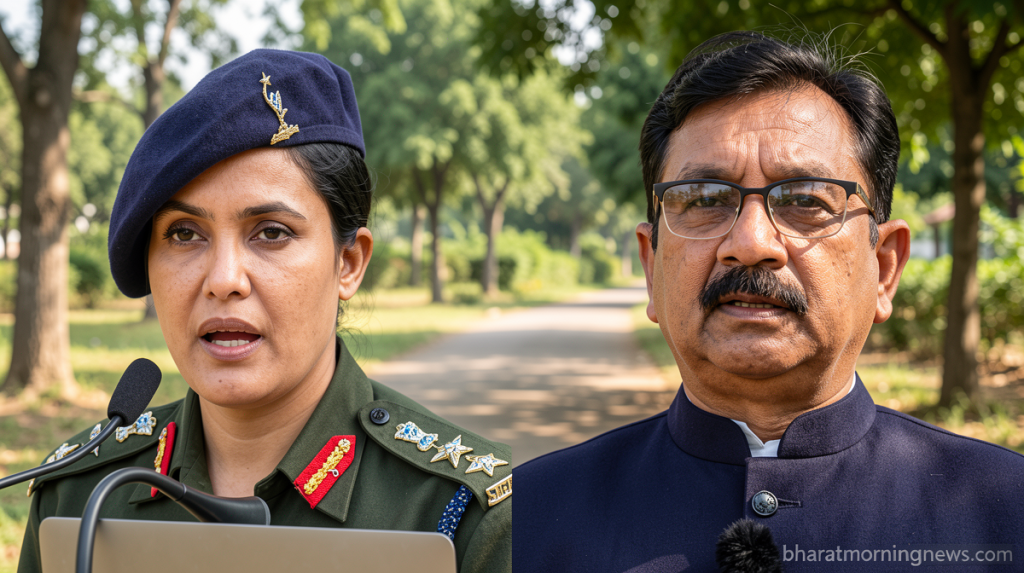
Supreme Court Holds Prosecution of MP Minister in Limbo Pending Governor’s Sanction Call
Bharatmorningnews.com – The apex court on Monday chose to keep the prosecution of Madhya Pradesh state minister Kunwar Vijay Shah on hold, directing that the matter will proceed only once the state governor formally grants or withholds sanction under the country’s new criminal procedure code. The decision came as the bench, led by Chief Justice Surya Kant and joined by Justices Joymalya Bagchi and V Mohana, reviewed the status of a special investigation team’s completed probe into remarks Shah made against Colonel Sofiya Qureshi during Operation Sindoor.
The Sanction Bottleneck
Under section 217(1) of the Bharatiya Nagarik Suraksha Samhita, 2023 (BNSS), a minister enjoys statutory protection from prosecution unless the governor of the state in question grants written sanction. The three-member SIT constituted by the Madhya Pradesh government had finished its investigation and sealed its findings, but the report cannot be placed before a trial court until that executive green light arrives. The SIT had submitted its report to the state government back in August 2025, meaning the sanction request has been sitting in the governor’s office for roughly five months.
In January, the Supreme Court had already given the state government a two-week window to make a final determination. That deadline has now lapsed without a decision. Additional Solicitor General KM Nataraj, appearing on behalf of the state, told the bench that the request had been forwarded to the governor and that a response was expected “in a day or two.”
“The investigation of the SIT is complete and a report has been placed before us in a sealed cover as sanction of the governor is awaited. It is directed that as soon as sanction is granted, the report will be filed before the competent court.”
With that instruction, the bench posted the matter for two weeks, effectively telling the SIT to wait outside the courtroom until the governor’s office issues its verdict.
How the Case Reached the Top Court
The controversy traces back to a public address in Indore where Shah, a senior minister in the BJP-led state cabinet, referred to Colonel Qureshi — the officer who became the public face of India’s Operation Sindoor campaign against Pakistan — as the “sister of terrorists.” The Madhya Pradesh High Court took suo motu notice of the remark and directed registration of a First Information Report against the minister, triggering the SIT investigation.
Shah challenged the high court’s order before the Supreme Court. Senior advocate Maninder Singh, his counsel, argued that the minister had recognised his gaffe almost immediately and offered a public apology the very next day. By the time of the latest hearing, Shah had issued what was described as his fourth apology, underscoring the minister’s repeated attempts to defuse the legal storm.
The SIT’s Position and Procedural Dead End
DIG Kalyan Chakraborty, representing the SIT in court, urged the bench to take the team’s final report on record immediately, arguing that the investigation was finished and the findings should be preserved. The bench declined, explaining that only the competent trial court — not the Supreme Court — has jurisdiction to receive and consider the SIT’s report. Until sanction is granted, the sealed file remains in limbo.
The SIT had earlier informed the court in January that its sanction request had been pending with the state government since August 2025, when the report was first submitted. The prolonged wait has raised questions about how quickly executive sanction decisions are processed under the BNSS framework, particularly when the subject is a sitting minister with political weight.
Why the Sanction Provision Matters
The BNSS, which replaced the century-old Code of Criminal Procedure in 2024, carries forward the long-standing principle that ministers require executive permission before they can be hauled before a criminal court. Section 217(1) codifies this protection, making the governor’s written sanction a precondition for the trial court to take cognizance of offences alleged against a minister. The provision is designed to shield elected representatives from politically motivated prosecutions, but critics note that it can also delay accountability when the sanction decision itself becomes protracted.
In this instance, the delay has stretched across multiple court dates and at least two adjournments. The SIT completed its work, sealed its report, and waited. The state government forwarded the file to the governor. The governor’s office, however, has yet to act. The Supreme Court’s Monday order simply formalises that impasse: the court will not speculate on the outcome, will not open the sealed report, and will not entertain the SIT’s plea to take the findings on record prematurely.
Broader Implications
The case sits at the intersection of ministerial privilege, judicial oversight, and public expectation of accountability. Colonel Qureshi’s role in Operation Sindoor made her a national figure, and remarks perceived as dismissive of her service drew widespread public reaction. The high court’s suo motu intervention signalled that the judiciary viewed the remark as warranting formal investigation rather than mere political debate.
Whether the governor ultimately grants sanction will determine whether Shah faces trial charges, whether the SIT’s findings ever see the light of a courtroom, and whether the BNSS’s ministerial-protection clause functions as a shield or a stall in practice. Until that decision lands, the sealed report remains sealed, the SIT remains on standby, and the Supreme Court remains waiting — two weeks at a time.
Related Reading
Frequently Asked Questions
What is SC awaits Guv s call on MP?
SC awaits Guv s call on MP is the main topic of this guide. The article explains the context, practical details, and next steps readers should understand.
Why does SC awaits Guv s call on MP matter?
SC awaits Guv s call on MP matters because readers are looking for a useful answer, not just a short summary. Good content should match search intent and help them decide what to do next.