
Satya Niketan tragedy: Delhi University colleges open their gates to help students who had to evacuate their PGs
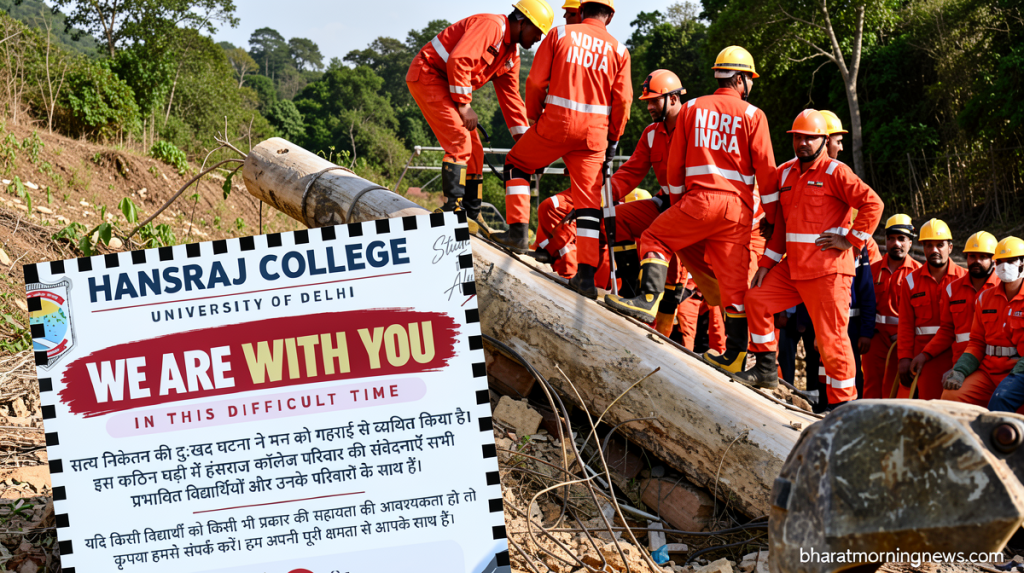
After the Satya Niketan Collapse: Delhi University’s Colleges Become Emergency Shelters for Displaced Students
Bharatmorningnews.com – The capital was thrown into shock on a Sunday afternoon when a multi-storey structure at Satya Niketan gave way, trapping occupants beneath tonnes of concrete and steel. The building had long served as a paying-guest (PG) residence for undergraduate and postgraduate students attending institutions across Delhi University’s South Campus — a dense cluster of colleges where thousands of young people from smaller towns and rural districts live in tightly packed, often informally regulated, shared accommodations. As harrowing photographs and video clips spread across social platforms within hours, a second story emerged alongside the grief: the rapid, improvised mobilisation of nearby DU colleges that opened their gates, dining halls, and hostels to students who suddenly had nowhere to go.
Motilal Nehru College Takes In Around Eighty Students
Among the first institutions to absorb displaced residents was Motilal Nehru College, which sheltered roughly eighty students on the night of the disaster. Aditya Kumar, a second-year undergraduate there, described the chaotic but organised response that unfolded within the college walls.
“Around 80 students took shelter in our college premises that night,” he recounted. “Some of those in nearby buildings were asked to evacuate, and we guided them to make emergency kits. Many of these are first-year students and very new to the city. We’re ensuring that they get proper meals and all essential items of use. Some of them were so shaken that day that they couldn’t even dial up their parents, so we helped them contact their homes and inform that they are safe.”
The scene he described — frightened first-years, many of whom had arrived in Delhi only weeks earlier and knew no one locally — captures a recurring vulnerability of the PG system. Students who cannot afford university hostels or family housing in the capital often settle into informal arrangements where oversight is minimal and structural safety is rarely verified. When a building fails, those residents have no institutional safety net behind them. In this case, that net was stitched together overnight by fellow students and college staff.
Sri Venkateswara and ARSD Colleges Close Classes to Offer Shelter
Two other South Campus institutions — Atma Ram Sanatan Dharma (ARSD) College and Sri Venkateswara College — went a step further by suspending all Monday classes entirely, freeing up lecture halls, common rooms, and hostel blocks for displaced occupants. Sanjay Sahu, president of the Students’ Union at Sri Venkateswara, outlined the scale of the operation.
“We arranged dinner and night stay for around 50 girls and 40 boys on Sunday night, which included volunteers from our college. We also provided all the students with lunch on Monday afternoon, and will continue to help them for as long as its needed. Everyone in our college is coming forward to help, including the hostel staff. We are hopeful that the number of students coming in will decrease, as most of them are going back to their hometown or shifting in with their local guardians or relatives. But incase the number increases, then we might need more volunteers.”
The decision to cancel an entire day of teaching underscores how the academic calendar bent to human need. For colleges that operate on fixed timetables and examination schedules, such a closure carries administrative weight; yet the choice was made without hesitation.
Jesus and Mary College Runs Donation Drives Alongside Shelter
At Jesus and Mary College (JMC), the response combined immediate shelter with longer-term material support. Emili Yolmo, president of the JMC Students’ Council, explained that nine to ten students spent the night of the incident within the college compound.
“On the night of the incident, we had 9-10 students staying with us in the college. We’re providing them food, clothing, and all the basic amenities. Our college’s societies are even conducting donation drives to collect mainly blankets, bedsheets, and towels that can be used by these students.”
The involvement of student societies in collecting textiles and bedding reflects a grassroots logistics effort that no single administrative office could have organised in hours. It also highlights a gap: displaced PG residents often lack even basic linens and warm clothing, items that become critical when one is suddenly sleeping in a communal hall rather than a private room.
Hansraj and Lady Shri Ram Extend Institutional Support
Principal Rama of Hansraj College framed the response in explicitly university-wide terms, emphasising that institutional loyalty transcends campus geography.
“Bachhe chahe South Campus ke ho ya North ke, sab hain toh humari university ke hi… As soon as the news came in, our NSS students rushed to the site to help. We’ve even posted contact numbers on our social media account so that anyone in need can approach us. If anyone needs help, we’re eagerly available to provide counsellors to aid those youngsters who are under trauma after having witnessed such an ordeal.”
The deployment of National Service Scheme (NSS) volunteers to the collapse site within hours of the incident illustrates how structured student-service programmes can convert into rapid disaster-response assets. The offer of counsellors, meanwhile, points to a less visible but equally urgent need: psychological first aid for students who watched a structure crumble metres from their own beds.
Kanika K Ahuja, Principal of Lady Shri Ram College for Women, added a personal dimension to the institutional response. The college had arranged beds for ten to fifteen displaced students. More poignantly, the institution’s own counsellor had been residing in the building immediately adjacent to the one that collapsed.
“We have made an arrangement for accommodation of 10 to 15 students in our college. Our own college counsellor lived in the building right next to the one that collapsed… All of us are in this together.”
Human Toll and the Road Ahead
As of Monday afternoon, rescue operations had drawn twelve survivors from the rubble while seven deaths had been confirmed. The final toll remained uncertain, and families across the country waited for word. For the students now sleeping in college corridors and dining halls, the immediate crisis of shelter was being addressed; the longer questions — structural regulation of PG buildings, liability of landlords, insurance coverage for informal tenancies, and the mental-health aftermath of witnessing a collapse — would require sustained institutional and governmental attention.
What the colleges demonstrated over those forty-eight hours, however, was something harder to legislate: that a university is not merely a collection of examination centres but a community that, when its youngest members are in peril, opens its doors and stays awake.
Related Reading
Frequently Asked Questions
What is Satya Niketan tragedy?
Satya Niketan tragedy is the main topic of this guide. The article explains the context, practical details, and next steps readers should understand.
Why does Satya Niketan tragedy matter?
Satya Niketan tragedy matters because readers are looking for a useful answer, not just a short summary. Good content should match search intent and help them decide what to do next.