
‘I felt like a foreigner’: Traveller questions health self-declaration form at Mumbai airport
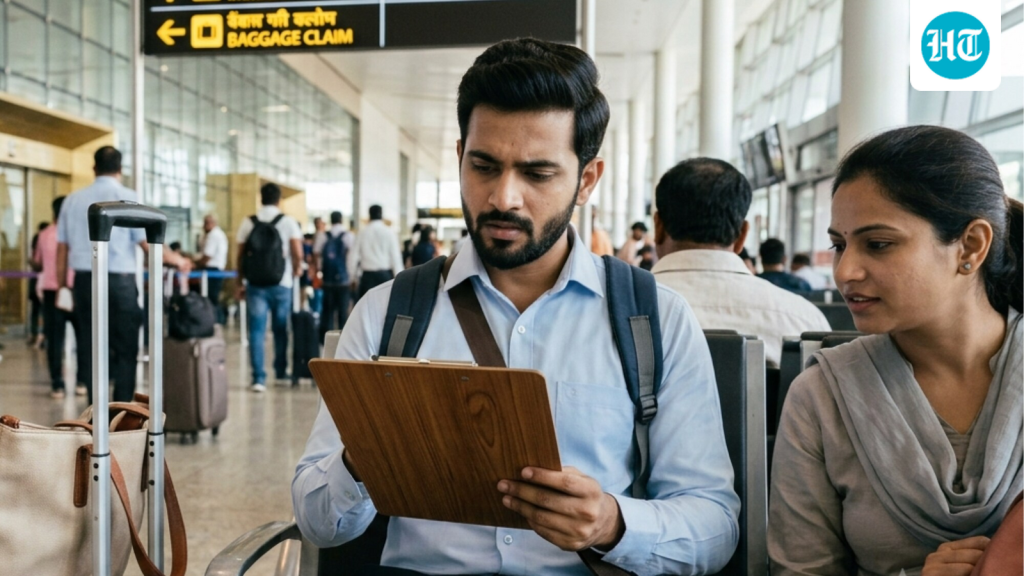
Traveller Raises Questions Over Mumbai Airport Health Declaration Requirement
Bharatmorningnews.com – A long international journey ended with an unexpected extra step for one passenger arriving in Mumbai: completing an online health self-declaration before reaching immigration. The traveller, Abhimanyu Kulkarni, said the requirement left him feeling less like a returning Indian resident and more like a visitor navigating unfamiliar entry procedures.
Kulkarni shared his experience on X after travelling from the Netherlands to Mumbai. His trip began in Eindhoven at 7 am, followed by an 11:45 am departure from Amsterdam. He arrived in Mumbai at 12:20 pm, bringing his travel time to nearly 18 hours.
“Nothing reminds you that you’re back in India faster than landing at an Indian airport.”
After such a lengthy route, Kulkarni had expected the immigration stage to be relatively simple. Instead, he said Indian travellers were directed to complete a Self Declaration Form through an online link before immigration processing.
Information requested from arriving passengers
The digital form asks passengers for information including their name, flight details, country of origin, Indian address and recent travel history. It also includes a question on whether the person has travelled through an African country.
Kulkarni’s main concern was the apparent duplication of information. Passports and airline records already contain some of the details requested, and he questioned why passengers needed to enter them once more after landing.
His post also focused on the practical difficulties involved. A person who has spent many hours in transit may have limited phone battery, patchy connectivity or trouble locating the required link. The process could be more challenging for elderly passengers, adults travelling with young children, and people dealing with fatigue after overnight flights.
For many arriving passengers, airport procedures are not merely administrative tasks. They occur at the end of long queues, baggage collection, customs checks and unfamiliar terminal navigation. Even a short online form can feel inconvenient when it is introduced at a point where travellers expect to proceed directly to passport control.
Part of health-screening process
The declaration is linked to India’s health-screening measures for international arrivals rather than routine immigration documentation. AIR SUVIDHA 2.0 was launched in June 2026 following the Ebola outbreak and requires travellers to provide details connected to recent movement and health-related screening.
Such declarations can help authorities identify passengers who may need additional attention during a public-health response. Travel history can be relevant when officials are monitoring a disease outbreak in a particular region, particularly where symptoms may develop after a person has travelled.
At the same time, Kulkarni’s post highlighted a recurring question for travellers: how can health safeguards be implemented without making arrivals more difficult for people who have already completed airline and border formalities? Digital systems can speed up processing when travellers receive clear instructions in advance, but they can cause delays if passengers first encounter them after landing.
International passengers often provide personal and travel information at several stages of a journey, including booking, check-in, boarding and border entry. The purpose of each request may differ, even when some fields appear similar. Airline data is used for operational and travel purposes, while an airport health declaration may be intended for screening and public-health follow-up.
Online reaction split over the form
Responses to Kulkarni’s post reflected sharply different views. Some social-media users felt the form was a reasonable precaution given the health context, while others agreed that it was an unnecessary burden for exhausted arrivals.
One user pointed out that the document was not meant for immigration processing and connected it to concerns over Ebola in Africa. The commenter added that completing it generally takes only a couple of minutes.
“It’s not for immigration, it’s for the recent Ebola outbreak in Africa.”
Another response took a more humorous view of the complaint, suggesting that airport crowds and poor queue discipline were a more familiar sign of being back in India than filling out a form.
“Filling a form reminds you you’re back? I thought it’s the people cutting lines, pushing & lacking basic civic sense that should have reminded you already.”
Some users said the requirement had existed for months and noted that paper versions may be available at certain airports. That option may matter for passengers who do not have a working smartphone, internet access or comfort with online forms.
Not every traveller described Mumbai immigration as slow or frustrating. One passenger said they had received the form while boarding in London, rather than after arrival, and considered Mumbai’s immigration experience quicker than the processes at Amsterdam and London airports.
Another commenter backed Kulkarni’s criticism without qualification.
“Completely agree. Such a ridiculous rule.”
Why timing and communication matter
The debate is not only about whether a health declaration should exist, but also about when and how it is completed. Sending the form before boarding or during the flight could allow passengers to finish it before joining immigration lines. Clear signs, staff assistance and accessible paper alternatives can also reduce confusion at the terminal.
For families, older travellers and those arriving after extended connections, predictability can make a substantial difference. Knowing in advance that a declaration is required allows passengers to prepare their travel details and avoid searching for information while standing in a queue.
Kulkarni’s post drew attention to the gap that can emerge between a policy’s public-health objective and the experience of the people required to follow it. Health checks may serve an important screening purpose, yet passengers are likely to judge the system through its convenience, clarity and effect on their arrival process.
The discussion remains rooted in personal accounts shared online, with differing experiences suggesting that the process may not feel identical for every international traveller. For those arriving in Mumbai from abroad, the self-declaration form has become one more part of the journey home.
Related Reading
Frequently Asked Questions
What is I felt like a foreigner?
I felt like a foreigner is the main topic of this guide. The article explains the context, practical details, and next steps readers should understand.
Why does I felt like a foreigner matter?
I felt like a foreigner matters because readers are looking for a useful answer, not just a short summary. Good content should match search intent and help them decide what to do next.