
Congress flags ‘discrepancies’ in BJP-backed Nathwani’s RS poll nomination papers; files complaint
Congress Flags Discrepancies in BJP-Backed Nathwani’s RS Poll Nomination Papers
Bharatmorningnews.com – In a significant development, the Congress party has raised concerns over alleged discrepancies in the nomination papers of Parimal Nathwani, a BJP-backed candidate for the Rajya Sabha election in Jharkhand. The party filed a formal complaint with the returning officer, challenging the validity of Nathwani’s documents. This move highlights the ongoing scrutiny of BJP-supported candidates in the upper house polls, as political parties vie for strategic advantages in the race.
The Nomination Process and Key Concerns
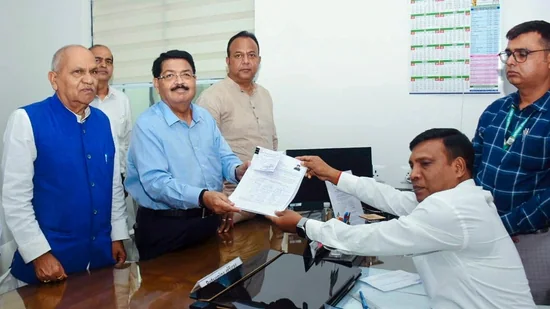
Parimal Nathwani, currently a member of the Rajya Sabha representing Andhra Pradesh, submitted his nomination for one of Jharkhand’s two Rajya Sabha seats on Monday. He was joined by JMM candidate Baidyanath Ram and Congress nominee Pranav Jha during the filing process. The nomination papers, which are crucial for validating a candidate’s eligibility, were scrutinized by the electoral commission, revealing inconsistencies that led to the Congress’ intervention.
The BJP’s backing of Nathwani has been central to the debate, with critics arguing that the party’s influence may be altering the integrity of the process. The returning officer, Ranjit Kumar, initially paused Nathwani’s nomination, granting him until Wednesday at 11 am to resolve the issues. This delay raised questions about the transparency of the selection and the standards applied to BJP-supported candidates versus those from other parties.
Political Implications and the Hearing
According to Congress MLA Naman Bixal Kongari, the scrutiny process uncovered multiple inconsistencies in Nathwani’s paperwork, including a name error. As the proposer for their candidate Pranav Jha, Kongari submitted the complaint before the scrutiny phase, emphasizing the party’s commitment to upholding electoral norms. The Congress observer for the Rajya Sabha polls in Jharkhand, Bhupesh Baghel, noted on X that the discrepancy had been reported and a hearing on the complaint was underway.
Baghel’s remarks underscored the broader implications of the case, suggesting that the BJP’s backing might be a decisive factor in Nathwani’s continued candidacy. He questioned whether the same scrutiny would be applied to other BJP-supported candidates, hinting at potential ethical concerns. Meanwhile, Nathwani’s associates claimed the objections raised had already been resolved, pointing to the last date for withdrawing nominations, June 11, and the upcoming polling on June 18.
The Rajya Sabha elections in Jharkhand are pivotal for shaping the upper house’s composition, with each candidate needing at least 28 first-preference votes to secure a seat. The Congress’ complaint adds another layer to the competition, as the party seeks to challenge the BJP’s dominance in the state. The case has sparked discussions about the fairness of the nomination process and the role of party alliances in influencing electoral outcomes.
Political Landscape and Party Dynamics
The Jharkhand Assembly is a microcosm of the state’s political alignment, with the INDIA bloc holding 56 seats. This bloc is composed of 34 seats for the Jharkhand Mukti Morcha (JMM), 16 for Congress, and four each for the Rashtriya Janata Dal (RJD) and CPI(ML) Liberation. The National Democratic Alliance (NDA), which includes 24 MLAs, is led by the BJP with 21 seats, while the LJP (Ram Vilas) and JD(U) each contribute one MLA. The Jharkhand Loktantrik Krantikari Morcha (Jharkhand Loktantrik Krantikari Morcha) holds a single MLA, underscoring the fractured political landscape.
The BJP’s support for Nathwani is part of a larger strategy to consolidate its influence in Jharkhand, where it has historically struggled to gain traction. By backing Independent candidates like Nathwani, the party aims to maximize its representation in the Rajya Sabha without directly allocating seats. However, this approach has drawn criticism from opposition parties, who argue that such candidates may receive preferential treatment in the nomination process.
As the elections approach, the Congress’ complaint could impact the final outcome, particularly if the discrepancies are upheld. The party’s actions reflect its determination to ensure that the BJP’s backing does not compromise the fairness of the polls. This case is likely to become a focal point in the broader debate about the integrity of the electoral process and the role of party alliances in shaping it.