
Caste bias has made empathy impossible
When Equality Is Read Without History
Bharatmorningnews.com – India’s debate over reservation is often framed as a contest between merit and social justice. That framing, however, obscures a more fundamental question: can a society shaped by caste hierarchy treat opportunity as if everyone begins from the same place?
The Constitution’s early years brought this conflict sharply into view. India’s founding document, the world’s longest written constitution, was drafted over 165 sittings across almost three years. Yet within six months of its coming into force, a legal challenge exposed the tension between formal equality and the State’s obligation to repair entrenched disadvantage.
A Challenge from Madras
Champakam Dorairajan, a 35-year-old Brahmin woman from Tamil Nadu, had obtained a science degree from the University of Madras in 1934. Financial constraints prevented her from pursuing medicine at the time. When she returned to that ambition 15 years later, admissions to medical colleges in Madras were governed by an order that distributed seats among communities on the basis of caste population.
Before submitting an application, Dorairajan challenged the arrangement before the Madras High Court. She was joined by CR Srinivasan, a Brahmin student seeking entry into an engineering programme. Their case questioned whether caste-based allocation of educational seats could survive the Constitution’s guarantees of equality.
The High Court invalidated the communal order, and the Supreme Court upheld that decision in 1951. The Court held that admission could not be determined by religion, race or caste. Its approach placed a strict reading of fundamental rights above the directive principles that urge the State to promote social welfare.
The result was consequential. By striking at the legal basis for reservation, the judgment created a constitutional impasse at a time when exclusion from education and public life remained deeply tied to caste. The response was the Constitution’s First Amendment, which included a provision intended to safeguard affirmative action.
Ambedkar’s Warning
BR Ambedkar, then law minister, strongly disagreed with the judgment’s separation of caste from merit. In parliamentary debate, he argued that caste was not an incidental identity that could simply be ignored when assessing access and opportunity.
“Every Hindu has a caste — he is either a Brahmin or a Mahratta or a Kunby or a Kumbhar or a carpenter. There is no Hindu — that is the fundamental proposition — who has not a caste,” he said in Parliament.
Ambedkar’s observation remains central to understanding the reservation debate. A claim to neutrality may appear fair in principle, but it can preserve inequality when social networks, educational access and inherited standing have already been distributed unequally over generations.
The Persistent Fiction of a Level Field
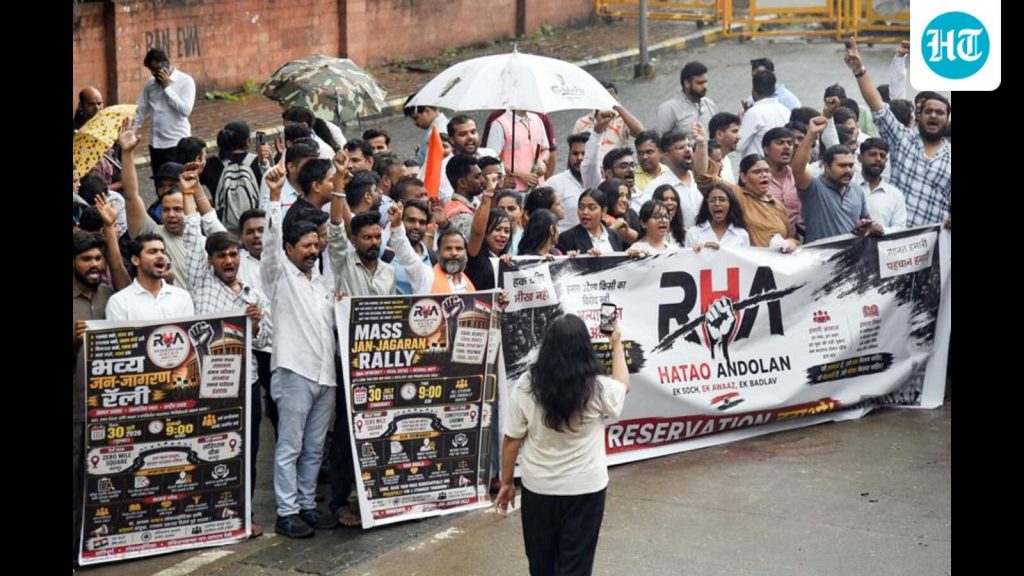
More than seven decades later, reservation continues to provoke anger among sections of the upper castes. The increased visibility, political influence and upward movement of some marginalised communities have not erased that resentment; in many cases, they have made it more rigid.
Public opposition has repeatedly presented reservation as the enemy of merit. The country has seen a medical student set himself on fire in protest against the Mandal mandate, while women students demonstrated for the imagined employment prospects of their future husbands. Such episodes showed how readily anxiety about status can be translated into a language of merit.
Yet caste has not disappeared from the institutions where merit is supposedly measured. Birth and community still affect access to schools and universities, the likelihood of receiving job-interview callbacks, personal relationships, housing and even burial grounds. These realities make it difficult to claim that competitive examinations or admissions processes operate in a vacuum.
The contradictions become clearer when reservation is available to economically weaker sections among upper-caste groups. This route is, in effect, an upper-caste quota, but it has not attracted the same dismissive label of “quota student” that is applied to beneficiaries from historically marginalised communities. The unequal stigma reveals that the argument is often less about opposition to quotas in general than about who is considered entitled to support.
Networks Are Also Advantages
Dominant communities that once resisted reservation have themselves sought quotas. Their demands underline a truth that public discussion frequently avoids: opportunities are not created solely by individual effort. Family connections, social references, familiarity with institutions and collective mobility can all ease a person’s path.
Harvard historian Ajantha Subramanian has examined the way caste and merit are made to appear naturally connected. This idea encourages the belief that identity politics belongs mainly to the marginalised, while those who benefit from caste privilege can imagine themselves beyond caste altogether.
That belief is powerful because it transforms inherited advantage into personal achievement. It also permits discrimination to be recast as a grievance against reservation. In this inverted narrative, the people who have faced structural exclusion become the visible symbol of unfairness, while the systems that favour others remain unnamed.
Beyond Electoral Symbolism
Political parties have often supported reservation because electoral realities leave them little choice. Their record, however, raises doubts about the depth of that commitment. Reserved posts are not always filled transparently, and many campuses still fail to provide an environment in which marginalised students can flourish.
The limits of political representation are visible as well. Parties led largely by upper-caste politicians seldom field Dalit candidates outside constituencies reserved for them. Social justice then becomes an electoral emblem rather than a sustained project of rebuilding institutions and redistributing dignity.
This mixture of ignorance, prejudice and political convenience has widened social distance. It is entirely possible for an upper-caste Indian to move through life without a Dalit friend, colleague, partner or housemate, and without sharing in a Dalit family’s grief. Such separation makes empathy difficult because exclusion is experienced as an abstraction rather than a lived reality.
Reservation cannot by itself dismantle caste. But treating it as the central source of discrimination misunderstands the problem. The deeper challenge is to recognise how caste continues to organise access, status and belonging, even when its influence is denied. A serious commitment to equality requires more than insisting on formal neutrality; it requires confronting the unequal world in which merit is judged.
Related Reading
Frequently Asked Questions
What is Caste bias has made empathy impossible?
Caste bias has made empathy impossible is the main topic of this guide. The article explains the context, practical details, and next steps readers should understand.
Why does Caste bias has made empathy impossible matter?
Caste bias has made empathy impossible matters because readers are looking for a useful answer, not just a short summary. Good content should match search intent and help them decide what to do next.