
BAPS goes to Paris
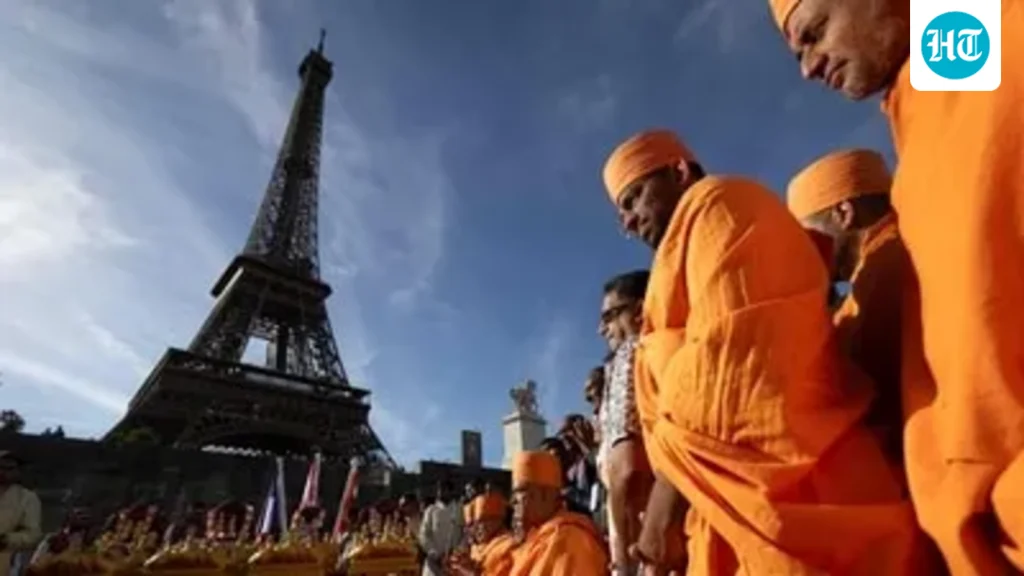
BAPS Goes to Paris: A Debate Over Faith and Women’s Equality
Bharatmorningnews.com – BAPS goes to Paris, and a planned visit to the Eiffel Tower by monks linked to the Bochasanwasi Akshar Purushottam Swaminarayan Sanstha has sparked a wider debate about religious accommodation, public workplaces and women’s equality. The visit followed the consecration of a BAPS temple in a Paris suburb, with about 100 people associated with the organisation expected to visit the landmark on a Saturday morning.
The Eiffel Tower’s operating company said that arrangements had been requested to limit interactions with women. BAPS said on social media that, to the best of its knowledge, no visitor had been refused entry. Yet women employees were reportedly asked to remain out of sight during the monks’ visit, turning a travel arrangement into a national controversy.
Staff responded with a strike, and the Eiffel Tower was closed on Monday. Union representative Diane Davoine said female employees had been humiliated after being instructed to leave their workstations. What began as a dispute over one group’s visit therefore raised a broader question: how far can a public institution go in accommodating religious practices?
When Public Accommodation Becomes Exclusion
French political leaders across ideological lines objected to the reported treatment of women workers. Former prime minister Gabriel Attal argued that faith and custom cannot determine women’s place in society.
“In France, no culture, no belief, no worship, nothing nor anyone can come to dictate to women their place.”
Marine Le Pen also said that France should not accept restrictions on women’s presence. While such reactions may contain national political posturing, the principle behind them deserves serious consideration. Public facilities can reasonably accommodate disability access, dietary needs, security requirements and religious observance. Asking women to become less visible in their own workplace is a different matter altogether.
Tourist landmarks, museums, transport hubs and civic buildings are shared spaces. Their employees should be able to carry out their ordinary duties without being treated as an obstacle to another person’s religious discipline. Accommodation should help people participate in public life; it should not require others to withdraw from it.
Celibacy and Personal Responsibility
BAPS monks follow a particularly strict celibate discipline, including practices intended to avoid physical contact with women. The organisation has described how Pramukh Swami, after accidentally blessing a girl in 1986, took a ritual bath at the nearest river and fasted that night. Before a cataract operation in Boston in 1980, he reportedly requested that women nurses not be present, even while he was unconscious.
Individuals are entitled to follow demanding religious codes, including celibacy. The difficulty arises when a personal vow imposes costs on people who did not make it. A man’s commitment to avoid contact with women cannot reasonably require women to leave a reception desk, workplace or public monument.
The core issue in the BAPS goes to Paris debate is not whether monks may practise their faith. It is whether religious discipline can be maintained by limiting women’s movement, visibility or participation. If avoiding women is necessary for a vow, responsibility for that avoidance should remain with the person who made the vow.
A Pattern Beyond One Eiffel Tower Visit
Similar concerns have surfaced at BAPS events, where women are often seated at the back so that monks do not see them. The organisation has also recounted an occasion when Swamiji declined to serve as chief guest at an event honouring blood donors because women required to sit in the rear might resent BAPS. That concern recognised the possible hurt, but not the unequal arrangement creating it.
At a 2024 gathering of chartered accountants in Kolkata, women already seated in the front rows were asked to move before a BAPS-affiliated religious leader spoke. Such incidents explain why the Paris episode cannot be dismissed as a misunderstanding involving a single tourist group. The recurring question is whether women must alter their ordinary participation so that men can preserve a chosen separation.
BAPS goes to Paris has consequently become a useful test of the limits of accommodation. Religious freedom matters, but it cannot mean shifting the burden of religious practice onto women employees or excluding them from public space. Equality in shared institutions requires that women remain fully present, visible and free to do their work.
FAQ: What Does the Paris Controversy Mean?
What happened during the BAPS visit to the Eiffel Tower?
Women employees were reportedly asked to remain out of view during a planned visit by BAPS monks. The Eiffel Tower’s operating company said arrangements had been sought to reduce interactions with women, while BAPS said it was unaware of anyone being denied entry.
Why did Eiffel Tower staff strike?
Staff began a strike after female workers were reportedly told to leave their workstations. Union representative Diane Davoine said the women had been humiliated by the request.
Can public institutions accommodate religious practices?
Yes, practical accommodations are often possible. However, accommodation becomes problematic when it prevents workers, especially women, from carrying out their normal roles or participating equally in a public space.