
Assam floods: Death toll touches 47; CM Sarma says 70-80 people still missing
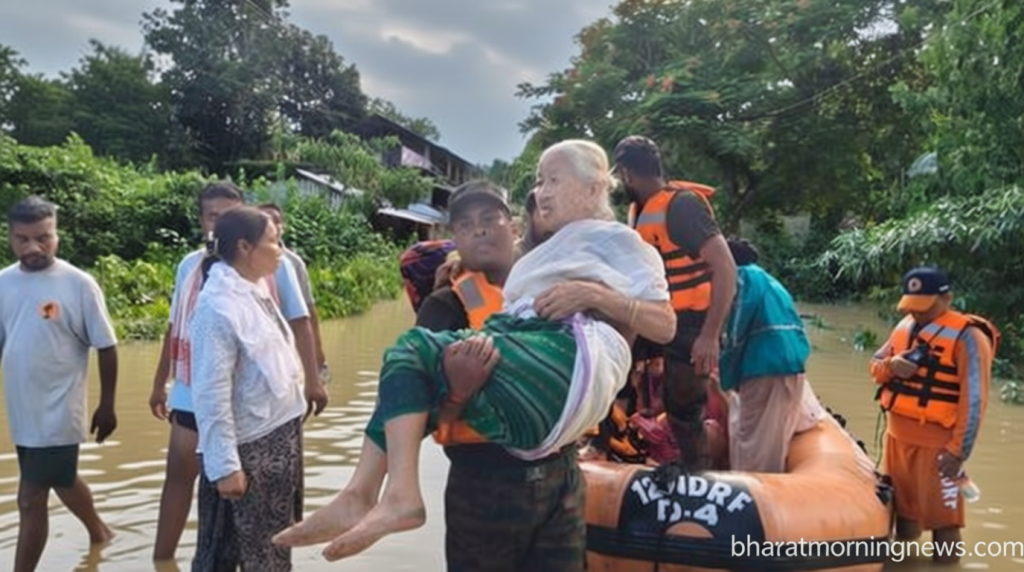
Assam Floods: Death Toll Hits 47, 70-80 Still Missing
Bharatmorningnews.com – The devastating Assam floods have claimed 47 lives so far, according to official confirmation received on Thursday. This grim total comes after six additional fatalities were reported across the state, bringing the human cost of the disaster to a significant level. The latest deaths were recorded in two heavily affected districts—Sivasagar and Charaideo—marking these areas as the epicenter of the crisis. As rescue operations continue around the clock, officials warn that the situation remains fluid and the death toll could climb further in the coming days.
Chief Minister Himanta Biswa Sarma provided a sobering update during his visit to the flood-affected regions, revealing that between 70 and 80 people are still unaccounted for. These missing individuals are believed to be trapped in submerged areas or swept away by the raging waters. While the Assam State Disaster Management Authority (ASDMA) has not yet officially verified the exact number of missing persons, the Chief Minister’s figures paint a concerning picture of the scale of the disaster.
“In Sivasagar, nearly 70 are missing and overall, at least 80 are missing and the number of deaths may rise in the upcoming days,” Chief Minister Sarma stated during his field visit.
Relief Operations and Humanitarian Response
In a move to support grieving families, the Chief Minister announced an ex gratia payment of ₹4 lakh for each household that has lost a member in the Assam floods. This financial assistance is part of a broader relief package being rolled out to affected communities. The ASDMA’s comprehensive assessment reveals that 721,024 residents across 37 revenue circles in 13 districts have been directly impacted by the flooding. Among these affected populations, 24,124 individuals have been relocated to relief camps where they are receiving food, shelter, and medical care.
The disaster has also taken a heavy toll on livestock and agriculture. Approximately 3.71 lakh domestic animals have either been affected or completely swept away by the rising floodwaters, devastating the livelihoods of farmers and herders. Agricultural losses are equally severe, with more than 25,375 hectares of productive farmland remaining submerged under the relentless floodwaters, threatening food security in the region.
Multi-Agency Rescue Efforts Underway
The Indian Army has been at the forefront of rescue operations under Operation Jal Rahat, successfully saving over 1,000 stranded individuals from the floodwaters. Many of those rescued also received immediate medical attention at field hospitals set up in the affected areas.
“Over 1,000 people have been rescued, more than 200 have received medical assistance, and essential relief supplies have been distributed to affected communities,” the army reported, highlighting ongoing efforts to restore critical connectivity and support the revival of essential services.
The army’s Flood Relief Columns of the Red Shield Division under Spear Corps continue their operations across Sivasagar, Charaideo, and Jorhat districts, ensuring that remote areas are not left behind. Rescue efforts in the Assam floods involve a coordinated response from multiple agencies including the National Disaster Response Force (NDRF), State Disaster Response Force (SDRF), Assam Rifles, and Fire and Emergency Services. Security forces have evacuated 24,458 people so far, with Indian Air Force helicopters playing a crucial role in aerial rescues and supply drops.
Understanding the Causes and Future Preparedness
According to Chief Minister Sarma, the severe flooding in Upper Assam was triggered by intense rainfall in both Assam and neighboring Nagaland. The Chief Minister has outlined plans for structured dialogue with adjacent states once the immediate emergency subsides. These discussions aim to strengthen coordination mechanisms against upstream cloudbursts and similar disasters that frequently affect the region.
“We mostly have plains while most of the neighbouring states, be it Arunachal Pradesh, Nagaland, Manipur, Meghalaya or others, are hill states. When it rains there, the water comes down to our side, causing floods,” he explained, highlighting the geographical vulnerability of the region.
The ASDMA reported that several major rivers—including Buridihing, Dikhou, Disang, Dhansiri, and Kushiyara—are currently flowing above their danger levels, posing a continued threat to communities along their banks. Infrastructure damage is significant, with over 400 concrete structures damaged and 1,848 houses partially destroyed by the relentless floodwaters. As the Assam floods continue to unfold, authorities are working tirelessly to minimize further loss of life and property while preparing for potential escalation of the crisis.