
An old SpaceX rocket is about to crash into the Moon
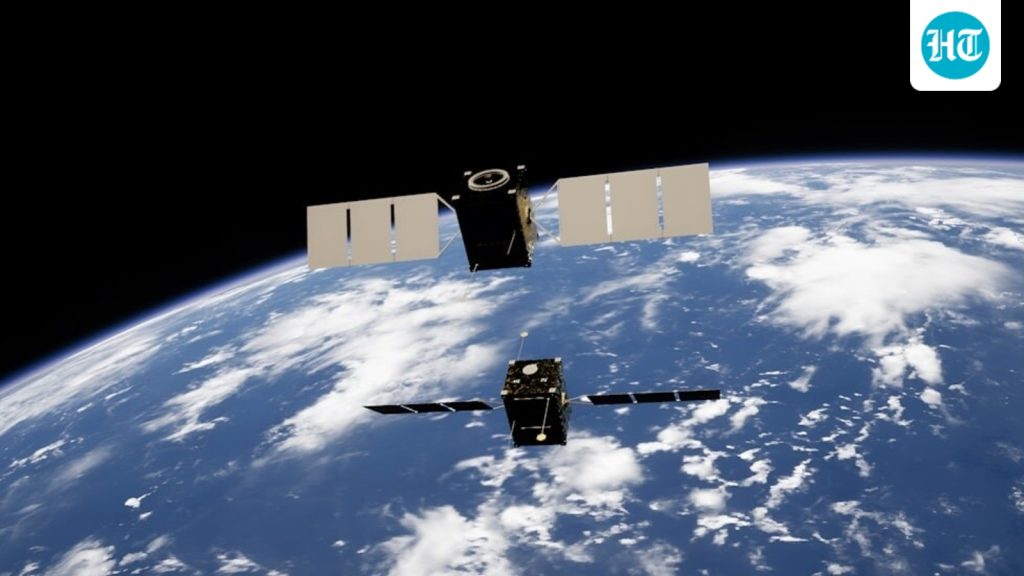
SpaceX’s Discarded Rocket Stage Set for Lunar Collision
Bharatmorningnews.com – On August 5th, a Falcon 9 upper stage from SpaceX will slam into the Moon’s surface at approximately 8,700 kilometers per hour—equivalent to 5,400 miles per hour. This collision represents more than just another piece of space debris returning to a celestial body; it offers scientists an unprecedented opportunity to study lunar impacts with precision.
From Lunar Mission to Moon-Bound Wanderer
Back in January 2025, this same rocket section had served its purpose by launching two lunar landers toward their destination. However, rather than following the typical fate of discarded rocket stages, this one found itself trapped in a trajectory that would eventually bring it crashing down onto the Moon.
Most spent rocket stages are left in low-Earth orbit, where residual atmospheric particles gradually slow them until they tumble back to Earth and burn up during re-entry. This particular stage, however, was propelled far enough away that atmospheric drag could not capture it. Bill Gray, an astronomer based in Maine, was the first to identify that this rocket was destined for the Moon.
A Scientific Gift Wrapped in Carelessness
Gray noted that the incident highlights a “certain carelessness” regarding the disposal of space hardware. The rocket’s projected path initially raised concerns that it might pass close enough to a South Korean lunar satellite to create potential hazards.
Yet this seemingly careless trajectory has proven to be a scientific blessing. Since 1999, researchers have documented only a few hundred meteoroid impacts on the lunar surface. Because these space rocks arrive unpredictably and their exact sizes remain unknown, scientists have relied on measuring the brightness and duration of impact flashes to estimate dimensions.
The Falcon 9’s upper stage changes this equation entirely. Weighing 4,000 kilograms with precisely known dimensions, it provides astronomers with a controlled impact event. The advance warning allows them to calibrate their historical measurements with unprecedented accuracy.
Where the Rocket Will Strike Matters
The collision will occur on the Moon’s sunlit side, though the exact landing spot remains somewhat uncertain. Over months of travel through space, the faint pressure from solar radiation has gradually shifted the rocket’s orbit, potentially moving the impact point by several kilometers.
This positional uncertainty carries scientific significance. Should the rocket strike hard lunar bedrock, the resulting flash might be too dim for detection. Conversely, if it impacts the softer dust covering much of the Moon’s surface, the flash should be bright enough for Earth-based telescopes to observe clearly.
Debris Plume Offers New Research Opportunities
The visual flash represents only part of the scientific value. Benjamin Fernando, an astronomer at Los Alamos National Laboratory and lead author of a preprint paper published on July 16th, emphasized the unique nature of this event.
“We’ve never seen an ejecta plume like this on the lunar surface before,” Fernando stated.
The massive rocket will likely send debris soaring high above the lunar surface, where sunlight illuminates the particles against the dark backdrop of space. These conditions enable researchers to track debris trajectories and analyze composition through reflected light patterns.
Implications for Future Lunar Exploration
Understanding how lunar material responds to impacts extends beyond academic curiosity. NASA’s Artemis IV mission, currently scheduled for early 2028, will mark the first crewed Moon landing since 1972. The United States aims to establish a permanent research facility at the lunar south pole by 2032, while China and Russia plan to create their own lunar research station sometime during the mid-2030s.
If these ambitious plans materialize, lunar debris will become one of numerous challenges facing astronauts working on the surface. Without atmospheric resistance to slow it down, fragments from meteoroid strikes or spacecraft landings can travel hundreds of kilometers at speeds reaching thousands of kilometers per hour.
“If any of those fragments were to hit an astronaut or their habitat it could do a lot of damage,” Dr. Fernando explained.
With this upcoming collision providing valuable data, scientists and space agencies alike are better prepared for the hazards that await humanity’s return to the Moon.
Related Reading
Frequently Asked Questions
What is An old SpaceX rocket is about?
An old SpaceX rocket is about is the main topic of this guide. The article explains the context, practical details, and next steps readers should understand.
Why does An old SpaceX rocket is about matter?
An old SpaceX rocket is about matters because readers are looking for a useful answer, not just a short summary. Good content should match search intent and help them decide what to do next.