
Two accidents trigger 12-km traffic jam on Delhi-Gurugram Expressway
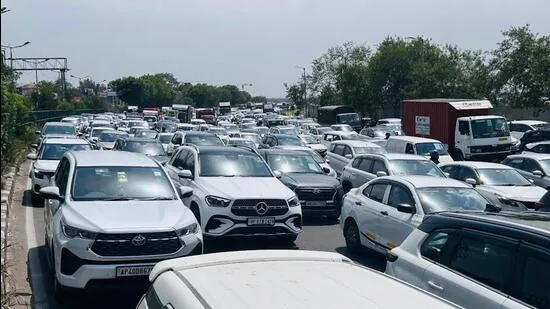
Twin Accidents Cause 12-Kilometer Traffic Jam on Delhi-Gurugram Expressway
Bharatmorningnews.com – A series of two major collisions along the Delhi-Gurugram Expressway resulted in a prolonged 12-kilometer traffic bottleneck on Tuesday morning, severely disrupting the flow of thousands of daily commuters, commercial vehicles, and travelers. The incident, which occurred around 9:30 AM, caused significant delays and forced traffic authorities to deploy emergency measures to restore normalcy. The expressway, a critical link between Delhi and the National Capital Region (NCR), became a focal point of concern as congestion spilled over into adjacent roads, affecting movement in both directions.
Cause of the Congestion
The traffic jam was caused by two separate accidents: one involving a collision between two buses near the sector-10 interchange, and another where a heavy truck overturned near Rajokri, a key junction in the southwest Delhi area. These incidents triggered a chain reaction, as vehicles queued up behind stalled trucks and damaged buses, creating a massive gridlock. According to traffic officials, the trucks’ overturning blocked a critical lane, while the bus collision further exacerbated the situation by reducing the number of lanes available for traffic. The combined effect of these events led to a bottleneck stretching over 12 kilometers, with delays reported in both the northbound and southbound directions.
“The two accidents, though localized, had a cascading impact on the entire corridor. Our teams are working round the clock to clear the debris and manage the flow of vehicles,” said an anonymous traffic official, speaking to HT. “We’ve also coordinated with the Delhi Metro and local transport authorities to minimize the disruption to public commuters.”
The congestion reached its peak by mid-morning, with vehicles coming to a standstill between the Kherki Daula and Sirhaul segments. Drivers were forced to wait for over an hour, causing frustration among those heading to work, schools, and airports. The heavy traffic also extended to nearby major junctions such as Atlas Chowk, IFFCO Chowk, and Signature Tower, where additional delays were reported due to the overflow of vehicles from the expressway. Commuters on the National Highway faced a significant challenge as the 12-km traffic jam became a symbol of the region’s vulnerability to sudden disruptions.
Response from Authorities
As soon as the accidents were reported, Gurugram police deployed a team of 12 officers to key choke points to oversee traffic and assist in rerouting vehicles. The police also worked closely with the Delhi traffic department to manage the overflow and coordinate with rescue teams to clear the debris. “We prioritized the removal of the overturned truck first, as it posed a greater risk to other vehicles on the road,” explained Mahavir Singh, a traffic inspector. “The bus collision, while less severe, still required careful handling to prevent further delays.”
Meanwhile, the National Highway Authority of India (NHAI) and local authorities initiated a rapid response to ensure the road was cleared as quickly as possible. Cranes and recovery vehicles were mobilized to extract the damaged buses and trucks, while additional traffic police were stationed at strategic locations to guide vehicles and ease the flow. The DCP of traffic, speaking to HT, confirmed that the 12-km traffic jam was a result of the two accidents and that efforts were underway to restore the corridor to its usual capacity. “We’ve managed to clear most of the affected lanes, but the situation remains tense until all vehicles are removed,” he added.
By late afternoon, the congestion had started to subside, with traffic authorities reporting a gradual improvement in the flow. However, the 12-km traffic jam left a lasting impact on the region’s transportation network, highlighting the need for better infrastructure and emergency response systems. “The time it took to clear the jam was longer than expected, but we’re working to prevent similar incidents in the future,” said an official from the traffic division.
Impact on Daily Life and Economy
The 12-km traffic jam had far-reaching consequences for the daily lives of commuters and the local economy. Thousands of people relying on the expressway for their morning commute faced delays of up to an hour, forcing some to take alternative routes or arrive late at their destinations. This disruption also affected businesses in Gurugram and Delhi, as goods and services could not be transported efficiently. “The traffic jam cost us an estimated 30% of our usual productivity,” said a local business owner, adding that the delays caused significant financial losses.
Moreover, the accident on the Delhi-Gurugram Expressway raised concerns about road safety and the need for regular maintenance checks. The truck overturning, which occurred at a high-speed stretch, underscored the risks associated with overloading and driver fatigue. Commuters and transport operators expressed dissatisfaction with the speed of the response, particularly in light of the 12-km traffic jam that could have been mitigated with more efficient coordination. “If we can’t clear the jam within an hour, the impact on the economy and public mobility will be severe,” noted a transport analyst, emphasizing the importance of timely interventions.
As the situation stabilized, authorities urged drivers to remain cautious and avoid the affected areas until the roads were fully cleared. The incident serves as a reminder of the fragility of the region’s transportation infrastructure and the critical role of emergency preparedness in managing such crises. The 12-km traffic jam, though temporary, has sparked discussions about the need for dedicated lanes, improved signage, and better accident management systems to ensure seamless travel for the millions who depend on the expressway daily.