
Ex-Karnataka CM Siddaramaiah chairs AHINDA event; 3 key leaders skip
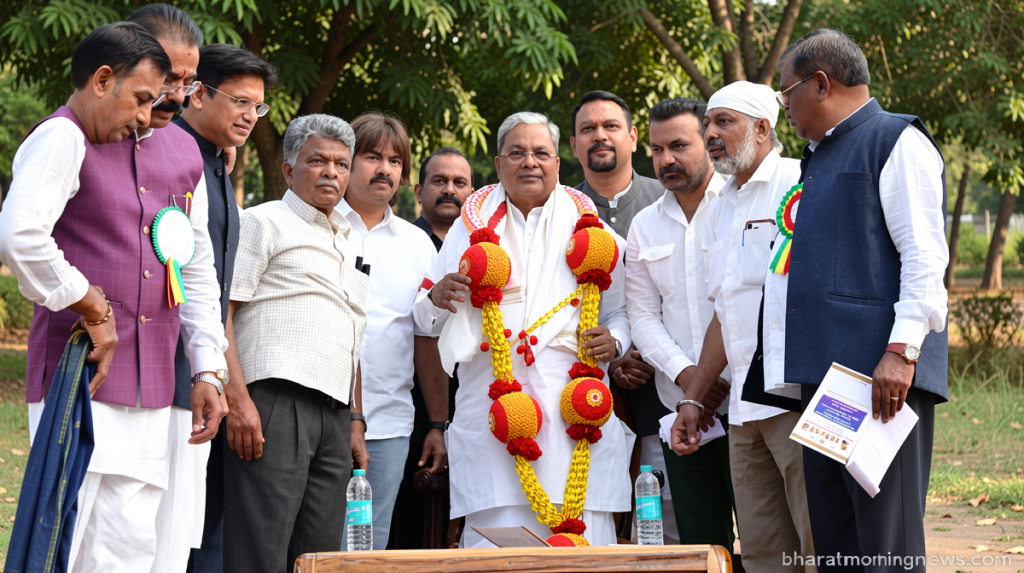
Power Struggles Surface at AHINDA Silver Jubilee as Siddaramaiah Takes the Helm
Bharatmorningnews.com – The silver jubilee of the Karnataka State Backward Castes Federation, held at Palace Grounds in Bengaluru on Sunday, was meant to celebrate two decades of the AHINDA movement’s advocacy for socially marginalized communities. Instead, the gathering became a stage on which the internal fault lines of the state’s ruling Congress party were laid bare in plain view. Former chief minister Siddaramaiah, now 78, presided over the event, yet three of the most visible AHINDA-associated ministers and former ministers chose not to attend — a decision that sent ripples through Karnataka’s political establishment well into the following week.
Absences That Speak Louder Than Attendance
Public Works Minister Satish Jarkiholi, Housing Minister BZ Zameer Ahmed Khan, and former minister HC Mahadevappa — all figures deeply embedded in the AHINDA political ecosystem — were conspicuously missing from the jubilee proceedings. Their collective no-show was not a minor scheduling conflict; it landed squarely in the middle of a period when the Congress is sharpening its electoral machinery ahead of the 2028 Assembly elections and the political contest that will inevitably precede them.
On Monday, the absentees addressed reporters and attempted to frame their non-attendance as a non-event. Jarkiholi, the most politically consequential of the three, was blunt about the reason.
“I was not invited, so I did not go. This is not a serious issue. AHINDA is not anyone’s property. Anyone can claim the AHINDA identity,” he said.
The phrasing carried weight beyond a simple grievance about an invitation. By declaring the movement “not anyone’s property,” Jarkiholi implicitly challenged the notion that Siddaramaiah — the architect of the AHINDA platform during his two stints as chief minister — holds a proprietary claim over its political brand. In a party where patronage networks still shape candidate selection and public visibility, such a statement is rarely neutral.
The Succession Question and Jarkiholi’s Ambition
The timing of the snub cannot be divorced from the succession calculus already underway within Karnataka’s Congress. Jarkiholi has cultivated a distinct identity as a backward-class voice independent of any single patron. Yathindra Siddaramaiah, the former chief minister’s son and a rising figure in state party politics, had earlier publicly projected Jarkiholi as a future leader of the movement. More pointedly, Jarkiholi himself has stated openly that he aspires to become chief minister by 2028.
That ambition places him in a delicate position: close enough to the Siddaramaiah orbit to benefit from its institutional memory, yet far enough to maintain an independent constituency of support among OBC and Dalit voters who see him as a peer rather than a protégé. The invitation question, however small in isolation, becomes a symbol of where that boundary is being drawn.
Siddaramaiah’s Announcements: Reservation Push and Electoral Withdrawal
At the jubilee itself, Siddaramaiah used the platform to escalate two long-standing demands. He called for intensifying the push toward 75 per cent reservation for Dalits, backward classes, and minorities in government employment as well as in the Lok Sabha and state legislative assemblies. The figure — well above the current combined reservation ceiling — has been a recurring talking point in Karnataka’s caste-politics discourse since the early 2000s, and Siddaramaiah’s reiteration signals that he intends to keep the issue alive even as he steps back from direct electoral competition.
In the same address, the 78-year-old leader made a second announcement that drew immediate attention: he would not contest the 2028 Assembly elections.
“The electoral system has become very expensive and has deteriorated. I have also grown old,” Siddaramaiah said.
The declaration, while framed in personal terms, carries structural implications. Siddaramaiah’s name has functioned as the gravitational centre of Karnataka’s Congress since his return to power in 2023. Removing that anchor from the ballot forces the party to accelerate its search for a successor who can carry both the AHINDA mandate and the broader electoral coalition into the next cycle.
Shivakumar’s Parallel Claim
Separately, Chief Minister DK Shivakumar moved to consolidate the AHINDA label within the party’s official ideological vocabulary. Speaking apart from the jubilee, he asserted that the movement belongs to the Congress as an institution rather than to any individual leader.
“AHINDA is ours. Congress ideology is AHINDA ideology. The Congress will continue to uphold its ideology towards the backward classes,” he said.
The statement is consistent with the party’s long-standing position that caste-based mobilisation is a structural feature of its electoral strategy in Karnataka, not a personal project of one leader. Yet delivered in the same week as Jarkiholi’s “not anyone’s property” remark, it reads as a bid to centralise ownership of the AHINDA brand at the top of the state unit, potentially marginalising both Siddaramaiah’s residual influence and Jarkiholi’s independent trajectory.
Why AHINDA Still Matters in Karnataka’s Political Arithmetic
For readers outside the state, the acronym deserves a brief unpacking. AHINDA — Alpasankhyataru (minorities), Hindulidavaru (Hindu backward castes), and Dalitaru (Dalits) — was formalised as a political platform during Siddaramaiah’s first term as chief minister in the late 1990s and early 2000s. It consolidated three historically separate reservation and welfare constituencies under a single advocacy umbrella, giving the Congress a coherent caste-politics narrative that had previously been fragmented. Two decades on, the movement’s silver jubilee marks both its institutional maturity and its unresolved question: who speaks for it, and who benefits politically from its continued existence?
With the 2028 elections approaching, that question will stop being academic. The interplay between Siddaramaiah’s withdrawal, Jarkiholi’s ambition, and Shivakumar’s institutional claim will determine whether AHINDA remains a unifying platform or fractures into competing factions within the very party that built it.
Related Reading
Frequently Asked Questions
What is Ex Karnataka CM Siddaramaiah chairs AHINDA?
Ex Karnataka CM Siddaramaiah chairs AHINDA is the main topic of this guide. The article explains the context, practical details, and next steps readers should understand.
Why does Ex Karnataka CM Siddaramaiah chairs AHINDA matter?
Ex Karnataka CM Siddaramaiah chairs AHINDA matters because readers are looking for a useful answer, not just a short summary. Good content should match search intent and help them decide what to do next.