
Political controversy escalates over Jauhar University, fate of 3000 students hangs in balance
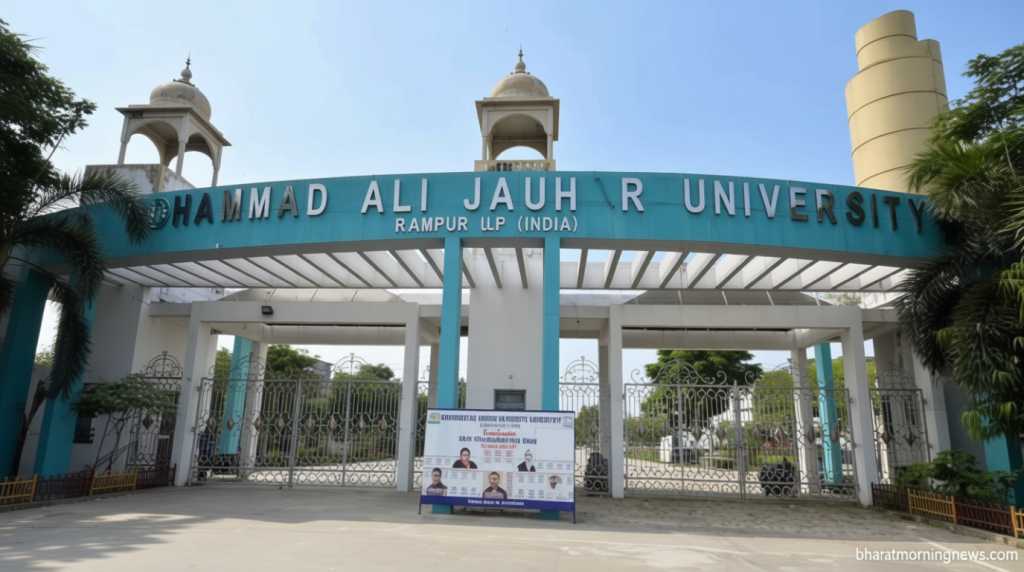
Jauhar University Faces Political Controversy, 3,000 Students’ Futures at Risk
Bharatmorningnews.com – The political situation surrounding Jauhar University has reached a critical point as demolition orders threaten the future of nearly 3,000 students. Located in Rampur, the university—a key project of former Uttar Pradesh minister Azam Khan and the Samajwadi Party—has become a flashpoint in the ongoing debate over its legitimacy. Authorities have declared 38 of its buildings as unauthorized, citing lack of approved plans and violations of fire safety regulations. This decision has sparked fierce opposition, with political parties clashing over the implications for education and governance. The fate of the institution and its students now hinges on the outcome of legal proceedings that could reshape the landscape of higher education in the region.
Legal Dispute Over Construction Jurisdiction
The Rampur Development Authority (RDA) has positioned itself at the center of the controversy, asserting that the university’s 38 buildings were constructed without valid permissions. This claim has intensified the legal battle, with the RDA accusing the institution of breaching urban planning laws. District magistrate Ajay Kumar Dwivedi, who rejected the university’s documentation, has given it a 15-day deadline to remove the structures on its own or face forced demolition. The RDA maintains that approximately 82,309.80 square metres of the campus were built outside the approved boundaries, potentially jeopardizing the university’s long-term existence.
“The university has been given 15 days to demolish illegal constructions on its own. If not, the RDA will proceed with the action,” said Dwivedi.
Meanwhile, the university’s leadership, led by Vice Chancellor Prof Sachin Maheshwar, has contested the RDA’s assertion. They argue that the land was not under the RDA’s jurisdiction when the structures were built and that approvals were obtained through the zila panchayat. The dispute highlights a broader issue of overlapping administrative authority and raises questions about the transparency of the approval process. As the legal tug-of-war continues, the trust is preparing to challenge the RDA’s orders in court, emphasizing the need for a thorough review of the case.
Fire Safety Concerns Fuel the Crisis
The recent fire safety audit, prompted by a devastating blaze at a Lucknow coaching center that claimed 15 lives, has further complicated the university’s situation. Inspectors identified multiple lapses in fire safety protocols, including the absence of essential safety equipment and non-compliant emergency exits in several buildings. The district administration issued a seven-day notice to the university, urging it to address these deficiencies, but officials report no response. This oversight has now been used as a legal basis to escalate the demolition threat, linking the university’s infrastructure to broader safety standards.
“The audit revealed that the university’s safety measures fall short of required standards, which has given authorities a stronger case for action,” noted a local official.
With the fire safety issue now central to the debate, the university faces dual challenges: proving its construction legitimacy and addressing structural vulnerabilities. The situation has drawn attention from state legislators and education experts, who are urging a balanced approach to ensure that the university’s closure does not disrupt the academic calendar for its students. As the legal deadline looms, the community remains on edge, fearing the repercussions of the demolition on both educational and economic fronts.
Student Anxiety and Relocation Plans
The looming threat of demolition has created a climate of anxiety among Jauhar University’s students, many of whom are concerned about the loss of their academic environment. In response, the district magistrate has initiated discussions with Guru Jambheshwar University in Moradabad to explore potential relocation options for affected learners. These efforts aim to mitigate the immediate impact on students, though the process is fraught with logistical and financial challenges. The university’s leadership has also sought to reassure the public, highlighting the institution’s role in providing quality education to the local population.
“We are working tirelessly to find a solution that protects both the students and the university’s legacy,” said Prof Maheshwar.
As the political drama unfolds, the focus remains on the students, whose futures are intertwined with the university’s survival. Advocacy groups and alumni have rallied to support the cause, emphasizing the need for a fair resolution. The broader implications of the case extend beyond Rampur, sparking conversations about the role of political affiliations in educational policies and the potential for similar disputes in other institutions. The outcome of this crisis may set a precedent for how future projects are evaluated and managed in the state.
Political Tensions and Public Reaction
The controversy has deepened political tensions between the ruling BJP and opposition parties, with each side leveraging the situation to criticize the other. The BJP has accused the Samajwadi Party of failing to maintain proper oversight, while the opposition argues that the demolition is a calculated move to undermine a key ally’s legacy. Public opinion is divided, with some residents supporting the RDA’s strict enforcement of regulations and others rallying behind the university as a symbol of local development and opportunity.
Local media has amplified the debate, with reports highlighting the emotional and economic stakes for families reliant on the university’s infrastructure. The trust’s wife, Tazeen Fatima, has become a vocal figure in the dispute, meeting with party leaders and management to coordinate a unified response. Her presence underscores the personal dimension of the crisis, as she and others appeal to the public’s empathy to prevent the university’s closure. As the deadline approaches, the community watches closely, hoping for a resolution that balances legal accountability with educational continuity.
Implications for Higher Education and Governance
The situation at Jauhar University has raised broader concerns about the governance of educational institutions in Uttar Pradesh. Critics argue that the demolition orders reflect a growing politicization of urban development and education policy, with decisions influenced by political alliances rather than objective criteria. This has sparked fears that similar actions may target other institutions, creating uncertainty for students and educators alike. The case also highlights the importance of clear regulatory frameworks, as the dispute over construction permissions underscores gaps in how urban planning and educational projects are managed.
With the focus keyword “Political controversy escalates over Jauhar” woven throughout the article, the narrative now spans legal, administrative, and political dimensions. As the university’s fate remains uncertain, the debate is expected to continue, with potential ramifications for the state’s educational landscape. The outcome of this crisis will not only determine the future of Jauhar University but also serve as a test of how political decisions intersect with public welfare in the context of higher education.