
The Vikings row on: Haaland steers Norway into World Cup history
The Vikings Row On: Haaland Steers Norway Into World Cup History
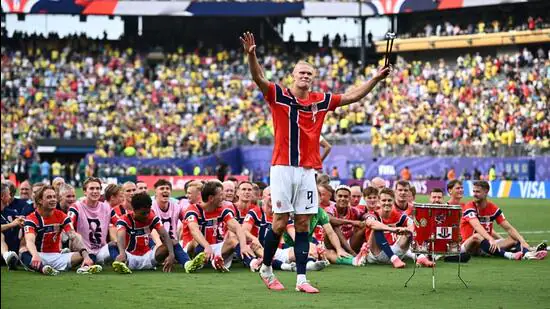
Bharatmorningnews.com – In a striking blend of history and modern football, The Vikings row has become a symbol of Norway’s unprecedented World Cup breakthrough. The ritual, rooted in Viking traditions, echoes through the team’s latest triumph as Erling Braut Haaland, a descendant of the legendary Norse explorers, led Norway to their first-ever quarter-final appearance. This achievement, fueled by his extraordinary goal-scoring prowess, marks a historic moment for a nation that once struggled to make an impact on the global stage. With The Vikings row serving as both a cultural anchor and a team-building practice, Norway’s journey to the knockout rounds has been as much about unity as it has been about skill.
A Cultural and Tactical Legacy
The concept of The Vikings row has transcended its historical origins to become a unique team tradition. After every match, Norway’s players adopt a striking formation reminiscent of Viking longships, paddling in unison with synchronized movements to the beat of a drum. This practice, believed to foster resilience and collective spirit, has been a staple of their preparation for decades. It reflects the nation’s pride in its Norse heritage while symbolizing the relentless drive that defines their footballing philosophy. The ritual is not merely a spectacle—it is a reminder of the indomitable will that propelled ancient Vikings across the seas, now channeled into the modern game.
Haaland’s Transformative Impact
At the heart of Norway’s success stands Erling Braut Haaland, whose meteoric rise has redefined the role of a forward in international football. The 25-year-old striker, who hails from a lineage of Viking explorers, has become a living embodiment of Norway’s perseverance. His double against Brazil in the 2026 World Cup not only sealed the nation’s historic advancement but also showcased his ability to perform under pressure. With 14 consecutive international goals in 2023, Haaland’s consistency has cemented his status as one of the tournament’s standout performers. His success is a testament to the blend of raw power, technical finesse, and tactical awareness that has now become Norway’s hallmark.
Haaland’s achievements are particularly significant given Norway’s limited resources and history of underachievement in major tournaments. His performance in the group stage, including a decisive header in the 79th minute and a powerful strike in the 90th, highlighted his ability to deliver in high-stakes moments. While his delayed positioning during Brazil’s counter-attack cost him a potential hat-trick, his two goals were pivotal in securing a 2-1 victory. This display of resilience and composure has not only elevated Haaland’s reputation but also rekindled global interest in Norway’s footballing potential.
Strategic Evolution and Team Unity
Norway’s tactical evolution over the years has been a key factor in their World Cup success. The team’s high-pressing style, combined with a cohesive defensive unit, has allowed them to compete with larger, more established nations. In the Brazil clash, this strategy was evident as the squad prioritized quick transitions and disciplined marking. The role of goalkeeper Ørjan Nyland, who made crucial saves to neutralize Brazil’s attacking threats, further underscored the team’s balanced approach. The Vikings row tradition, however, is not just about history—it also reinforces the camaraderie that fuels such strategic execution.
Haaland’s ability to adapt to this system has been remarkable. While his physical presence dominates the attack, his willingness to contribute defensively aligns with the team’s ethos. This versatility, often overlooked, highlights Norway’s shift from a squad reliant on individual flair to one built on collective effort. The success of The Vikings row as a unifying ritual mirrors this transformation, bridging the gap between the past and present in a way that resonates with fans and players alike.
The Road to the Quarter-Finals
Norway’s ascent to the quarter-finals represents more than just a sports milestone—it is a cultural renaissance. The team’s journey from their 1994 debut, where they earned their first points, to this historic achievement in 2026, has been marked by perseverance and incremental progress. Haaland’s influence has been instrumental in this shift, drawing comparisons to football legends like Kylian Mbappé and Lionel Messi, who also scored in double figures during their World Cup debuts. His performance in the tournament has not only redefined his personal legacy but also positioned Norway as a force to be reckoned with in international football.
The 2-1 victory over Brazil was a turning point for Norway, with Haaland’s goals acting as the catalyst for their advancement. The match itself was a testament to the team’s ability to execute under pressure, a skill honed through rigorous training and the symbolic strength of The Vikings row. As Norway prepares for the next round, the lessons learned from this campaign will be vital. The striker’s dual role as a goal-scorer and playmaker, alongside the team’s disciplined structure, has set the stage for a new era of Norwegian football. This breakthrough is not just a moment—it is the beginning of a legacy.
“The Vikings row is more than a tradition; it is a statement of identity, resilience, and ambition. Haaland’s performance has brought Norway to the forefront of the World Cup, proving that perseverance and unity can overcome even the greatest challenges.”