
Congress merger buzz, heavy-weight rebel camp, MPs abandoning Mamata: What’s happening in TMC
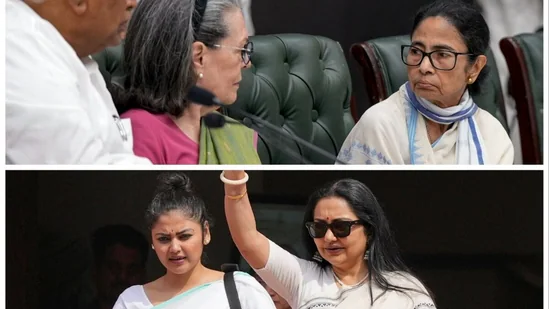
Congress Merger Buzz and Rebel Factions in TMC
Bharatmorningnews.com – The Congress merger buzz has intensified within the Trinamool Congress (TMC), led by Mamata Banerjee, as heavy-weight rebel camps gain momentum. Political analysts suggest that the growing discontent among key lawmakers and MPs is not just a reflection of internal power struggles but also signals a potential shift in the party’s strategic direction. With dissenters challenging the leadership’s authority and speculations about a merger with the Congress party circulating, the TMC faces a critical juncture in its governance.
Internal Strife and Leadership Challenges
Recent weeks have seen a series of high-profile resignations from the TMC, including Rajya Sabha MP Prakash Chik Baraik, who became the third lawmaker to exit this week. His departure followed the resignation of Sushmita Dev as a Rajya Sabha MP and TMC leader Sukhendu Sekhar Ray, who cited “unbridled corruption” and “anarchical rule” as reasons for his exit. These resignations underscore a deepening rift, with lawmakers questioning the party’s decision-making processes and governance style. The rebel faction, spearheaded by figures like Ritabrata Banerjee, has accused the leadership of authoritarian practices, further fueling the Congress merger buzz.
Meanwhile, a separate group of MPs, including Kakoli Ghosh, a four-term TMC MP, has begun defecting to the National Democratic Alliance (NDA). Ghosh claimed that her group has secured the support of 19 lawmakers, signaling a significant shift in the party’s parliamentary strength. “We have decided to write to Lok Sabha Speaker Om Birla and formally support the NDA,” she stated in a
statement
. This move raises concerns about the TMC’s ability to maintain its majority and could weaken its position in the upcoming legislative sessions.
Merger Speculation and Political Realignment
The Congress merger buzz has gained traction following Mamata Banerjee’s recent meeting with Congress leader Sonia Gandhi in Delhi. While the encounter was described as cordial, it has fueled debates about the potential alignment of the two parties. Some within the TMC view the merger as a way to strengthen their electoral base, while others dismiss it as a short-term political maneuver. Abhishek Banerjee, the TMC’s national general secretary, has engaged in discussions with Rahul Gandhi to explore “possibilities to deepen ties,” indicating a cautious approach to the merger talks.
Congress sources, however, have downplayed the Congress merger buzz, calling it “baseless.” Jairam Ramesh, a senior Congress leader, emphasized that the meeting between Sonia Gandhi and Banerjee was focused on personal matters rather than formal alliance talks. “Some news reports on what supposedly transpired in the meeting are completely inaccurate,” he added in a
statement
. Despite this, the speculation continues to shape the political narrative, with observers noting that the TMC’s internal instability could make it more open to external partnerships.
Broader Implications and Future Outlook
As the Congress merger buzz grows, it raises questions about the TMC’s long-term viability. The party’s leadership has been under pressure to address internal grievances, with many lawmakers demanding greater transparency and democratic processes. The defection of 19 MPs to the NDA, coupled with the formation of rebel factions, highlights a significant challenge to Mamata Banerjee’s hold on power. Analysts suggest that the TMC’s ability to unify its ranks will determine whether the Congress merger buzz leads to a lasting partnership or a temporary distraction.
Meanwhile, the party’s recent challenges extend beyond the legislative sphere. Kolkata Mayor Firhad Hakim and Bidhanna Mayor Krishna Chakraborty have also resigned, adding to the perception of a leadership crisis. These developments have sparked discussions about the TMC’s future strategy, with some speculating that the Congress merger buzz might be part of a larger effort to rejuvenate the party’s image and bolster its electoral prospects. As the political landscape evolves, the TMC’s next steps will be closely watched by both allies and rivals.
Stability and Strategic Reassessment
The TMC’s current situation demands a strategic reassessment. With the Congress merger buzz and rebel factions gaining traction, the party must decide whether to consolidate its power, engage in alliances, or risk fragmentation. The leadership’s response to these challenges will be crucial in shaping the party’s trajectory. While Mamata Banerjee remains a central figure, the growing number of dissenters suggests that her authority is being tested at every level.
Political observers note that the TMC’s internal dynamics are a microcosm of broader trends in Indian politics. The Congress merger buzz reflects a desire to pool resources and broaden support, but it also highlights the risks of over-reliance on a single leader. As the party navigates this period of uncertainty, its ability to balance unity and dissent will determine its effectiveness in the upcoming elections and policy initiatives. The rebels’ push for change, whether through defection or merger, could redefine the TMC’s role in the political arena.