
India’s death-bowling resolve offers a blueprint for improvement
India Seek a Fuller Bowling Display After Sealing T20I Series
Bharatmorningnews.com – India have already wrapped up the T20I series against New Zealand, but their six-wicket win in Wellington also underlined an area that still requires attention. A controlled finish from the bowlers prevented New Zealand from posting an even more daunting total, before Abhishek Sharma’s remarkable hundred turned the chase into a one-sided affair.
With a 3-0 lead secured ahead of Friday’s fourth T20I in Auckland, India’s batting appears to be in strong order. The next step is for the bowling unit to make its late-innings discipline visible across a complete 20-over effort.
Late control changed the shape of the contest
New Zealand were well placed at 146 for three after 15 overs and looked capable of pushing beyond 200. Their hitters had begun to take charge, finding value in deliveries that fell into their preferred range. India, though, responded with greater clarity in the closing stages and restricted the damage before the target became psychologically more demanding.
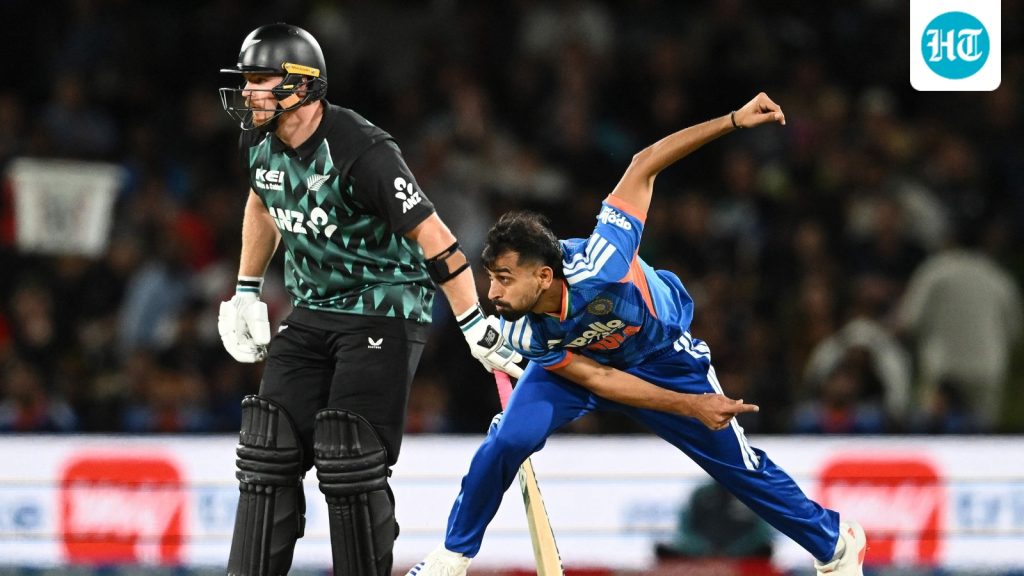
Prince Yadav’s final over was especially significant. He allowed only nine runs while bowling to Mitchell and Jacobs, who had been threatening a forceful finish. By targeting a fuller, wider line, Prince made it difficult for the batters to swing freely. His final ball was too full for Jacobs to get underneath, denying New Zealand the boundary they wanted.
That over did more than improve the final total. It demonstrated the value of retaining composure when momentum begins to shift. India’s openers were able to begin their chase without the added weight of pursuing 200 or more, and Sharma’s 113 from 38 deliveries ensured the target was overhauled with considerable room to spare.
Wide yorkers offered an answer
Shreyas Iyer explained after the match that India recognised the need to adjust once New Zealand’s batters started exploiting familiar lengths.
“After 10 overs I realized that anything half volley or hard length was going into the stands, so we were looking to bowl wide yorkers,” he said.
The change made sense on a surface where pace and predictable length gave batters an opportunity to line up their shots. A wide yorker changes both the angle and the required reach, forcing a hitter to extend towards the ball rather than strike cleanly through it.
For India, that should be a useful lesson rather than simply a successful end-over tactic. Death bowling is not only about producing six accurate deliveries at the finish. It also involves recognising patterns early enough to stop an opposition innings from gathering sustained momentum through the middle phase.
Consistency remains the key objective
There were still costly overs in Wellington. Nitish Kumar Reddy conceded 15 in the 19th, while Bhuvneshwar Kumar gave away nine in the 18th. Those figures do not diminish the value of India’s recovery, but they show why the final over alone cannot define the bowling performance.
The challenge in Auckland will be to mix pace, angles and lengths without losing precision. At international level, a delivery intended as a variation can quickly become a scoring option if it is fractionally misplaced. Bowlers need clear plans for different batters, particularly those willing to use the crease and attack anything in their hitting arc.
Arshdeep Singh has already made an impact with disciplined bowling against New Zealand’s openers. India will also need their middle-over bowlers to stay alert if Mitchell and Jacobs continue to target fuller balls. Avoiding repetitive lengths could be just as important as executing the perfect yorker at the end.
Fielding can support the bowling plans
Prince’s closing over also highlighted the importance of reliable work in the field. A bowling plan is more effective when fielders collect cleanly, limit twos and convert half-chances into singles. Conversely, fumbles and overthrows can undo several well-executed deliveries in a matter of moments.
Auckland presents a fresh set of calculations, with different boundary dimensions likely to influence which areas can be defended safely. India’s bowlers will need to assess those conditions quickly rather than rely on the plans that worked in Wellington.
With the next T20 World Cup still two years away, India have time to test their young bowling group, absorb difficult moments and improve through competition. There is little need for a wholesale change to an attack that has helped secure the series. Greater control during the middle overs, earlier adaptation and sharper awareness of New Zealand’s scoring zones would offer more meaningful progress.
India proved in Wellington that they can finish an innings calmly under pressure. Their aim in Auckland will be to turn that late resilience into a standard that runs through all 20 overs.
Related Reading
Frequently Asked Questions
What is India s death bowling resolve offers?
India s death bowling resolve offers is the main topic of this guide. The article explains the context, practical details, and next steps readers should understand.
Why does India s death bowling resolve offers matter?
India s death bowling resolve offers matters because readers are looking for a useful answer, not just a short summary. Good content should match search intent and help them decide what to do next.