
Chhattisgarh eyes complete mineral value chain, says CM Vishnu Deo Sai
Chhattisgarh Pushes for End-to-End Mineral Value Chain as Critical-Mineral Auctions Accelerate
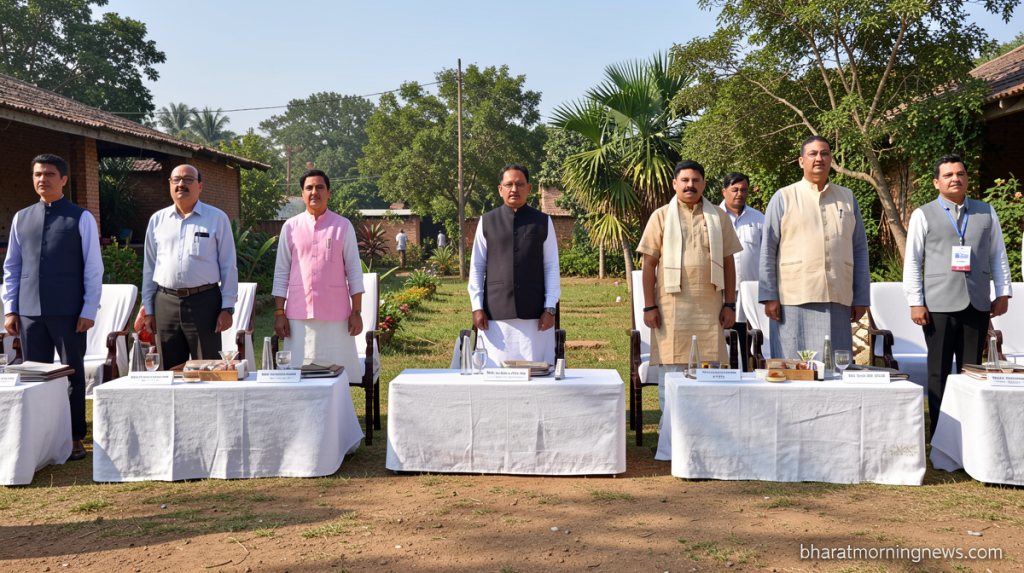
Bharatmorningnews.com – The state of Chhattisgarh has set its sights on building a fully integrated mineral value chain — spanning exploration, extraction, processing, value addition, advanced manufacturing, and recycling — within its own borders, Chief Minister Vishnu Deo Sai announced on Monday. The declaration came during a roadshow tied to the eighth tranche of India’s auction programme for critical and strategic mineral blocks, hosted by the Union Ministry of Mines at Nava Raipur.
The ambition is not merely symbolic. Critical minerals underpin nearly every frontier sector of the modern economy: defence systems, artificial-intelligence hardware, semiconductor fabrication, lithium-ion and solid-state batteries, clean-energy infrastructure, electric-vehicle platforms, digital-technology supply chains, and high-precision manufacturing. India’s heavy dependence on imported feedstocks for these materials has made domestic supply security a matter of both economic strategy and national defence. Sai framed the state’s mineral endowment as a lever that could draw fresh capital, seed entirely new industrial clusters, and generate sustained employment for local communities.
The Eighth Tranche and Chhattisgarh’s Share
The current auction round covers twenty critical and strategic mineral blocks spread across seven states, with five of those blocks located in Chhattisgarh. The chief minister used the roadshow platform to invite investors to bid in the auction and to map out opportunities across the full spectrum — from greenfield exploration to downstream processing and finished-goods manufacturing.
“Strengthening domestic supplies of such minerals is important for India’s economic interests and national security,” Sai stated, underscoring that the state’s role extends beyond raw extraction into the higher-value stages of the chain.
What Lies Beneath Chhattisgarh’s Soil
The state’s geological profile is unusually diverse for a single Indian state. Lithium deposits and rare-earth-element occurrences have been identified in the Katghora and Bastar regions. Balrampur district hosts graphite, vanadium, and gallium resources. Phosphorite occurrences sit in Balod, while Mahasamund district carries nickel, chromium, and glauconite. Together these deposits give Chhattisgarh a portfolio that touches battery chemistry, aerospace alloys, semiconductor dopants, and agricultural inputs — a breadth that few other Indian states can match.
Over the past two and a half years, the state’s mineral development arm has launched forty exploration projects and completed more than 2,800 kilometres of geological survey work, according to Rajat Bansal, managing director of the Chhattisgarh Mineral Development Corporation. Bansal added that sixty-five mineral blocks have been auctioned to date, with projected revenue estimated at roughly ₹4 lakh crore over their lifetimes.
Revenue Growth and Community Dividends
The financial trajectory of the state’s mineral sector has been steep. When Chhattisgarh was carved out of Madhya Pradesh in 2000, annual mineral revenue stood at approximately ₹400 crore. Today that figure exceeds ₹16,000 crore. State officials say the proceeds are channelled into development and public-welfare programmes, including targeted projects in mining-affected districts administered through the District Mineral Foundation Trust — a mechanism designed to ensure that communities living alongside mines receive direct infrastructure and livelihood benefits.
Investment Climate and Incentive Architecture
To convert geological potential into industrial activity, the state has rolled out a new industrial policy paired with a suite of fiscal incentives. These include capital-investment assistance, exemptions from stamp duty and electricity duty, interest-rate subsidies on project loans, and employment-linked incentives calibrated to the number of jobs created. Chief Secretary Vikas Sheel told the audience that the administration would extend “handholding” support to prospective investors through every regulatory gate — environmental clearances, forest permissions, land-acquisition processes, and allied approvals — reducing the time and friction typically associated with large-scale mineral projects.
Mineral Resources Secretary P. Dayanand emphasised parallel investments in scientific exploration, systematic geological data collection, high-resolution mapping, and transparent auction mechanisms, arguing that data quality and procedural integrity are prerequisites for attracting long-term, institutional-grade capital.
Portals Launched: Sand Supply and Tin-Trade Transparency
During the same programme, Sai inaugurated two digital platforms aimed at smaller-scale mineral and mineral-adjacent activities. The E-Ret Sangwari portal is designed to facilitate concessional sand supply to households enrolled under the Pradhan Mantri Awas Yojana housing scheme, streamlining a material that is often procured informally. The Tin Portal targets tribal communities in Dantewada who have traditionally collected and sold tin-bearing ores; the platform aims to introduce price transparency so that producers receive fair market rates rather than being squeezed by intermediaries.
Strategic Partnerships Sealed
Two memoranda of understanding were executed during the event. The first links the Chhattisgarh Mineral Development Corporation with Indian Overseas Bank for structured financial cooperation on mineral-sector projects. The second pairs the corporation with Pt Ravishankar Shukla University to develop specialised training programmes in corundum cutting and polishing — a niche but high-value segment of the gemstone and abrasives supply chain that Chhattisgarh’s corundum deposits could feed.
Taken together, the announcements signal a state that is attempting to move up the mineral value chain rather than remain a passive supplier of raw ore. Whether the combination of geological endowment, fiscal incentives, regulatory facilitation, and institutional partnerships can translate into sustained industrial activity will depend on execution over the coming years — but the architectural blueprint, at least on paper, is now in place.
Related Reading
Frequently Asked Questions
What is Chhattisgarh eyes complete mineral value chain?
Chhattisgarh eyes complete mineral value chain is the main topic of this guide. The article explains the context, practical details, and next steps readers should understand.
Why does Chhattisgarh eyes complete mineral value chain matter?
Chhattisgarh eyes complete mineral value chain matters because readers are looking for a useful answer, not just a short summary. Good content should match search intent and help them decide what to do next.