
Who is Pawan Kumar Chandana, Skyroot CEO behind India’s historic Vikram-1 launch?
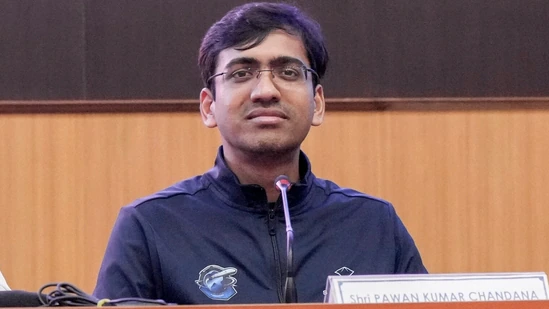
Who is Pawan Kumar Chandana: Skyroot CEO Behind India’s Vikram-1 Breakthrough
Bharatmorningnews.com – Pawan Kumar Chandana, the CEO of Skyroot Aerospace, has emerged as a central figure in India’s growing commercial space sector following the historic success of the Vikram-1 rocket launch. The mission, named Aagaman, marked a significant milestone as the rocket successfully deployed its payloads into a 450 km orbit from the Satish Dhawan Space Centre in Sriharikota. This achievement not only highlighted India’s capabilities in private space exploration but also underscored Chandana’s pivotal role in shaping the nation’s future in aerospace technology.
Pawan Kumar Chandana’s Journey to Leadership
Pawan Kumar Chandana’s path to becoming a leading figure in India’s space industry began with a deep-rooted passion for machinery and engineering. Born into a middle-class family in Hyderabad, he demonstrated an early aptitude for technical pursuits, eventually earning a dual BTech-MTech degree in mechanical engineering from IIT Kharagpur. His academic foundation was complemented by hands-on experience at the Indian Space Research Organisation (ISRO), where he worked for nearly six years before transitioning to entrepreneurship in 2018.
Chandana co-founded Skyroot Aerospace with Naga Bharath Daka, another former ISRO engineer. The duo’s vision was to develop affordable and reliable rocket technology that could democratize access to space. Chandana’s leadership has been instrumental in steering the company’s innovation, particularly in the design and development of the Vikram-1 rocket. This mission, which launched on Saturday, represents a culmination of years of research, testing, and strategic planning.
Technological Innovations and the Vikram-1 Mission
The Vikram-1 rocket is a testament to Chandana’s commitment to cutting-edge engineering. Standing at seven stories tall, it is constructed entirely from carbon composites, making it both lightweight and durable. The rocket’s propulsion system integrates three solid-fuel stages with a 3D-printed liquid-fuel module, showcasing India’s growing expertise in advanced manufacturing. This combination allows for efficient performance and cost-effectiveness, critical factors in the competitive global space industry.
Chandana’s emphasis on indigenous development is evident in the design and production of Vikram-1. “It is 100% designed in India, 100% manufactured in India. We have built it from scratch,” he told Hindustan Times. This self-reliance is a key differentiator for Skyroot, as it positions the company to compete with established players while addressing the unique needs of India’s growing satellite market.
With a payload capacity of up to 350 kg, Vikram-1 is tailored for small satellites, which are increasingly vital for communication, Earth observation, and scientific research. The rocket’s success marks a shift toward private enterprise-led space missions in India, reducing dependency on government agencies and accelerating innovation. Chandana’s work has not only expanded the scope of India’s space ambitions but also inspired a new generation of engineers and entrepreneurs.
Expanding Skyroot’s Reach and Vision
Skyroot’s achievements have grown exponentially since its inception. The company’s earlier success with the Vikram-S suborbital rocket in 2022 laid the groundwork for the orbital mission. This progress has been accompanied by significant investment, with Skyroot raising $60 million in May 2026 at a valuation of $1.1 billion. Such funding has enabled the firm to scale its operations and establish a state-of-the-art Infinity Campus in Hyderabad, where it can produce one orbital rocket monthly.
Chandana’s leadership has transformed Skyroot from a startup into a major player in India’s aerospace landscape. His focus on affordability, reliability, and indigenous innovation has resonated with both domestic and international stakeholders. The Vikram-1 launch is a prime example of how Chandana’s vision has materialized into tangible progress, offering a glimpse into the future of private space exploration in South Asia.
Chandana’s Role in Shaping India’s Space Economy
As the CEO of Skyroot, Chandana has played a defining role in India’s transition from a space-faring nation to a hub of commercial aerospace innovation. His efforts have addressed critical gaps in the industry, such as high costs and limited access to launch services. By creating a sustainable and scalable model, Chandana has positioned Skyroot to meet the rising demand for satellite launches, driven by sectors like agriculture, disaster management, and telecommunications.
Chandana’s work also reflects a broader trend of private sector involvement in space exploration. While ISRO has been the backbone of India’s space program, companies like Skyroot are now playing a crucial role in expanding its capabilities. The Vikram-1 mission exemplifies this shift, demonstrating that private enterprises can achieve orbital launches with precision and efficiency. Chandana’s journey from ISRO scientist to CEO highlights the dynamic evolution of India’s space industry.