
Getting serious about gangsters
Getting Serious About Gangsters: A Global Challenge for India
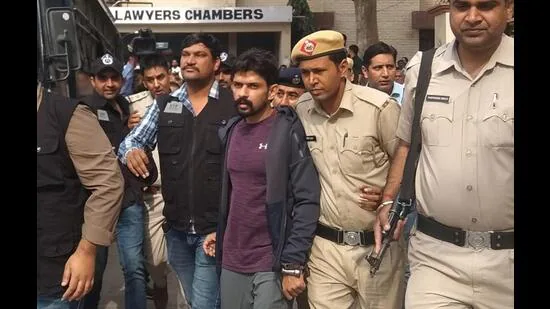
Bharatmorningnews.com – In a landmark development, the U.S. government has taken a serious stance against gangsters by unsealing a federal indictment in Los Angeles that accuses Indian gangster Lawrence Bishnoi of orchestrating the 2023 murder of Sikh separatist leader Hardeep Singh Nijjar in Canada. This two-year investigation, involving the FBI, Los Angeles police, the Royal Canadian Mounted Police, and U.S. Customs and Border officials, highlights the growing transnational reach of organized crime. The charges under Operation Hard Ball, which targets global criminal networks, now place Bishnoi and his associates at the center of an international legal battle, signaling a shift in how India’s socio-political challenges are being addressed on the global stage.
The case has intensified the diplomatic tension between India, Canada, and the United States, with the latter accusing the Indian government of covert involvement in the killing. While New Delhi initially dismissed these claims as implausible, the arrest of Nikhil Gupta in the U.S. added weight to the allegations. However, the revelation that the Indian government was not directly involved in the crime offers some reprieve, underscoring the need for more transparency and accountability in the fight against criminal elements. This incident raises critical questions about the balance between state authority and the influence of organized gangs in shaping political outcomes abroad.
The Legal Framework and Transnational Threats
The U.S. prosecutors have applied the Racketeer Influenced and Corrupt Organizations Act (RICO) to Bishnoi, a legal tool previously used against Mafia factions like the Bonanno, Colombo, Gambino, Genovese, and Lucchese families. This decision positions Bishnoi as a key player in a globalized criminal landscape, where gangs operate across borders with alarming efficiency. His ability to run his gang seamlessly from prison, even while in solitary confinement since 2023, demonstrates the resilience of these networks and the challenges faced by Indian authorities in dismantling them. The case also names Gurinderjit Singh Nagra, a Punjab Police officer, for aiding the Jaggu Bhagwanpuria gang in international extortion, further complicating the narrative of state-backed criminality.
“The legal charges against Bishnoi reveal a sophisticated structure of transnational organized crime.”
As the U.S. seeks to extradite Bishnoi and his associates, the Indian government’s response will be pivotal in shaping its reputation. The legal battle not only exposes the vulnerabilities in India’s law enforcement systems but also underscores the need for stronger international cooperation to combat such groups. This case exemplifies how gangsters have become a focal point for global justice, with their actions now impacting India’s diplomatic and economic standing. The implications are far-reaching, as the fight against organized crime takes center stage in India’s broader efforts to assert itself as a responsible global actor.
Global Economic and Security Implications
The indictment of Bishnoi has sparked a global conversation about the economic and security threats posed by transnational gangs. The World Bank’s Latin America and the Caribbean Economic Review (LACER) highlighted how organized crime exacerbates economic instability, while the United Nations Interregional Crime and Justice Research Institute (UNICRI) emphasized the link between terrorism and illicit economies. These findings resonate strongly in the context of India’s current economic trajectory, where the International Monetary Fund (IMF) predicts sustained growth until at least 2028. Yet, if criminals continue to operate with impunity, India’s global economic ambitions could be undermined by the ripple effects of their activities.
“Organized crime is not just a local concern but a global challenge that affects India’s development narrative.”
Furthermore, the case underscores the role of cross-border gangs in destabilizing political systems. As these groups expand their operations, they challenge the perception of India as a stable and law-abiding nation. The Bishnoi case, with its international dimensions, serves as a reminder that the fight against gangsters requires a multifaceted approach, combining domestic reforms with international collaboration. For India to maintain its image as a development-focused leader, addressing the root causes of criminal syndicates must become a priority in its socio-political agenda.