
‘President of the Unites States’: Typo spotted in Trump’s White House ‘super intelligence’ accord
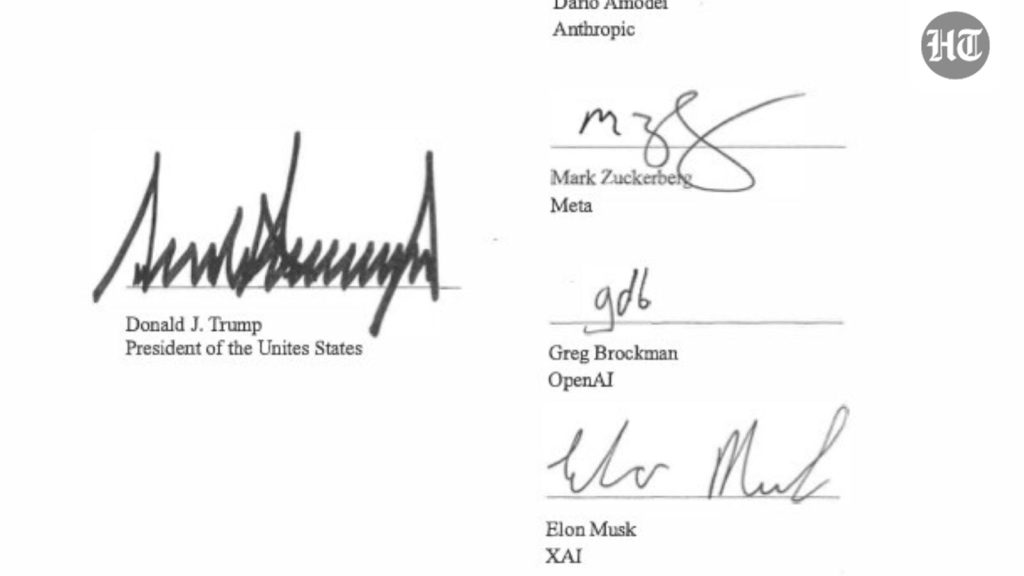
White House AI Accord Draws Attention After Typographical Error
Bharatmorningnews.com – President Donald Trump joined leading technology executives at the White House on Tuesday to sign a voluntary agreement focused on the development and oversight of advanced artificial intelligence. The document quickly attracted attention online for an unexpected reason: beneath Trump’s signature, his title contained a spelling error.
The text identified him as the “President of the Unites States” rather than “President of the United States.” The mistake appeared on an accord that Trump characterized as an important framework for what he called the future of “super intelligence.”
Among the executives whose signatures appeared on the agreement were Google chief executive Sundar Pichai, Anthropic’s Daria Amodei, Meta chief executive Mark Zuckerberg, OpenAI president Greg Brockman, Elon Musk, and NVIDIA chief executive Jensen Huang.
Four layers of AI oversight
The agreement outlines a multi-stage approach intended to improve safety practices around powerful AI systems. It calls for companies to establish internal controls for monitoring their models, create internal teams to assess whether those controls are working, obtain independent outside evaluations, and maintain review by an independent board committee.
The framework also commits participating companies to work with independent auditors who would examine whether AI tools are functioning in the way their developers intend. The companies agreed to take steps aimed at preventing their systems from hacking or reaching technical systems in unintended ways.
Such commitments remain voluntary, meaning the agreement is not the same as a federal law or regulation. Still, the involvement of several of the world’s largest AI and technology companies gives the document significance as a public statement of industry expectations.
AI safety has become a central concern as companies release more capable systems for public and business use. Researchers and policymakers have raised questions about whether advanced models can be reliably tested, controlled, and monitored before they are deployed more widely. The White House accord places particular emphasis on audits and corporate governance as tools for identifying risks.
Trump promotes the term “super intelligence”
Trump said artificial intelligence would now be called “super intelligence” in the United States, using the shortened term “SI” while speaking with reporters. He said the name had been formally changed by the “biggest, smartest and greatest people anywhere in the world.”
“Biggest, smartest and greatest people anywhere in the world.”
Within the technology sector, superintelligence generally refers to a hypothetical form of AI that surpasses human cognitive ability across every area. That idea goes beyond the AI tools commonly available today, which may perform strongly in selected tasks but do not match human ability in all fields.
Trump compared the newly signed agreement to a constitutional framework, saying it offered “a form of protection.” He also described the group of signatories as some of the “biggest people in the world.”
“Almost like a constitution.”
The administration’s emphasis on rapidly advancing AI arrives alongside broader debate over the infrastructure needed to support it. Large AI systems require extensive computing power, and technology companies have expanded plans for data centers to meet growing demand. Those projects can bring major investment and construction activity, but they have also prompted concerns in some communities about energy use, water demand, land use, and local environmental effects.
Data-center expansion remains a priority
Trump reaffirmed his support for expanding data-center capacity even as questions continue over AI safety and the effect of new facilities on surrounding areas. When asked whether backing such projects could create political risks for Republicans in November, he said technology companies would make communities “happy” with their proposals.
“These big, powerful, very rich, very smart companies are going to be making massive contributions to communities.”
The comments highlighted a key tension in AI policy: officials want the United States to remain competitive in advanced technology while communities seek assurances about how large projects will affect daily life. The accord’s safety provisions address the behavior of AI systems, while the data-center debate concerns the physical infrastructure behind them.
For readers, the distinction is important. Audits, internal testing, and board oversight are designed to address how AI models are developed and used. Data-center planning, by contrast, involves questions about construction, power supply, local permits, and community engagement. Both areas are likely to shape the public conversation around AI as investment in the sector continues.
America.gov’s early responses change
Trump also introduced an AI-powered version of the America.gov website, presenting it as a tool to make government information and services easier for the public to navigate. Its question-and-answer feature initially responded to several politically sensitive subjects, including whether Trump’s name appears in the Epstein files, whether Joe Biden defeated Trump in the 2020 election, and whether human activity is the main cause of climate change.
The tool later changed course. It stopped providing answers to those questions and instead said that it does not respond to political inquiries.
The shift illustrates another challenge for AI systems used in public-facing government services. A tool designed to provide straightforward information must also determine what subjects it will address, how it will handle disputed or politically charged topics, and whether its answers remain consistent over time.
Tuesday’s White House event therefore combined a high-profile commitment from technology leaders, a new government AI service, and a minor error that became a major online talking point. While the typo was small, it underscored the intense scrutiny surrounding every aspect of the administration’s push to define the next phase of artificial intelligence.
Related Reading
Frequently Asked Questions
What is President of the Unites States?
President of the Unites States is the main topic of this guide. The article explains the context, practical details, and next steps readers should understand.
Why does President of the Unites States matter?
President of the Unites States matters because readers are looking for a useful answer, not just a short summary. Good content should match search intent and help them decide what to do next.