
Bengaluru founder shares why she spent ₹1.5 lakh to make her first YouTube video: ‘It is a 20-minute video’
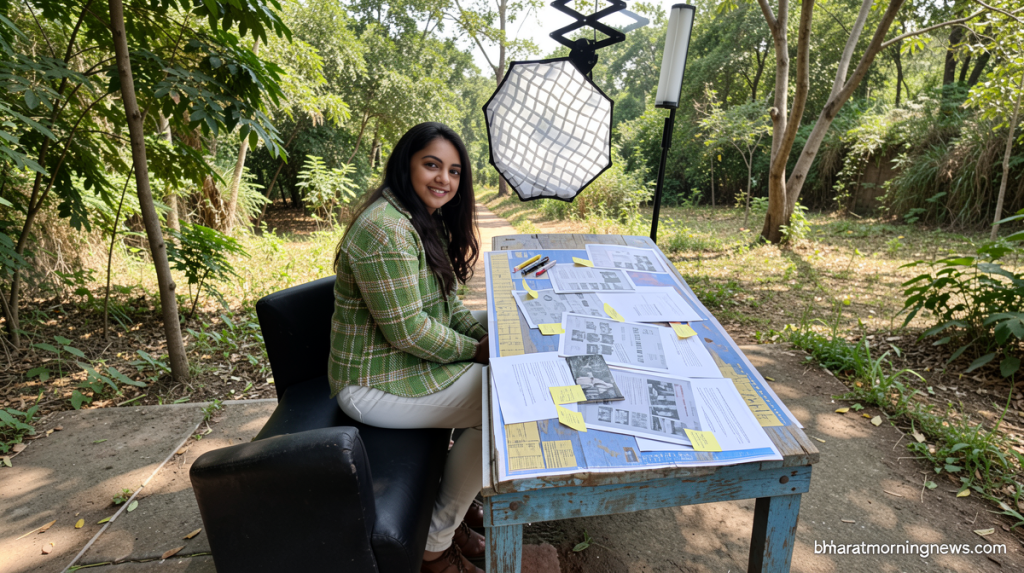
₹1.5 Lakh for a Single 20-Minute Video: A Bengaluru Founder’s Gamble on Long-Form Finance Content
Bharatmorningnews.com – In an era where most creators launch with a smartphone, a ring light, and a prayer that the algorithm notices them, one Bengaluru-based entrepreneur chose a radically different entry point into YouTube. Chandralekha MR, a founder based in India’s tech capital, committed ₹1.5 lakh — roughly $18,000 — to producing her very first long-form video before she had ever uploaded a single frame to the platform. The result was not a quick talking-head clip but a fully researched, scripted, and edited 20-minute explainer examining why India’s currency continues to lose ground against the US dollar.
The decision, which she detailed in a LinkedIn post, was born out of what she described as an 18-month paralysis. For a year and a half, she had told herself she wanted to start a YouTube channel. The intention never materialised until she attached a concrete, expensive commitment to the calendar.
“I waited 18 months to start YouTube, then spent ₹1.5 lakh on video one. My first long-form video has taken one month and a team to produce. It is a 20-minute video on why India keeps losing to the dollar. Could we have opened a camera, spoken for 20 minutes, and uploaded it at a much lower cost? Obviously.”
Why a Finance Explainer Demands More Than a Reel
Chandralekha’s reasoning centred on the specific difficulty of translating financial concepts into video format. Unlike lifestyle or entertainment content, where a hook and a quick cut can carry a viewer through 30 seconds, a finance topic requires the audience to follow a chain of logic, absorb terminology, and remain engaged across an extended runtime. A shallow treatment risks losing the viewer within the first minute.
“But I didn’t want my first serious YouTube attempt to be a longer Instagram Reel. Finance becomes difficult on video because the viewer needs to understand the idea and want to continue watching it.”
That requirement, she explained, meant every production layer had to be engineered in concert rather than bolted on sequentially. Research had to inform the script; the script had to shape the examples; the examples had to drive the visual treatment; the edit had to preserve pace without sacrificing clarity. A single weak link in that chain could render an otherwise accurate video dull.
“That meant we had to work on the research, script, examples, visual treatment, edit, and overall pace together. A weak decision in one layer could make a technically correct video feel boring.”
The Cost Question: Sensible Template or One-Time Catalyst?
Chandralekha was candid that the expenditure was not a model she intended to replicate. Spending six figures on every subsequent upload would be financially untenable for any independent creator. What made the outlay justifiable, in her framing, was its function as a forcing mechanism. The money broke the inertia of 18 months of deferred intention and, simultaneously, forced her team to learn the full scope of long-form finance production in compressed time.
“Spending ₹1.5 lakh on the first video is probably not a sensible template for the next 20. I know that. For this one, the investment forced us to learn what long-form finance production demands. It also ended the one-and-a-half-year loop of saying, ‘I want to start YouTube.'”
For founders and professionals who oscillate between ambition and execution, the episode touches a well-documented behavioural pattern: the tendency to wait for a guarantee of success before taking a visible risk. Chandralekha acknowledged she had no such guarantee when she greenlit the project.
“Founders often wait for certainty before entering a new format. I had no certainty that YouTube would work for me. I had a topic I cared about, a team willing to make it, and a very expensive commitment sitting on the calendar.”
What Happens After Upload
With the video now live on YouTube, Chandralekha framed the next phase in pragmatic terms. Audience metrics — watch time, retention curves, comment sentiment — would serve as the diagnostic tool for future iterations. The month of production, she noted, had already taught her team where the labour-intensive work concentrates, giving them a realistic cost model for subsequent episodes.
“The video now exists. Its performance will tell us what to improve, and the month of production has taught us where the work lives.”
Community Reaction and the Organic-Reach Debate
The LinkedIn post drew immediate responses from peers in the startup and finance-communication space. One commenter praised the strategy of attaching real stakes to kill procrastination, calling the decision “the smartest way to kill the 18-month hesitation” and arguing that “setting the bar high on day one beats 20 low-effort clips every time.” Others offered lighter notes, with one jokingly requesting a backend-research role on future episodes.
A more pointed question came from a fourth commenter: why not allocate the same ₹1.5 lakh to YouTube advertising instead? Chandralekha’s reply drew a clear line between paid distribution and earned credibility.
“Because Ads put content in front of people; organic depth earns their trust. My goal was to invest in content quality and production muscle, not buy short-term reach.”
That distinction matters in a creator economy where paid promotion can inflate view counts without building a durable audience. For a finance explainer channel, trust is the primary currency; a viewer who arrives through an ad but finds the content shallow will not return. A viewer who discovers the video through search or recommendation and finds genuine analytical depth is far more likely to subscribe, share, and treat the channel as a reference point.
Broader Context: The Hesitation Problem in Indian Founding Culture
Chandralekha’s account resonates with a pattern observed across Indian startup and professional circles: the gap between stated intention and executed action, often bridged only by an external constraint — a deadline, a co-founder’s departure, or, in her case, a six-figure invoice. The creator-economy literature frequently notes that the first piece of content carries disproportionate psychological weight compared with subsequent outputs. By front-loading the hardest production challenge into episode one, she converted an abstract fear of “starting YouTube” into a concrete project with a budget, a timeline, and a deliverable.
Whether the 20-minute dollar-explainer format scales into a repeatable series remains to be seen. What is already established is that the hesitation is over, the production pipeline is mapped, and the audience’s verdict — measured in watch time and engagement rather than ad spend — will shape the next chapter.
Related Reading
Frequently Asked Questions
What is Bengaluru founder shares why she spent 1?
Bengaluru founder shares why she spent 1 is the main topic of this guide. The article explains the context, practical details, and next steps readers should understand.
Why does Bengaluru founder shares why she spent 1 matter?
Bengaluru founder shares why she spent 1 matters because readers are looking for a useful answer, not just a short summary. Good content should match search intent and help them decide what to do next.