
Gendering India’s energy transition
Who Controls the Sun? Women, Solar Irrigation, and the Uneven Green Shift in Indian Agriculture
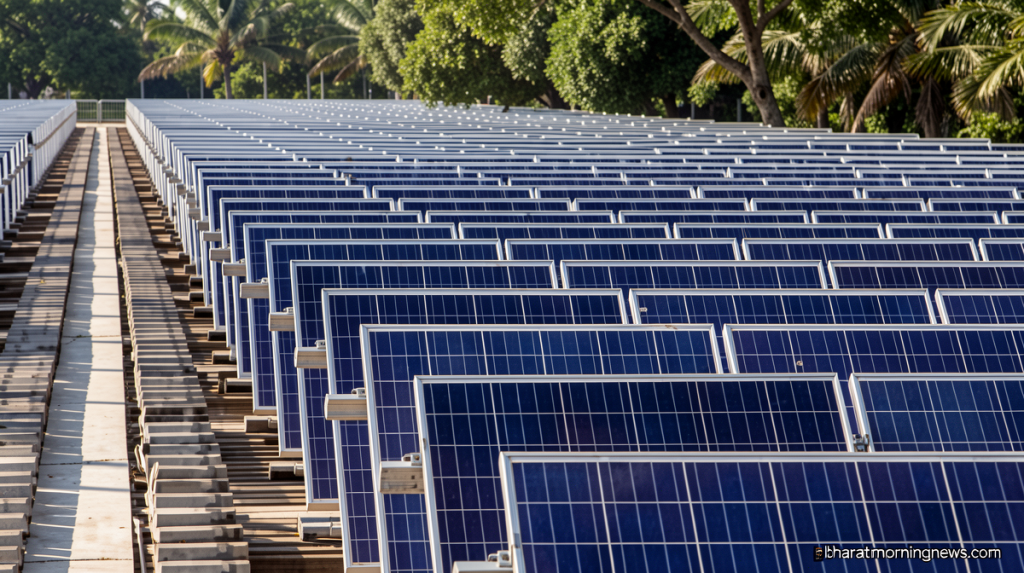
Bharatmorningnews.com – Across India’s vast farming belt, diesel engines are giving way to photovoltaic panels bolted above borewells and canal intakes. The central government’s PM-KUSUM scheme channels subsidies toward off-grid standalone solar pumps, grid-tied solar pumps, and solar-powered agriculture feeders, with state governments required to co-fund the programme. On paper, the architecture looks like a clean break from erratic grid supply and volatile fuel prices. In practice, however, the question that matters most is not whether the technology arrives, but who gets to operate it, own it, and profit from it. For the tens of millions of women who form the labour backbone of Indian agriculture, the answer has so far been discouraging.
The Scale of Women’s Agricultural Labour
The numbers tell a story of massive contribution paired with near-total invisibility in formal economic accounting. The Periodic Labour Force Survey for 2023–24 places women at roughly 64.4% of India’s agricultural workforce. Broader estimates suggest that between 76% and 80% of rural women are engaged in some form of farm activity. Within the production cycle itself, women shoulder close to 75% of crop cultivation tasks, approximately 79% of horticultural work, and as much as 95% of livestock-related duties. Yet this enormous input of labour translates into remarkably little economic recognition. National accounts and household surveys routinely undercount or entirely omit unpaid family work, rendering women’s contributions statistically ghostly.
The Land Ownership Chokepoint
At the root of the exclusion sits a single, stubborn variable: land title. Only between 8% and 14% of Indian women hold registered ownership of agricultural plots. That narrow band of ownership functions as a gatekeeper. Without a title deed, a woman cannot walk into a bank and draw institutional credit, cannot claim crop insurance, and cannot register for most subsidy-driven schemes. The consequence is a cascade: limited bargaining power at the local level, persistent wage discrimination, and systematic shut-out from market channels and policy benefits. Recent labour-force data show a sharp decade-long rise in unpaid female agricultural workers, confirming that women are being pushed further into informal, unremunerated roles even as the sector modernises.
The macroeconomic cost of this arrangement is not trivial. Research consistently indicates that granting women equal access to productive resources—land, credit, inputs, extension advice—could lift farm yields by 20% to 30%. In other words, the gendered constraint is not merely a justice issue; it is a productivity tax levied on the entire agrarian economy.
Agri-Tech and the Quiet Exclusion
Service platforms built around digital advisory, input supply, and insurance are marketed as gender-neutral. Field-level analysis, however, tells a different story. One examination of usage data from the agri-tech startup DeHaat found that fewer than 20% of women farmers actually availed themselves of the advisory and insurance products the platform offered, even though the services were technically available to both male and female growers. The gap is not one of access in the narrow sense; it is one of design, outreach, language, timing, and the assumption that a male household head will be the point of contact. Technology experts have flagged this pattern as a form of systemised exclusion embedded in the agri-tech revolution.
Solar Irrigation: Where the Gender Gap Becomes Tangible
No sector of the green transition makes the disparity more visible than irrigation. Solar-powered pumps are reshaping how rural households access water and electricity, replacing the diesel-and-grid model that left farmers at the mercy of fuel prices and load-shedding. Women participate heavily in the surrounding labour—water management, crop scheduling, post-harvest handling—yet their voice in decisions about pump installation, scheduling, and maintenance remains marginal. Institutional barriers, most notably the absence of land title, keep women outside the subsidy pipeline that funds these installations. Without a title, there is no subsidy claim; without a subsidy claim, there is no training enrolment; without training, there is no operational control. The cycle closes on itself.
The PM-KUSUM framework, for all its ambition, has not yet been redesigned to interrupt this loop. Extension services that accompany the programme tend to target the registered landholder, who is overwhelmingly male. Skill-development modules assume a male operator. Insurance and after-sales support follow the title deed. The result is a green economy in which women remain passive beneficiaries at best and absent altogether at worst, while men occupy the technical, managerial, and revenue-capturing roles.
What Would Have to Change
Breaking the cycle requires interventions at multiple points simultaneously. Land-tenure reforms that recognise joint or women-held titles would unlock the subsidy and credit channels that currently remain closed. Extension and training programmes must be restructured so that women are enrolled as operators and decision-makers, not as auxiliary labourers attached to a male household head. Agri-tech platforms need deliberate design choices—female field agents, vernacular interfaces, flexible scheduling around domestic workloads—that convert nominal access into actual uptake. Finally, national accounting and labour surveys must stop rendering women’s farm work invisible, because a contribution that is not counted cannot be protected, compensated, or planned for.
India’s solarisation of irrigation is proceeding at a pace that will reshape rural energy within a decade. Whether that reshaping widens or narrows the gender gap will depend less on the wattage of the panels than on the architecture of the institutions that distribute them. The technology is ready. The question is whether the policy scaffolding will be rebuilt before the transition locks in a new form of exclusion under the banner of green modernity.
Related Reading
Frequently Asked Questions
What is Gendering India s energy transition?
Gendering India s energy transition is the main topic of this guide. The article explains the context, practical details, and next steps readers should understand.
Why does Gendering India s energy transition matter?
Gendering India s energy transition matters because readers are looking for a useful answer, not just a short summary. Good content should match search intent and help them decide what to do next.