
Centre calls Ladakh leaders for talks on Sept 9 ahead of Kargil-Leh march
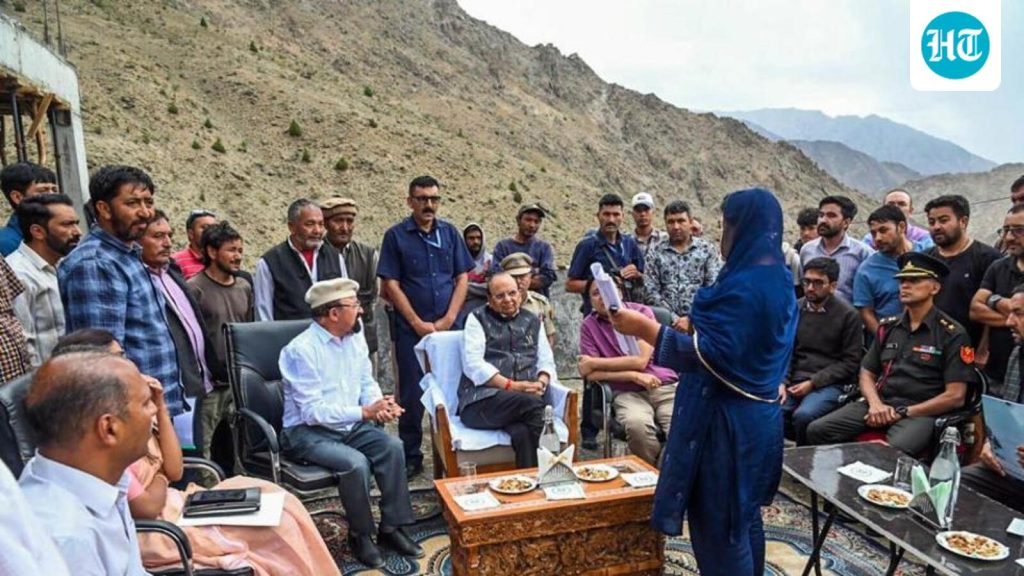
New Delhi Talks and a Foot March: Ladakh’s Statehood Push Enters a Critical Phase
Bharatmorningnews.com – The political landscape in Ladakh is tightening as two parallel tracks of engagement converge within a single week. The Union government has scheduled an official sub-committee meeting in New Delhi on September 9, while the Kargil Democratic Alliance has locked in a foot march stretching from Kargil to Leh between September 10 and 24. Together, these developments mark the most intensive period of dialogue and public mobilisation since the region’s status was restructured in 2019.
The Delhi Meeting: A Fourth Round of Dialogue
Chief Secretary Ashish Kundra confirmed on X on Thursday that the Ministry of Home Affairs has fixed the date for what will be the fourth sitting of the sub-committee. In his post, Kundra framed the gathering as part of “the ongoing dialogue for deepening democratic processes in Ladakh,” underscoring that the Centre views the talks as a continuing institutional exercise rather than a one-off negotiation.
The invitation follows a sequence of events in mid-August that accelerated the pace of engagement. On August 19, regional leaders travelled to Leh to meet Union home ministry officials and formally tabled a list of what they described as “non-negotiable” demands. The following day, the Ladakh administration withdrew pending cases against 25 individuals who had been registered in connection with the clashes of September 24, 2025. Kundra indicated that the demand list had been forwarded to the MHA, signalling that a further meeting would follow in early September.
Three rounds of talks have already taken place between the Ladakh leadership and the home ministry. The core agenda remains unchanged: full statehood for the Union Territory, inclusion under the Sixth Schedule of the Constitution to protect tribal and local rights, and a suite of additional constitutional and administrative safeguards.
The Kargil-to-Leh Padyatra
Running alongside the diplomatic track, the Kargil Democratic Alliance has announced full organisational support for a foot march spanning roughly 250 kilometres of high-altitude terrain. The padyatra, scheduled from September 10 through 24, will be led by social activist Sandeep Pandey and KDA leader Sajjad Kargili. The route and logistics were finalised during a meeting in Kargil attended by co-chairman Asgar Ali Karbalai and other stakeholders from the region’s civil society and political landscape.
The march is designed to keep public pressure on the statehood question visible during the very week the sub-committee convenes in Delhi. Organisers see the two-track approach—formal negotiation in the capital combined with grassroots mobilisation on the ground—as mutually reinforcing rather than contradictory.
Why the Question Has Not Gone Away
Ladakh was carved out as a Union Territory without a legislative assembly on August 5, 2019, in the same legislative package that abrogated Article 370 and bifurcated the former state of Jammu and Kashmir into two separate Union Territories. Since that date, political leaders, civil-society groups, and ordinary residents have pressed for restoration of full statehood, arguing that a UT without its own elected legislature leaves the region without adequate democratic representation or constitutional protection for its distinct cultural and linguistic identity.
In response to sustained agitation, the MHA constituted a high-powered committee in 2023 under then Minister of State for Home Affairs Nityanand Rai. Its mandate was to examine measures for protecting the region’s culture, language, and strategic interests, and its recommendations have fed into the ongoing sub-committee process now reaching its fourth round.
Local Governance Expansion: LAHDCs Across All Seven Districts
In a separate but related administrative development, Lieutenant Governor VK Saxena approved a notification issued by the UT revenue department that creates Ladakh Autonomous Hill Development Councils in all seven districts of the territory. Until now, elected local self-governance under the LAHDC framework had been confined to the two original districts of Leh and Kargil. The new notification extends that mechanism to five districts created more recently: Sham, Nubra, Changthang, Zanskar, and Drass.
The move operationalises the Centre’s July 13 announcement establishing the additional councils. Saxena publicly thanked Prime Minister Narendra Modi and Union Home Minister Amit Shah, describing the step as one that will “decentralise governance and allow local priorities to shape district planning.”
“The creation of Autonomous Hill Development Councils in all seven districts is a milestone in strengthening grassroots governance in Ladakh,” Saxena said.
Elections for the newly constituted councils are to be notified under Section 8 of the LAHDC Act, 1997, following formal publication in the official gazette. Once elected, these bodies will assume devolved functions in local infrastructure, agriculture, and social welfare, giving residents of the five newer districts a direct electoral voice for the first time.
What Comes Next
The convergence of a fourth round of high-level talks, a high-visibility foot march, and the imminent operationalisation of expanded local councils places Ladakh at an inflection point. Whether the September 9 sub-committee session yields concrete constitutional commitments—or merely another round of procedural dialogue—will shape the trajectory of the statehood movement for months to come. For now, the region’s political actors have chosen to press both the institutional and the public channels simultaneously, betting that sustained, multi-front engagement is the most effective lever available to them.
Related Reading
Frequently Asked Questions
What is Centre calls Ladakh leaders for talks?
Centre calls Ladakh leaders for talks is the main topic of this guide. The article explains the context, practical details, and next steps readers should understand.
Why does Centre calls Ladakh leaders for talks matter?
Centre calls Ladakh leaders for talks matters because readers are looking for a useful answer, not just a short summary. Good content should match search intent and help them decide what to do next.