
The Highs and Lows of My $2,500 Flight in Alaska’s New Long-Haul Business Class
A $2,500 Business-Class Gamble on Alaska’s Newest Trans-Atlantic Route
Bharatmorningnews.com – Somewhere above Leeds, England, a flight attendant rolled an ice-cream-sundae cart down the aisle while my suite screen played a scene of Anthony Bourdain devouring a cobra heart. It was the fourth course of a four-course dinner, and we had barely crossed two hours of a ten-hour Alaska Airlines flight from Rome to Seattle.
The Competitive Stakes
Alaska Airlines, headquartered in Seattle, entered the trans-Atlantic long-haul arena earlier this year with nonstop services to Rome and London. The aircraft are Boeing 787 Dreamliners, acquired through the airline’s 2024 merger with Hawaiian Airlines, and they carry business-class suites designed to attract high-spending corporate and leisure travelers.
The move was a direct challenge to Delta Air Lines, which had spent years cultivating its own international foothold out of Seattle. Delta responded swiftly, adding a Seattle-to-Rome route of its own once Alaska’s plans became public.
Why I Booked It
As a back-of-the-plane chronicler of premium cabins, I had already logged American Airlines a year prior, followed by La Compagnie’s all-business configuration and United’s Polaris product earlier this year. Alaska represented the fourth chapter. At roughly $2,500 one way—booked about ten days before departure—it was the least expensive splurge of the group, excluding a $939 last-minute Polaris upgrade from London to San Francisco. A standard economy fare on the same day sat at $1,700, while business-class fares on adjacent dates exceeded $5,000 one way.
Arrival and Lounge at Fiumicino
Check-in at Rome’s Fiumicino airport felt underwhelming, though the ticket did include a security fast pass and lounge access. The Alaska agent pointed me toward a lounge nearer my gate. Having ample time before boarding, I instead drifted into the British Airways lounge, which reviews suggested was less congested. There was no queue, and the space proved perfectly adequate despite lacking internal restrooms. The alternative, Prima Vista, had a long line when I passed by.
The gate area itself was cramped and chaotic, partly because the previous day’s Seattle-bound flight had been canceled. Suite passengers board first, but random security screening pushed me far down the sequence.
Suite 3J: Layout and Amenities
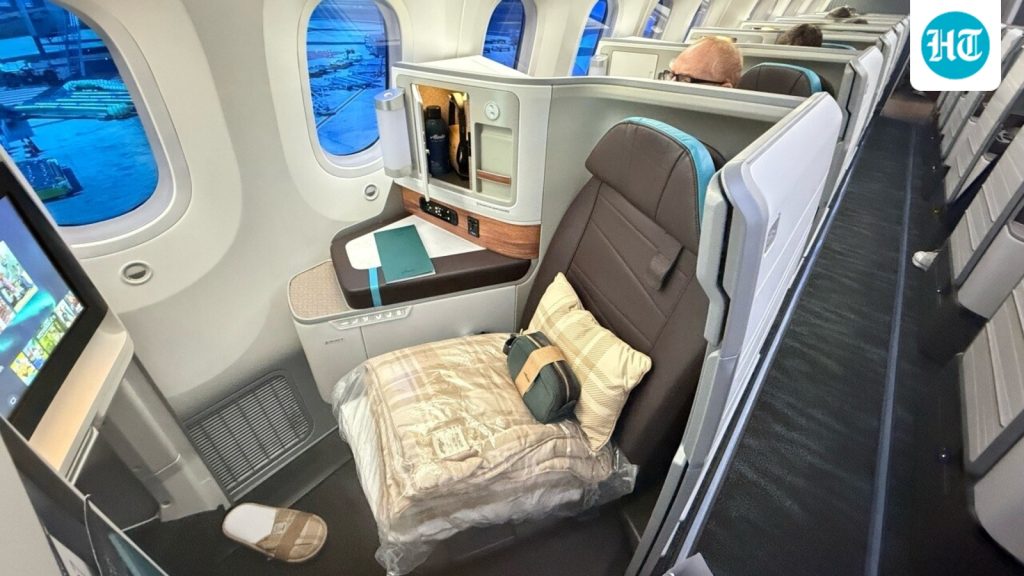
Alaska’s cabin features 34 suites arranged in a 1-2-1 configuration, each with a privacy door and direct aisle access. My assignment, 3J, angled toward the window. That orientation delivered excellent privacy but created a tight, awkward squeeze whenever I needed to rise and navigate to the lavatory.
Following the lead of seasoned business-class travelers across the aisle, I laid a mattress pad over the seat before settling in—they warned the surface turns sticky without one. The suite stocked the expected premium amenities: a larger screen with remote, bedding, skin-care lotion, socks, an eye mask, a reusable water bottle, ear plugs, and noise-canceling headphones. A wireless phone charger sat in the tray area but felt unreliable; a USB-C outlet would have been far more practical. The tray table itself was notably oversized.
Service and Dining
The cabin crew are Hawaiian Airlines flight attendants, and the service distinguished itself from the moment I boarded. As I was finding my bearings in the suite, an attendant appeared with a beverage tray that included sparkling wine. He confirmed my dinner selection and, when I hesitated between two white wines, offered:
“If you ever want to switch it up with a white wine tasting, you can do that as well.”
The four-course dinner opened with Alaska’s signature charcuterie plate and closed with the sundae cart. I enjoyed nearly everything except the main course. Tempted by social-media buzz around Delta’s Shake Shack first-class collaboration, I had ordered the burger. It arrived overcooked and flavorless—my notes record that I have eaten better from a concession stand. Neighboring passengers, by contrast, raved about the Veal Osso Buco.
The food program continued well past dinner. A smoked provolone pizza arrived midway through the flight, followed by a sandwich or salad option and tiramisu roughly ninety minutes before touchdown. Snack baskets were stationed throughout the cabin for grab-and-go access.
Connectivity and the Road Ahead
There was no inoperable Wi-Fi to endure, as I had experienced on a recent United flight—there was simply no connectivity option at all. At least the airline warned passengers in advance. Alaska has stated that Starlink will arrive on its wide-body fleet later this year, a refrain frequent flyers hear with growing fatigue from airline executives.
For all its rough edges—the cramped gate area, the absent Wi-Fi, the underwhelming check-in—Alaska’s new long-haul product delivered the core promise: a lie-flat suite, attentive service, and a dining program that, with one notable exception, held up against the best in the trans-Atlantic business-class conversation.
Related Reading
Frequently Asked Questions
What is The Highs and Lows of My 2?
The Highs and Lows of My 2 is the main topic of this guide. The article explains the context, practical details, and next steps readers should understand.
Why does The Highs and Lows of My 2 matter?
The Highs and Lows of My 2 matters because readers are looking for a useful answer, not just a short summary. Good content should match search intent and help them decide what to do next.