
How a Marathi play was built from unrecorded grindmill songs of women
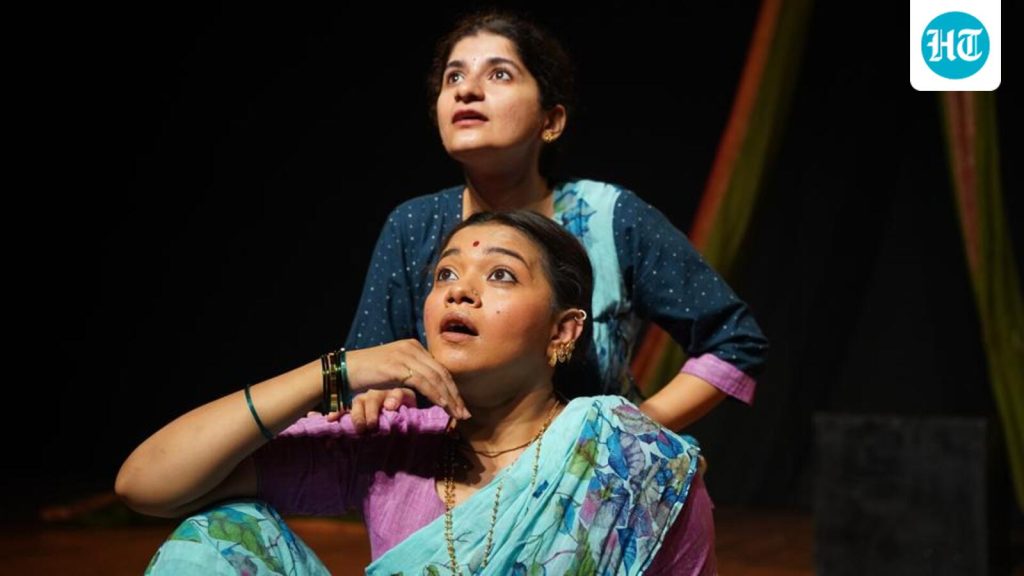
From Unwritten Songs to Stage: The Making of ‘Bhirrr…’
Bharatmorningnews.com – Two saris hang suspended above the performers, catching the light as it dims. This striking visual moment anchors the entire production of ‘Bhirrr…’, a play recently presented at The Tamaasha Studio. Mayuri Ravindra, who conceived and performs in the work, first imagined those floating garments long before any script existed. “I kept seeing two saris suspended in space,” she remembers. “I knew they belonged to this world.”
Theater creators often begin with images rather than concepts, and this approach birthed ‘Bhirrr…’. The story traces back to Abdullat, a village nestled within Kolhapur district, where women have sung for countless generations without ever committing their verses to paper.
The Living Archives of Women
These ovis—brief, unrhymed compositions created and performed by women during their daily labor—capture moments of grinding grain at the jate, journeys to agricultural fields, and lullabies sung to sleeping infants. According to Mayuri, these songs represent “archives of women’s memories, struggles, resilience, wit, humour, and ways of looking at the world”. Yet they remained unfiled, existing within memory, transmitted from voice to voice, disappearing whenever a generation ceased singing. ‘Bhirrr…’ seeks to preserve these voices before they vanish permanently.
Mayuri’s engagement with this material emerged organically rather than through formal study, though her investigation grew remarkably thorough. Everything commenced with one volume, ‘Bahinachi gani’ (The songs of Bahinabai), discovered unexpectedly during a film production near Nandurbar—close to where poet Bahinabai Chaudhari was born. “I wasn’t reading her because she was part of the syllabus,” Ravindra explains regarding her adult rediscovery of Bahinabai, whose poetry she had absorbed unconsciously from her grandmother’s conversations during childhood. “I was reading her because I wanted to understand how someone with no formal education could look at the world with such astonishing clarity, simplicity and imagination.”
Expanding the Research
Her investigation subsequently broadened considerably. The People’s Archive of Rural India’s Grindmill Songs Project documented over 110,000 ovis from villages throughout Maharashtra. Writer-researcher Dr. Tara Bhavalkar contributed scholarship examining the politics surrounding who preserves folk knowledge. Dr. Snehal Warekar operates an Instagram account named Roots and Rhymes, and her grandmother emerged as both source material and subject. Additionally, Radheshyam Jadhav’s ‘Harvesting Hope in the Suicide Zone’ explored women farmers reconstructing their existence following profound tragedy. These resources provided Mayuri “a contemporary lens” for the endurance she continually encountered within historical songs.
However, Mayuri emphasizes that her most significant research occurred within her own household. She repeatedly visited Abdullat to converse with her mother, aunt, and grandmother; subsequently, through an uncle who directs a small bhajani mandal—a gathering of Dhangar community women who continue composing and performing ovis.
A Quiet Correction
During one visit, Malu aaji, an elderly singer possessing complete confidence in her performances, remained with Mayuri. When Mayuri inquired whether the verses belonged to Malu’s own creation, the men in the room immediately responded: no, she had merely absorbed them from bhajans and kirtans. Yet when the women expressed their own perspectives, Mayuri recalls that nearly all declared, “No… these are mine.” This subtle correction evolved into the play’s central argument. “That is patriarchy,” Mayuri Ravindra observes. “Not only denying women authorship, but making them doubt it themselves.”
Supporting the Vision
The Niloufer Sagar Alumni Production Grant enabled ‘Bhirrr…’ to reach the stage. This initiative, established by the Drama School Foundation Mumbai in honor of producer and arts manager Niloufer Sagar—who championed allowing artists space to fail before achieving success—selected Mayuri Ravindra, a 2022 Drama School Mumbai graduate, through an open application process involving feedback sessions, resubmissions, and jury evaluation. ‘Bhirrr…’ emerged as one of five chosen projects. Months of mentorship followed, provided by Anupam Barve, Chanakya Vyas, and Sanjukta Wagh, alongside budgeting assistance and regular check-ins that allowed her “to take creative risks while being held by a rigorous support system”.
This form of assistance proves unglamorous yet essential—more accountant than muse—and represents precisely the infrastructure that emerging work seldom receives. “The grant gave me the time to research, travel, fail, rewrite, question,” she explains, “and keep returning to the work until we found the play we truly wanted to make.”
This transformative journey nearly derailed the production before achieving its final form. A month an
Related Reading
Frequently Asked Questions
What is How a Marathi play was built?
How a Marathi play was built is the main topic of this guide. The article explains the context, practical details, and next steps readers should understand.
Why does How a Marathi play was built matter?
How a Marathi play was built matters because readers are looking for a useful answer, not just a short summary. Good content should match search intent and help them decide what to do next.