
The Cauvery isn’t just a water dispute — it’s a river that runs through history, culture and livelihoods
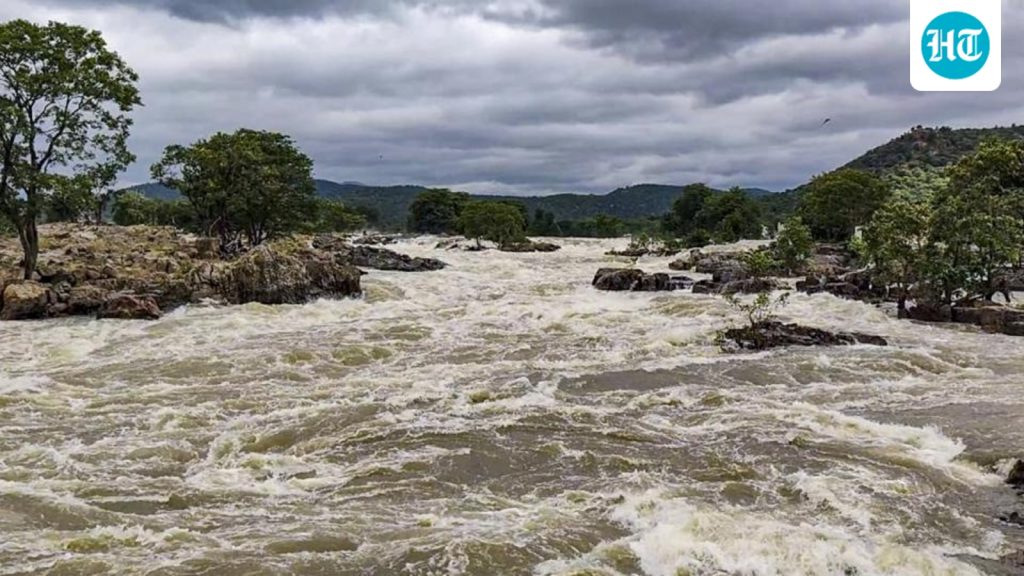
A River Beyond Water: How the Cauvery Weaves Through Centuries of History and Livelihood
Bharatmorningnews.com – When Karnataka and Tamil Nadu clash over water allocations, they are engaging in a conflict that transcends mere irrigation calendars. For more than a millennium, the Cauvery has influenced civilizations, agricultural cycles, and cultural identities—making contemporary disagreements particularly volatile.
Sacred Origins and Religious Significance
Religious literature frequently references this waterway. According to the Puranas, a creation narrative describes Lord Shiva filling sage Agastya’s vessel with water drawn from the Kaveri. Ganesha, appearing as a crow, then overturned the container, distributing water across parched territories. The location associated with this event, Talakaveri within Karnataka’s Kodagu region, derives its name from this legend—meaning “source of Kaveri.” Devotees consider the river among India’s seven sacred waterways, envision it as Goddess Kaveri, and refer to it in ancient texts as “Ponni,” signifying “the golden one.”
At Srirangapatna, the waterway passes memorial sites belonging to Hyder Ali, an eighteenth-century Mysore sovereign, alongside his son and heir Tipu Sultan. The river also flows near Adi Ranga, the inaugural of three island sanctuaries honoring Ranganatha, a manifestation of Vishnu, stretching throughout its course.
Historical Landmarks and Spiritual Centers
Sivasamudram marks where the river descends 98 meters through a cascade. In 1902, this location hosted Asia’s inaugural hydroelectric facility, situated adjacent to a Someshwara temple connected to Adi Shankara, who established the Advaita Vedanta philosophical tradition during the eighth century. Downstream, the waterway enters the historic Chola territory and surrounds Srirangam, an essential destination for Srivaishnavites practicing Vishnu devotion through Sri Vaishnavism.
Devotional composers integrated the river into sacred literature as well. The Azhwar saints—Tamil poet-saints who created hymns praising Vishnu between the sixth and ninth centuries—declared in the Naalayira Divya Prabandham that the Kaveri surpasses even the Ganga in holiness. Additionally, Krishnadeva Raya incorporated references to the river within his Telugu literary masterpiece, Amukta Malyada.
Agricultural Dependence and Economic Impact
Against this historical backdrop stands a waterway essential for survival. Approximately three crore agricultural workers across Karnataka and Tamil Nadu rely on the Cauvery, cultivating at least 40 lakh acres between both regions, as documented by Deccan Herald. The complete basin encompasses over 14,000 villages, comprising roughly 9,000 in Karnataka and 5,000 in Tamil Nadu, according to the Cauvery River Basin Atlas.
A 2016 research paper delivered at the Madras School of Economics, examining “Game Theoretical Approach to Regulate the Public-Owned River Water Utilities: A case study of Cauvery River,” indicated that 90–95% of total river flow supports irrigation across one million hectares, while remaining water supplies hydropower generation.
Significant portions of this water support crops offering limited returns relative to consumption. Rice, India’s foremost irrigation water consumer nationally, produces merely 3.7 kg per hectare for each millimeter of water utilized—substantially lower than sorghum at 9 kg/ha, maize at 8 kg/ha, and wheat at 12.5 kg/ha.
Tamil Nadu’s rice-dominant agricultural model intensifies this inefficiency. State irrigation channels deliver water continuously across seasons instead of employing rotational distribution, a method the dispute tribunal has suggested could improve by minimum 5% through enhanced administration, per the research findings.
Karnataka demonstrates contrasting agricultural practices—cultivating ragi, jowar, and pulses primarily under rain-fed or minimal irrigation scenarios, while restricting rice and sugarcane to established irrigation systems. Tribunal regulations limit sugarcane cultivation to 40,000 hectares.
Consequences of Water Scarcity
Dr. Manu CN’s paper, “The Cauvery Water Dispute: Political and Social Ramifications in Karnataka,” outlines cascading effects during drought periods. Limited water releases trigger crop failures for farmers cultivating water-demanding plants, reducing agricultural productivity and gradually depleting rural economies, as documented in the 2018 International Journal For Innovative Engineering and Management Research publication.
Workers unable to secure agricultural employment relocate to urban areas, creating pressure on cities while simultaneously weakening the rural economic foundations they abandoned.
These economic challenges accompany social consequences. Dr. Manu CN’s investigations reveal that persistent legal interventions and water deficits intensify divisions between populations across both states, embedding the dispute deeper into regional identity and daily life.
Related Reading
Frequently Asked Questions
What is The Cauvery isn t just a water?
The Cauvery isn t just a water is the main topic of this guide. The article explains the context, practical details, and next steps readers should understand.
Why does The Cauvery isn t just a water matter?
The Cauvery isn t just a water matters because readers are looking for a useful answer, not just a short summary. Good content should match search intent and help them decide what to do next.