
Drawing Room: Vandana Kothari on K G Subramanyan’s striking murals
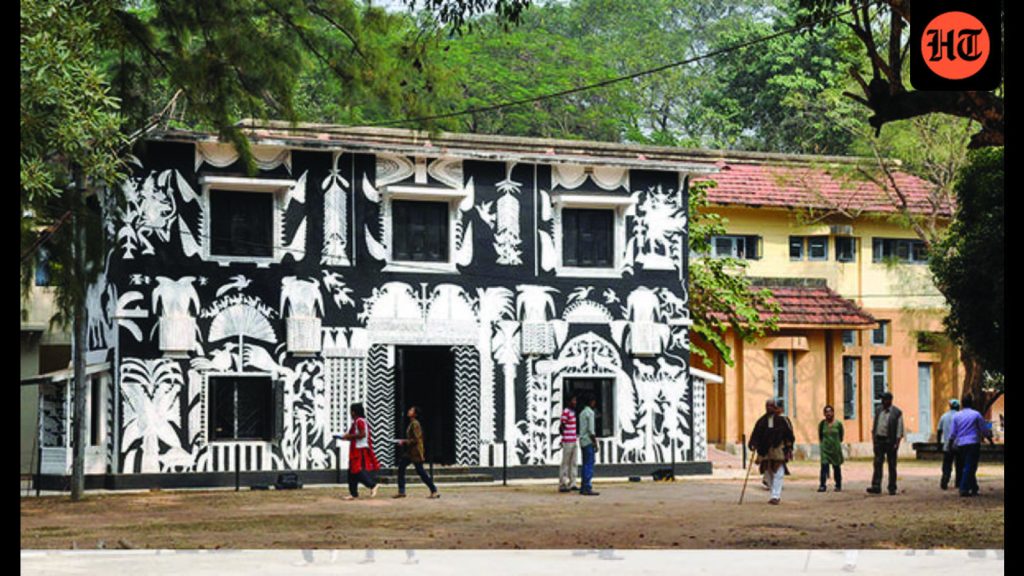
Living with Time: K G Subramanyan’s Enduring Mural at Santiniketan
A Canvas That Breathes
Bharatmorningnews.com – Step into the Design Department at Visva-Bharati University’s Kala Bhavana art school in Santiniketan, and you’ll encounter something extraordinary. A sweeping black-and-white mural stretches across the walls, its composition woven together without any clear starting point or conclusion. Within this visual tapestry, human silhouettes blend seamlessly with creatures and avian forms, while ornamental patterns shift into living entities. Voids within the artwork gain significance through their placement. Rather than guiding viewers along a fixed narrative or embedding hidden critiques, the piece invites free exploration. Each moment of observation reveals fresh relationships between elements.
What makes this work even more remarkable is its physical presence on the building itself. The mural transforms an entire structure into a universe where humans, animals, mythological beings, and natural forces coexist without hierarchy. A child extends a bloom toward a young woman; she regards it warily. Durga traverses atop her feline mount while, elsewhere, a reader—perhaps the artist himself—sits quietly beneath a floating female figure. Forest-dwelling elephants encounter aquatic reptiles. Winged creatures spiral from twisting vines. Multi-headed beasts wander without boundaries. The ordinary and the fantastical occupy equal ground.
The Artist’s Daily Ritual
I witnessed this masterpiece being renewed firsthand during my time residing on campus in 2010. By that point, K G Subramanyan—affectionately known as Mani Da to those around him—had surpassed his eightieth year. Each morning, he ascended bamboo scaffolding, secured a cloth across his brow to absorb perspiration, and methodically repainted sections of the mural he had originally conceived decades before. The two-storey edifice bore his work from foundation to roofline on every face. Observing such a distinguished creator engage in this physical devotion, driven by genuine pleasure, stands as one of my most treasured Santiniketan recollections.
When questioned about choosing a delicate combination of soot and adhesive over lasting industrial coatings, Subramanyan offered a simple response:
“Don’t worry, I’ll paint it again.”
For him, artistic creation transcended mere preservation. It represented an ongoing cycle of regeneration. The work’s worth emerged from the creator’s readiness to revisit it later with identical wonder, attention, and dedication. This mural was never designed to conquer time; rather, it was meant to coexist with it.
A Life of Art and Education
Subramanyan entered the world in 1924 within a Tamil Brahmin household in Kerala. During the 1940s, he actively participated in India’s independence struggle, enduring a half-year imprisonment for his involvement. Following this period, government establishments barred his entry. He found refuge at Kala Bhavana in 1944, where he cultivated a distinctive visual vocabulary balancing conventional and contemporary approaches.
His 1952 watercolour painting, Untitled (Girl with Sunflower), exemplifies this harmonious fusion. The subject’s almond-shaped eyes, customary hair arrangement, and traditional ornaments unmistakably root her in Indian heritage, while the soft colour scheme and botanical background reflect Western abstract traditions.
Beyond painting, sculpture, and murals, Subramanyan explored poetry and prose. Yet his most significant contribution came through teaching. Serving as principal at Maharaja Sayajirao University in Baroda, he guided a remarkable generation of creators whose collective output earned the designation ‘Baroda School’. I considered it one of life’s greatest honours to observe him seated beneath the Chhatimtala tree, encircled by learners, colleagues, and guests. His dialogues with others functioned as lessons in themselves—conversations moving naturally between clever observation, pointed feedback, and levity. He possessed remarkable sensitivity toward both individuals and existence itself.
Where Influences Converge
The Kala Bhavana mural crystallizes Subramanyan’s decades of artistic development, merging Indian folk traditions with European post-Cubist abstraction. Though rendered in monochrome, the composition pulses with animation. Lines carry musicality; figures radiate momentum. The mural and its architectural home appear to share a single breath. Closer examination uncovers additional layers: a boy offers a girl a flower; she eyes it with suspicion. Durga rides her tiger while, in another corner, a man — possibly Subramanyan himself — reads quietly as a woman flies above his head. Elephants march through forests to meet crocodiles. Birds emerge from curling creepers. Many-headed animals roam freely.
The mythical, the mundane and the surreal exist side by side, with no hierarchy between them. In this monumental, life-defining work, Subramanyan transforms an entire building into a world inhabited equally by humans, animals, myths and nature.
Vandana Kothari is a contemporary Indian artist and Professor of Art at the School of Planning and Architecture (SPA), New Delhi. Her practice explores urban life, memory, fragmentation, emotional experience and human interconnectedness.
Related Reading
Frequently Asked Questions
What is Drawing Room?
Drawing Room is the main topic of this guide. The article explains the context, practical details, and next steps readers should understand.
Why does Drawing Room matter?
Drawing Room matters because readers are looking for a useful answer, not just a short summary. Good content should match search intent and help them decide what to do next.